
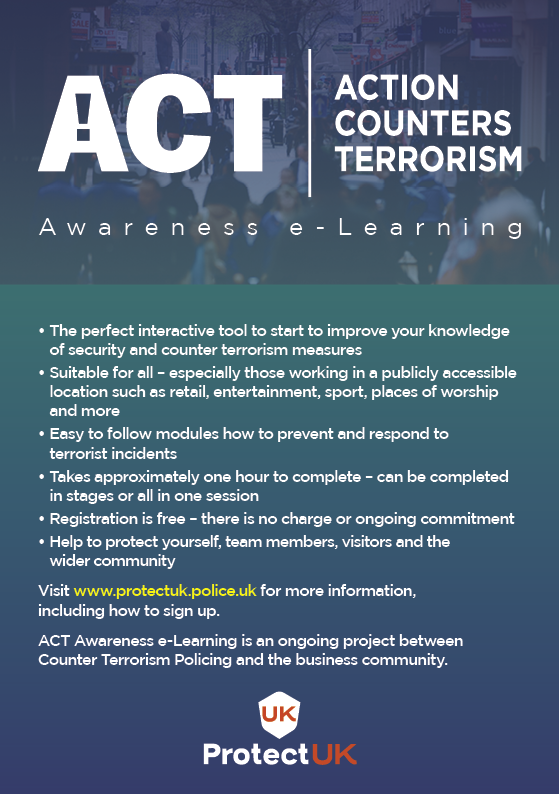
ACT Awareness e-Learning: a simple way to build counter-terrorism awareness at work
If you work anywhere the public can walk in, gather, queue, browse, or attend an event, you already know the truth: most days are normal… right up until the day they are not.
ACT Awareness e-Learning is designed for that reality. It gives you a clear, practical baseline in counter-terrorism awareness, without turning your day into a training marathon. It is built by the National Counter Terrorism Security Office (NaCTSO), delivered online via ProtectUK, and aimed at helping people spot concerns early and respond in a safer, more structured way.
What ACT Awareness e-Learning is
ACT stands for Action Counters Terrorism. The ACT programme includes online learning designed to improve “terror threat awareness” for people working in security and in public-facing organisations.
The ACT Awareness course is the starting point. ProtectUK describes it as a good place to begin your “security journey”, focused on good practice and security awareness.
It is also free online training for those in the private security industry, and it is widely promoted for organisations and individuals more broadly.
Who it’s for (and why it matters)
ProtectUK is explicit about the intended audience: the course is primarily targeted at staff working within venues and public spaces, and it is also relevant to critical national infrastructure (CNI) sites and members of the public.
So think beyond “security teams only”. ACT Awareness is relevant for:
-
Retail and shopping centres
-
Hospitality, leisure and visitor attractions
-
Places of worship and community spaces
-
Events and sport venues
-
Reception teams, supervisors, front-of-house, volunteers, duty managers
In plain terms: if your role puts you near people, entrances, queues, deliveries, or customer areas, this is built for you.
What you’ll cover (the module themes)
The course is split into short modules. The certificate template lists the full set, which gives a useful sense of scope.
You’ll see modules themed around:
-
Introduction to terrorism
-
Identifying security vulnerabilities
-
Recognising and responding to suspicious activity
-
Recognising and responding to a suspicious item
-
What to do in the event of a bomb threat
-
How to respond to a firearms or weapons attack
This is awareness training, not a “tactics course”. The value is in giving you a shared language and a calmer decision process, especially when something feels “off” but you cannot yet explain why.
How long it takes (and how to fit it into a shift)
ProtectUK lists the course length as 45 minutes.
Real life is messier than a stopwatch, though. The ProtectUK FAQ notes it can be completed in one sitting and suggests allowing around 60 to 90 minutes, depending on pace and whether you pause and resume.
A sensible approach is:
-
Schedule a 45-minute slot for most people
-
Allow up to 90 minutes the first time, especially for managers who want to take notes
-
Use the ability to pause and continue later if your day is shift-based
How to access it (and how teams can take it)
To take the training through ProtectUK, you create an account and subscribe to the course. ProtectUK notes that registration lets you save progress, access certificates, and continue where you left off.
Certificates (and why you should keep them)
Once you complete the modules, ProtectUK explains that your certificate appears in your user profile and can be downloaded as a PDF.
That certificate is not just a nice-to-have. Government guidance for the private security industry notes that ACT e-learning can count towards the counter-terrorism awareness section of SIA licence-linked qualifications, provided you save and show your certificates to the training provider.
Even outside the SIA context, keeping certificates helps with:
-
internal compliance records
-
tender requirements
-
venue assurance, audits, and staff onboarding evidence
After the course: turning awareness into a simple routine
Training is only useful if it changes what happens on an ordinary Tuesday.
A good “light touch” way to make ACT Awareness stick is to build one small habit after completion:
-
Add a 5-minute recap to a team huddle: “one thing you noticed, one thing you would do differently”
-
Make reporting routes obvious: who to tell, how to escalate, what “good information” looks like (without guesswork or drama)
-
Refresh periodically for new starters and seasonal staff
If your organisation needs tailored advice, policing guidance points to contacting a Counter Terrorism Security Adviser (CTSA) for specialist support.
And if you manage a venue or event space, it is also worth being aware that the UK now has the Terrorism (Protection of Premises) Act 2025 (Martyn’s Law), which introduces a tiered approach to preparedness requirements for certain premises and events. ProtectUK hosts guidance to help organisations understand scope and good practice.
You do not need to panic-read legislation, but you do want your baseline training culture in place, and ACT Awareness is a very sane first brick in that wall.
A clean next step
If you are starting from zero, start with the course itself on ProtectUK’s learning catalogue, and look for ACT Awareness e-Learning.
It is free, short, and built for the kinds of places most of us spend our time. The point is not to live in fear. The point is to be a little harder to surprise, and a little better prepared to keep people safe.