Is CCTV better than manned guarding for UK business security?
CCTV usually offers better long-term value when you need round-the-clock coverage and clear evidence. Guards are necessary for high-contact sites or where fast action matters. Many UK sites benefit from using both.
Quick 3-step test:
- Risk – Are you protecting people, property or both?
- Response – Do you need someone on the ground or just remote verification?
- Budget – Are you funding a one-off project or managing ongoing costs?
Use this guide: Sites with a lot of people generally need guards. Locations with perimeter risk are often better suited to CCTV. A mix works well when both apply.
What Do We Cover In This Article?
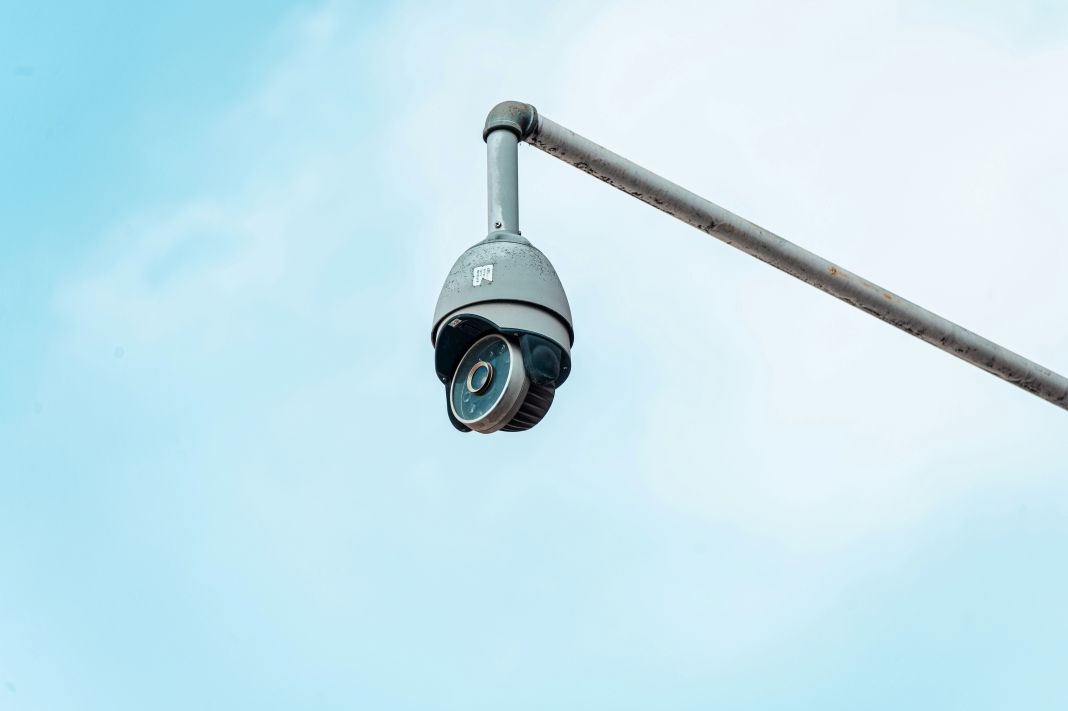
How do you compare the cost of CCTV vs guards?
Compare costs by looking at total cost of ownership (TCO) over 1, 3, and 5 years. CCTV requires upfront installation costs (CapEx), while guarding is mostly an ongoing operational cost (OpEx).
Remote monitoring cost can be a major component in CCTV-based security. It is important to factor in monthly ARC (alarm receiving centre) fees when building a full picture of affordability.
What CCTV delivers in terms of strengths, limits and real failure modes
CCTV strengths
- Continuous video coverage
- Footage for evidence
- Visible deterrent
- Alerts triggered by analytics
CCTV limitations and solutions
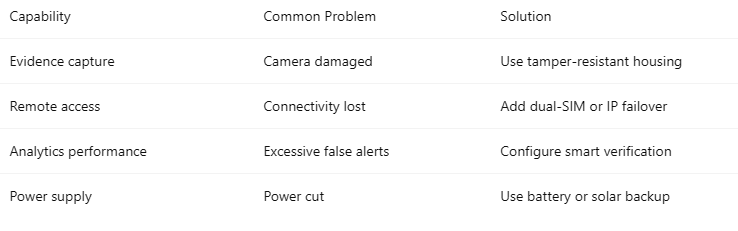
False alarms increase call-out costs and reduce monitoring efficiency. Poor setup also reduces accuracy. You can reduce false-alarm rates by applying a clear verification protocol through your ARC.
Compare Your Security Costs in 15 Minutes
Get a free breakdown of your site’s security cost over 1, 3, and 5 years.
What manned guards deliver in terms of strengths, limits and common operational problems
Guarding strengths
- Presence deters intruders
- On-the-spot decisions
- Physical incident handling
- Human reassurance
Guarding models
- Static guards
- Mobile patrols
- Alarm response and key-holding
Many alarm response providers offer mobile support, which can complement fixed CCTV systems.
Common operational issues
- Missed shifts or delays
- Missed or unlogged patrols
- Inconsistent incident reports
What to check before contracting
- SIA licence (mandatory)
- BS7858 vetting (identity, criminal record, employment history)
- Guarding KPIs in your contract
Basic supplier checklist
- Confirm active SIA licences.
- Request vetting evidence.
- Check training and induction records.
- Include KPIs: patrols, handovers, incident logs.
- Confirm supervisor-to-guard ratios.
Capability matrix: when cameras, guards or both make sense
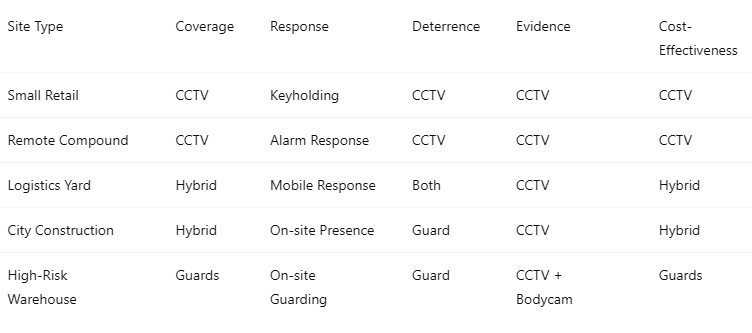
Use CCTV where budget and evidence are priorities. Choose guards where a fast physical response is essential. A hybrid approach suits most mixed-use sites.

Two worked site playbooks for retail and construction
Retail store setup (scenario figures only)
- Goal: Reduce theft and protect customers.
- Solution: Interior and exterior CCTV, monitoring outside opening hours, and key-holding support.
- Scenario:
- 300 sqm retail unit on high street.
- Busy during the day, break-in risk after hours.
- 3-year TCO:
- CCTV: £8,000 install.
- Monitoring: £200/month.
- Key-holding: £1,200/year.
- Total: ~£17,400.
Construction site setup (scenario figures only)
- Goal: Prevent plant theft and monitor access.
- Solution: Mobile CCTV tower linked to ARC, with alarm response backup.
- Scenario:
- 1-acre build site.
- Project duration: 12 months.
- 3-year TCO:
- CCTV tower: £1,200/month.
- Alarm response: £1,000/year.
- Total: ~£46,200.

Not Sure What Mix You Need?
Speak to a security procurement specialist about CCTV, guards or both.
Failure-mode quick fixes: what to include in your contract
Technical fixes
- Backup connectivity using dual-SIM or IP failover.
- Redundant power from battery or solar systems.
- Anti-vandal housings to protect exposed cameras.
- Live health monitoring alerts from your provider.
Human controls
- Patrol and report KPIs.
- Logged and random supervisor spot checks.
- Incentives that reward report accuracy.
Sample clauses
- “All guard shifts must include GPS-verified check-ins.”
- “Contract review triggered after three or more false alarms in one week.”
- “Monthly report must cover all KPIs and incident outcomes.”
Specify a false-alarm reduction target and verification protocol in your service contract. This keeps incident escalation manageable and improves ARC efficiency.

UK compliance essentials for CCTV and guarding
CCTV (ICO/UK GDPR)
- Display signage at all access points.
- Identify lawful basis, usually legitimate interest.
- Document a footage retention period, typically 30 to 90 days.
- Ensure a subject access request process is available.
When DPIAs are needed
- Wide-area coverage is planned.
- Facial recognition or vehicle tracking is used.
Guarding (SIA)
- Licences are legally required for all guards.
- Vetting must meet BS7858 standards.
System standards
- Use NSI or SSAIB certified security firms.
- Follow BS EN 62676 for CCTV design.
- Apply BS8418 for remote systems.
RFP questions and checklist
Ask suppliers:
- What are your 1, 3, and 5-year TCO figures?
- Describe ARC processes and responsibilities.
- Confirm SIA licensing and BS7858 vetting.
- List your standard KPIs.
- What is your incident response SLA?
- How do you manage power or signal failure?
- How do you reduce and verify false alarms?
- Can you provide case studies and references?
- How frequently do you report performance?
- Can I audit or test your service before sign-off?
FAQs buyers ask
Is CCTV cheaper than a guard? Yes. Over three or more years, CCTV usually costs significantly less.
Can CCTV replace guards? Only at certain sites. CCTV does not provide physical intervention.
How long can I keep footage? Thirty to ninety days is typical. You must justify your policy.
Do guards need SIA licences? Yes. It is a legal requirement in the UK.
Who pays for false alarms? The site operator typically pays. Some contracts include thresholds or caps.
Next steps: how Double Check Security Group can help
Need help choosing the right setup? Book a 15-minute cost review..