How does facilities management support business continuity planning?
Facilities management plays a decisive role in business continuity by ensuring that physical environments remain safe, operational and adaptable before, during and after disruption. It supports planning, readiness, important systems maintenance and recovery, making it a core function within overall continuity strategies.
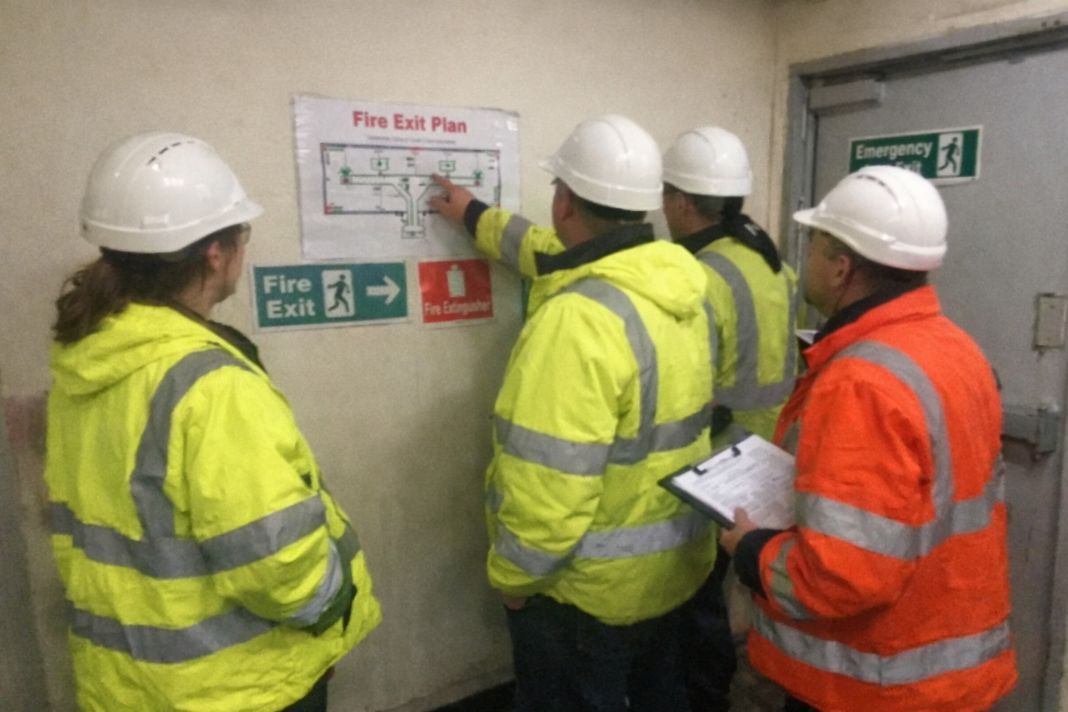
A representative image of a team in high-vis jackets conducting a site tour and reviewing fire exit routes
What Do We Cover In This Article?
Business Continuity Planning in Practice
Business continuity planning (BCP) often carries a reputation as a purely technical or IT-driven responsibility. In practice, the scope is much broader. Whether due to a flood that disables a ground-floor office or a capability failure that halts trading, continuity planning involves every part of an organisation that enables core functions to carry on, even in altered form.
BCP differs from purely emergency response plans. It includes preparation, mitigation, response and recovery, all with the objective of protecting people, safeguarding assets and minimising disruption to services.
Key components of effective BCP include:
- Risk assessment and scenario analysis: Identifying likely causes of disruption, both operational and environmental.
- Important operations mapping: Defining which processes are priority for restoration.
- Recovery time objectives (RTOs): Specifying how quickly each function must be restored.
- Continuity strategies: Developing practical plans that account for space, people, utilities and external dependencies.
- Testing and updates: Ensuring plans are adaptable and validated through drills or real-world feedback.
Physical infrastructure and building function are central to this process. Compliance frameworks such as ISO 22301 and best-practice models from the UK Government Resilience Framework reinforce that continuity depends as much on space and access as on systems and data.
Pro Tip: Bring facilities teams into cross-departmental continuity testing to uncover real-world gaps in readiness.
Integrate FM into Your Continuity Plan
Learn how to embed our facilities management services into your strategic continuity planning process.
Facilities Management: A Important Continuity Partner
Facilities management (FM) is sometimes associated only with repairs and cleaning. However, within the context of business continuity, its scope is far more strategic. When a disruption affects physical premises, FM is often the first and last line of defence, supporting both prevention and recovery.
A proactive FM team can:
- Maintain operational infrastructure to reduce the likelihood of failures.
- Execute site-specific protocols for access control and emergency procedures.
- Coordinate routine activities such as testing generators and maintaining back-up systems.
- Monitor the asset status and environmental conditions that inform risk-based decisions.
Owing to their physical presence and operational oversight, FM teams occupy a unique position. Their contribution after severe weather, technical failure or break-in can determine how quickly business operations can restart.
Despite this, FM functions are often excluded from continuity planning committees or strategy sessions. Reframing FM as a strategic contributor rather than a reactive service significantly improves preparedness and recovery outcomes.

A representative image of a daytime office building with blocked access due to heavy rain, with facilities staff placing warning signs
Recognising Risks and Preparing Sites
Facilities teams are often the first to recognise physical vulnerabilities, many of which can go unnoticed in traditional strategic planning. This on-the-ground insight makes FM an important source of risk data and preparedness intelligence.
Typical FM-led inputs to BCP include:
- Site risk assessments: From blocked fire exits to structural issues, FM teams observe what frontline staff often cannot.
- Inspection routines: Regular building audits reveal failing systems or poor maintenance before failure occurs.
- Environmental risk observation: FM teams track issues such as drainage hazards, heating failures or snow accumulation.
- Asset condition reporting: Equipment status is logged and escalated as part of longer-term resilience planning.
- Hazard mapping and seasonal planning: Adjusting for temperature extremes, flooding or icy access routes.
Frameworks such as ISO 31000 and the Fire Safety Order 2005 provide structured approaches to these responsibilities. Integrating FM insights into continuity planning ensures that risks linked to the built environment are addressed early.
Pro Tip: Use FM-collected asset data and building audits to inform and prioritise infrastructure investments.

A representative image of a facilities manager inspecting electrical control panels inside a service corridor
Important Infrastructure: Keeping Core Systems Alive
Continuity collapses when core systems do. Capability failures, water outages or uncontrolled temperatures can all halt operations, sometimes within minutes. Facilities management plays a important role in preventing this through structured maintenance and control.
For example:
- Electrical resilience: FM teams test generators, monitor circuit loads and ensure compliance with regulations such as BS 7671.
- Water services: Through routine checks aligned with WRAS guidance, FM ensures uninterrupted supply and safe water quality.
- HVAC: Heating and cooling systems are monitored for fault alerts, particularly in sensitive environments like data centres.
The difference between planned maintenance and emergency repair is often measured in cost, downtime and safety. Structured FM ensures readiness before failure occurs.
By keeping important infrastructure functional, FM creates a buffer that enables continuity strategies to deploy without avoidable disruption. This practical discipline often operates unseen, but when absent, the consequences become visible fast.
Assess Your Continuity Readiness
Identify gaps in your facilities management approach that could impact business continuity.
Incident Response: FM on the Front Line
When disruption breaks routine operations, facilities teams often form part of the immediate response. Their knowledge of the physical environment, access controls and containment procedures places them in a stabilising role during incidents.
Key FM responsibilities during acute events include:
- Coordinating site evacuations according to pre-approved plans
- Managing physical access for emergency services
- Activating back-up systems such as emergency lighting or fire suppression
- Communicating site conditions to internal and external stakeholders
- Logging actions and environmental changes for later review
In scenarios involving fire, flood or unauthorised access, FM teams help contain the incident while enabling safe passage and informed decision-making. Training, drills and defined protocols ensure these actions happen calmly, not reactively.
Partnerships with Local Resilience Forums and alignment with resources from the Emergency Planning College underpin this professionalism. Effective incident containment allows wider business continuity plans to activate in an organised, traceable manner.
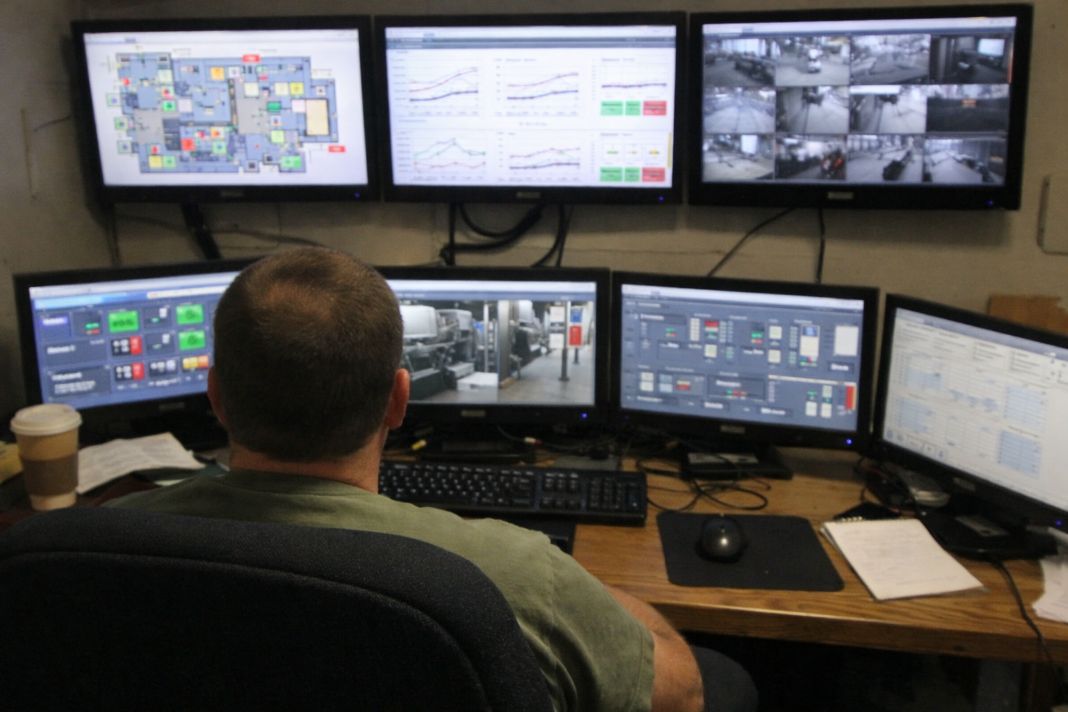
A representative image of a control room with multiple facility monitoring screens showing building stats
Supporting Recovery and Safe Reoccupation
After a disruption has been contained, focus shifts to recovery. Facilities management is responsible for restoring safe access, managing temporary requirements and ensuring compliance with reoccupation standards.
Typical recovery tasks include:
- Post-incident inspections: Assessing structural safety, equipment damage and system readiness.
- Environmental checks: Verifying air quality, ventilation and contamination levels in compliance with COSHH.
- Cleaning and hygiene: Implementing protocols from accredited bodies such as the British Institute of Cleaning Science to restore sanitary conditions.
- Staged access: Supporting phased re-entry to different building zones while ensuring control of movement.
- Temporary measures: Erecting safety barriers, organising mobile facilities or rerouting operations where infrastructure remains compromised.
All of these steps occur quietly but decisively behind the scenes. Without them, business leaders may face pressure to restart operations in unsafe or non-compliant environments. Facilities-led recovery enables confident resumption.
Integrating FM into Business Continuity Plans
To realise its full value, facilities management must be embedded into continuity planning, not consulted after plans are set. This requires both structural and procedural alignment between BCP and FM.
Practical steps include:
- Including FM in continuity committees or planning reviews
- Aligning FM protocols with documented BCP measures
- Participating in scenario-based testing with defined FM roles
- Clarifying escalation and communication pathways between FM teams and business leads
- Using integrated service providers who offer both strategic and operational insight
Standards such as ISO 22301 and guidance from organisations like IWFM support this integration. Planning continuity without FM input inevitably leaves operational gaps. Embedding it improves both preparedness and execution.
A Structured Model in Practice
Structured FM delivery models provide a practical example of how facilities teams contribute to long-term continuity outcomes. At operational firms such as Double Check Security Group, FM is treated not as an add-on but as a service line integrated through every stage of planning, monitoring and recovery.
Across sites, control centres operate 24/7, enabling real-time visibility and remote response. Scheduled audits, asset tracking and maintenance schedules feed into a live operational picture. These inputs support both day-to-day reliability and disruption readiness.
For example:
- Staff are inducted with site-specific safety and evacuation knowledge.
- Emergency protocols are reviewed frequently and tested quietly but consistently.
- System performance, from HVAC to alarms, is tracked centrally to ensure uptime.
Such consistency depends on structure, planning and oversight. Accreditation benchmarks such as ISO 9001 and the SIA Approved Contractor Scheme provide external validation, but the underlying principle is simple: continuity does not begin at the point of failure. It begins with how the site is managed on a normal trading day.
Ultimately, the organisations that recover quickest after disruption tend to be those where facilities teams are already integrated, prepared and informed. Structured FM, delivered as part of a wider continuity context, remains one of the most powerful contributors to resilience.