

How does round-the-clock monitoring protect your site?
A 24 hour security control room protects your site by linking CCTV, alarms, guards, keyholders and response instructions into one managed service. Operators receive alerts, check what is happening, decide who needs to act, record the incident and keep the right people informed.
Most weak explanations make the control room sound like a room full of screens. That misses the part you actually pay for: the decision-making behind the equipment.
Cameras record activity. Alarms raise signals. Guards manage the ground. The control room gives those separate parts a shared set of instructions, so an incident has a route through the service.
For a commercial site, the useful question is whether that route is clear before anything happens. If the answer is vague, the monitoring offer is vague too.
What Do We Cover In This Article?
The control room is the hub behind the site
A security control room is the staffed coordination point behind a site’s visible security. A proper 24 hour control room coordinates people, procedures and records, not just screens. Operators use agreed site instructions to handle CCTV monitoring, alarm monitoring, guard support, keyholder escalation and out-of-hours communication.
That distinction matters because “24/7 security monitoring” can mean very different things. In one service, it may mean a basic out-of-hours phone line. In a managed security operation, it means trained operators receiving signals, checking the situation and putting the right response in motion.
The table below compares common monitoring service types with what each one mainly does.
| Service type | What it mainly does |
|---|---|
| Security control room | Coordinates CCTV monitoring, alarm messages, on-site guards, mobile response, keyholders, emergency contacts and incident records. |
| Alarm Receiving Centre | Receives and processes alarm messages around the clock and starts response actions under recognised ARC procedures. |
| CCTV monitoring service | Watches or reviews camera feeds under agreed instructions, with records and footage managed under CCTV operating procedures. |
BS EN 50518:2019+A1:2023 describes Monitoring and Alarm Receiving Centres as facilities staffed 24/7 to receive and process alarms and start response actions. BS 7958:2015 is relevant where CCTV is received, stored, reviewed or analysed in controlled environments, especially where footage may later be used as evidence.
Those functions can overlap inside a professional service. The point for you as a buyer is simple: ask what sits behind the phrase “control room”, because the answer tells you whether the provider has an operation or only a label.
Monitoring turns alerts into decisions
Operator judgement is the working part of remote security monitoring. A security control room operator receives information from cameras, alarms and site contacts, then uses the agreed instructions to decide the next action.
- Watching: Operators review live CCTV where the monitoring arrangement calls for it. The viewing has a purpose, such as checking a trigger, supporting a guard or looking at a known risk area.
- Checking: Alarm verification means confirming what the signal appears to show before action is taken. That check may involve camera review, access control information or a call to the site.
- Contacting: Operators speak to guards, mobile response officers, keyholders or nominated site contacts according to the escalation route. Good instructions remove guesswork from those calls.
- Recording: Every meaningful action needs a record. The log should show what came in, what was checked and what decision followed.
Licensing has to match the activity. The SIA, the Security Industry Authority, says a public space surveillance CCTV licence is needed where someone works under a contract for services and uses video surveillance to identify people or monitor their activities to guard premises against disorder or damage, or to guard people against injury or assault. A security guarding licence covers video surveillance used to guard premises against unauthorised access or property against damage or theft, so the provider has to match the licence to the monitoring being supplied.
Competent monitoring relies on procedures that operators can follow under pressure, especially when the site is closed and the usual manager is unavailable.
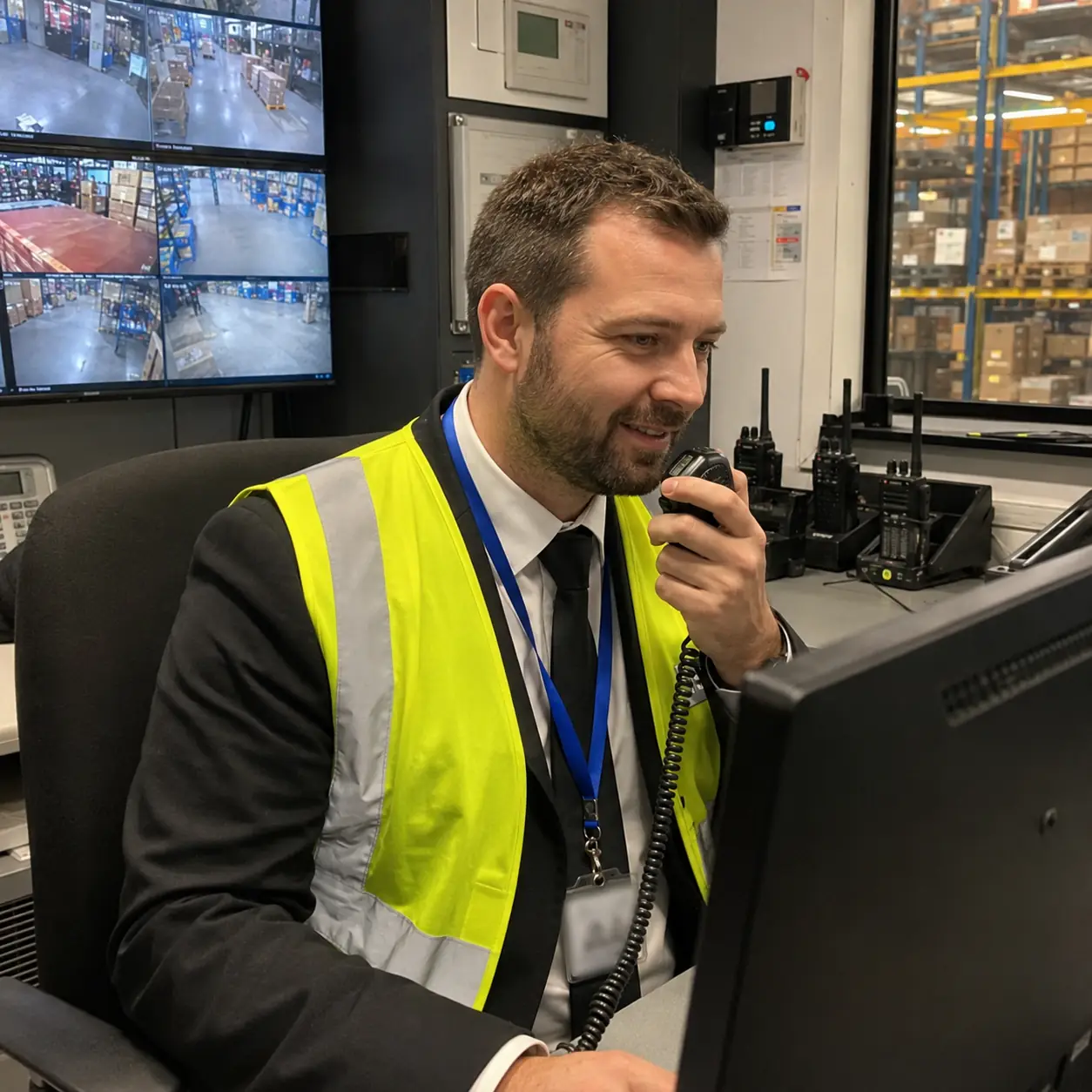
Security officer monitoring CCTV in warehouse control room – Illustrative Image
Why escalation follows a fixed sequence
When an alarm activates, the control room receives the signal and checks what it means before the response is set in motion. The sequence matters because rushed calls create noise, and slow calls leave the site exposed.
- Alert received: The alarm, camera trigger or site call reaches the control room.
- Verification: The operator checks the available information against the site instructions. CCTV, access details or guard contact may help confirm what is happening.
- Decision: The operator decides whether the event is routine, suspicious or urgent. That decision is shaped by the site’s escalation route.
- Response: A keyholder, mobile response officer, on-site guard or emergency service may be contacted where the situation supports that step.
- Logging: The operator records the time, action taken and any reference details needed for the incident record.
- Update: The right site contact receives the agreed update, so the incident does not disappear into a shift handover or unanswered voicemail.
Police attendance depends on the incident, the verification available and the arrangements in place. A professional provider treats the police call as a serious escalation decision, taken on what the verification actually shows.
Inside Double Check Security Group’s control centre support, the value sits in the agreed route from alert to response. That route gives each person involved a defined role, so responsibility does not drift between the guard, the keyholder and the person watching the system.
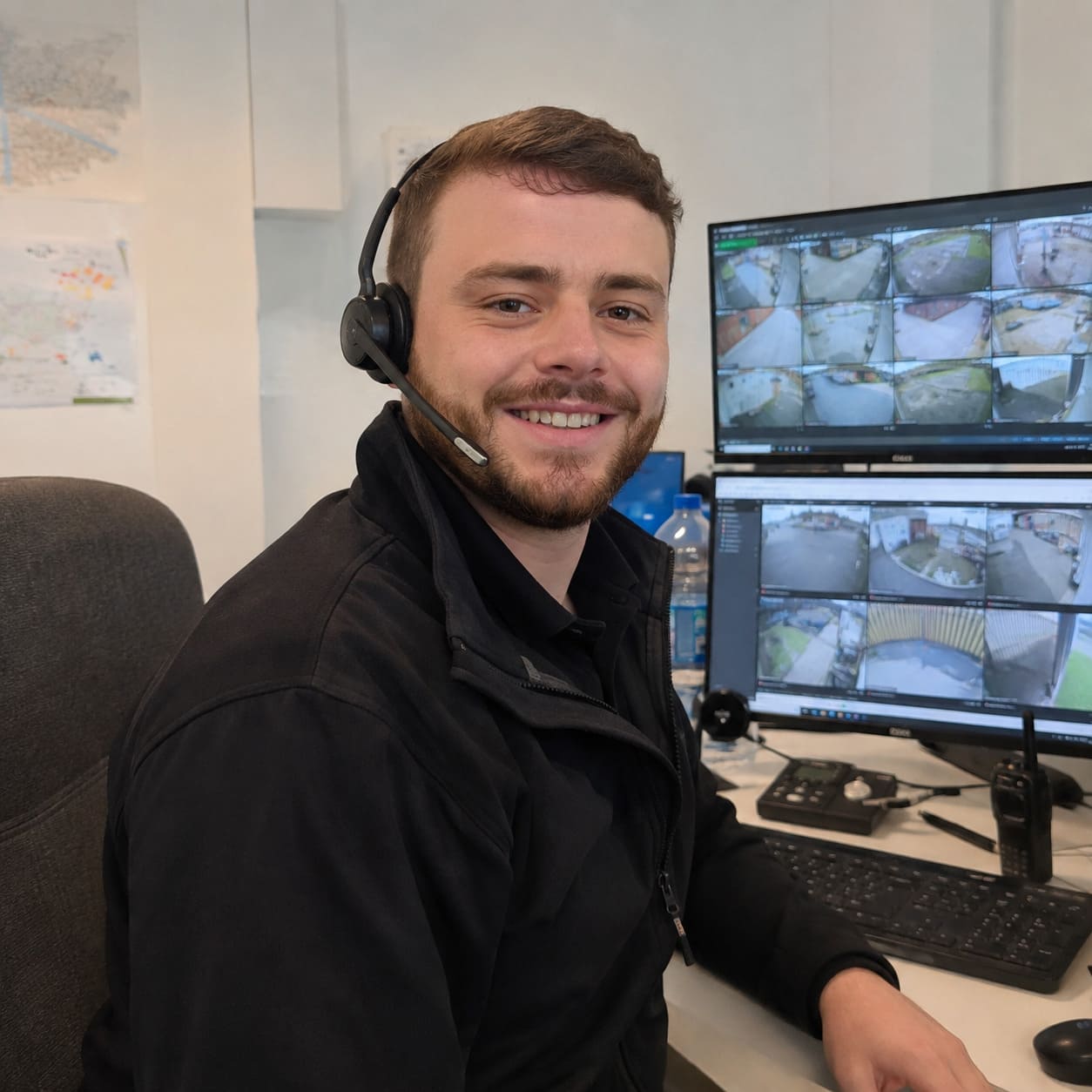
CCTV Operator happy to be at work – Illustrative Image
Evidence handling keeps incidents usable
An incident may be over quickly, yet the record continues to matter. If you need to review what happened, support an insurance discussion or provide footage to an investigator, the quality of the control room log becomes part of the outcome.
Incident logs should give a clear trail of the alert, the operator’s checks and the actions taken. Thin notes leave people guessing later. Strong records let you see why a decision was made at the time.
CCTV evidence handling also needs control. Footage may need to be found, extracted, protected from casual access and shared securely. Where people are identifiable, CCTV footage becomes personal data, so UK GDPR and the Data Protection Act 2018 duties apply to the organisation using the system.
The Information Commissioner’s Office says surveillance staff should be able to recognise requests to access, erase or restrict personal data, and systems should allow footage to be found and extracted. The practical requirement is simpler than it sounds: the provider should handle footage in a way that keeps it usable.
For a provider such as Double Check Security Group, structured reporting and governance are part of the service, because a control room that cannot produce a reliable record leaves you with a gap after the event.
The real test is accountable oversight
The stronger buying test is accountable oversight, not the number of cameras on a wall. A 24 hour security control room earns its place when it shows who acts, who checks the action and who records the decision.
Technology still matters. Cameras, alarms and access systems need to work properly, and the control room depends on them. The commercial risk sits in the handover between signal and action, because that is where weak providers become exposed.
Useful provider questions stay practical. Who is licensed for the monitoring being done? What escalation route applies to your site? How are incidents logged? How is footage controlled after an event? The answers should be clear before a problem occurs.
A control room is valuable when it creates one accountable chain from alert to recorded outcome.

CCTV monitoring officer records incidents while reviewing timestamped surveillance footage and reports – Illustrative Image
Common questions about 24 hour security control rooms
Can a control room monitor CCTV cameras already installed on your premises?
Yes, where the cameras, recording system and access arrangements are suitable for remote monitoring. The provider still needs clear site instructions, agreed viewing rules and a reliable way to act on what operators see.
Is 24/7 monitoring useful for a multi-site estate?
Yes, especially where several sites need a consistent escalation route outside normal working hours. A control room gives each site a defined process, while central records help you compare incidents across the estate.
What information does a provider need before monitoring starts?
The provider needs clear site instructions, emergency contacts, access arrangements and the agreed response route for common events. Poor setup produces poor monitoring, even where the cameras and alarms work.
Does Martyn’s Law mean every business needs a staffed control room?
No. The Terrorism (Protection of Premises) Act 2025 is not yet in force. When it commences it will cover qualifying public premises and events in two tiers, and enhanced tier premises, where 800 or more people may be present, will need appropriate public protection measures. Monitoring is one of those measure types, and the official examples given are security patrols, searches and CCTV.
Can access control alerts be handled by a security control room?
Yes, where the system is connected and the provider has agreed instructions for those alerts. Operators can check whether the event matches normal activity, then escalate it if the site rules say action is needed.
