

How does BICSc affect the clean your building gets each day?
BICSc, the British Institute of Cleaning Science, changes cleaning by making the task, expected finish, staff skill and check method clear before work starts. Your building gets a specification that can be trained, checked and corrected, so standards rely on method and evidence as well as effort.
Many cleaning proposals mention BICSc cleaning standards as if the letters answer the whole question. They do not. The useful question is what BICSc means in cleaning once it reaches your site schedule, your cleaners and your review meetings.
Good commercial cleaning standards give you a way to compare what was promised with what happened. Weakly managed standards stay trapped in proposal wording. For a facilities or property manager, the value sits in the gap between those two outcomes.
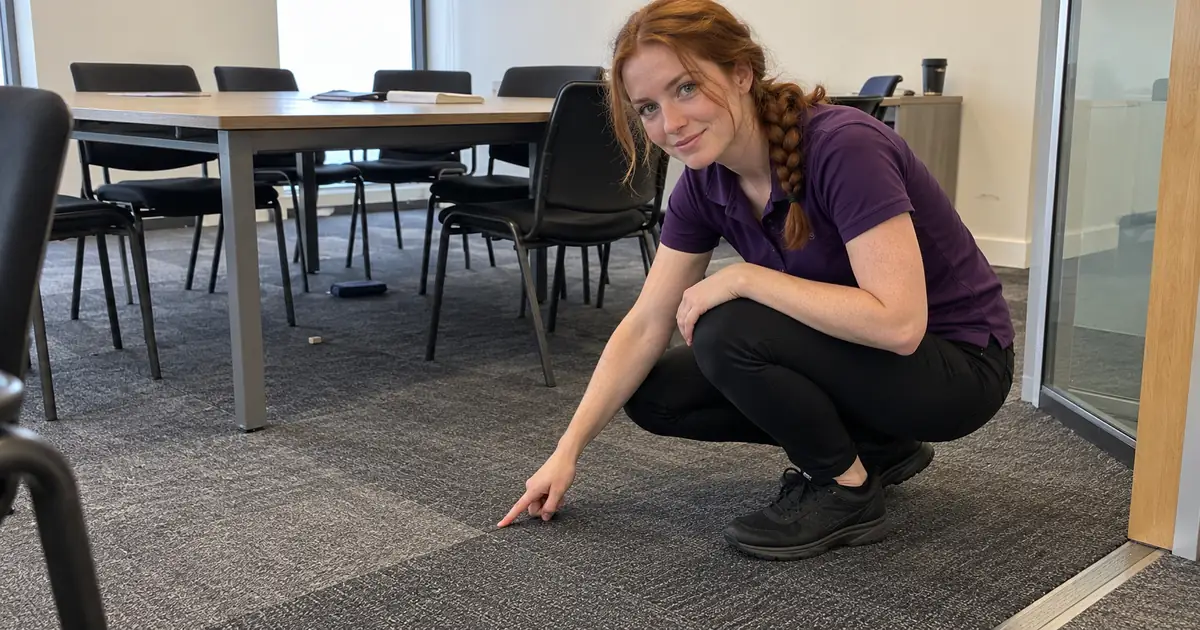
Commercial Office Carpet Tile Cleaning Survey – Illustrative Image
What Do We Cover In This Article?
BICSc standards turn cleaning into a measured system
BICSc standards give commercial cleaning a shared language for tasks, methods and checks. BICSc is an operating discipline, not a badge to leave in a tender response.
BICSc Standards & Best Practice brings together recommended colour coding, the Cleaning Professional’s Skills Suite, Outcome Criteria and Compound Productivity Rates. That matters because each tool affects a different part of your contract. Outcome Criteria define acceptable and unacceptable cleanliness. Compound Productivity Rates give a standard figure for calculating the time needed to complete a cleaning operation.
That changes the cleaning specification. A vague line such as “clean office floors” becomes a task with an expected finish, a method and enough time allocated to do the work properly. Commercial cleaning standards become easier to supervise because the supervisor has something clearer to check than effort or intent.
For ordinary offices, retail spaces, schools, hospitality premises and industrial buildings, BICSc standards for buildings still need to be applied to the site in front of you. A reception area, a staff kitchen and a workshop do different jobs. Strong cleaning specification standards reflect those differences while keeping the same management logic behind them.
Daily cleaning changes at task level
A shared kitchen can be cleaned from a vague instruction or from a controlled method. Under a loose instruction, the cleaner decides the order, cloth choice and finish by habit. Under a BICSc-led approach, the task sequence, equipment use and acceptable result are set before the work begins.
The table below compares a loose task list with a BICSc-led specification.
| Loose task list | BICSc-led specification |
|---|---|
| Says what area to clean | Defines the expected outcome for each task |
| Relies on habit and local routine | Uses agreed methods, sequence and supervision |
| Gives little evidence when standards slip | Creates clearer checks and correction points |
BICSc colour coding is one practical example. BICSc says colour coding commonly uses red, blue, green and yellow, with white or striped cloths added for site-specific uses. Outside healthcare, BICSc says no national or international compulsory colour coding standard exists across the cleaning industry, so the value comes from training the system, using it consistently and checking it on site.
Sequence matters as much as colour. BICSc’s golden rule is to work from the cleanest area to the dirtiest area. In plain building terms, that means your cleaners need a route and a method, especially where washrooms, kitchens and general office areas sit close together. The supervisor then checks how the task was done, not just whether a box was ticked.
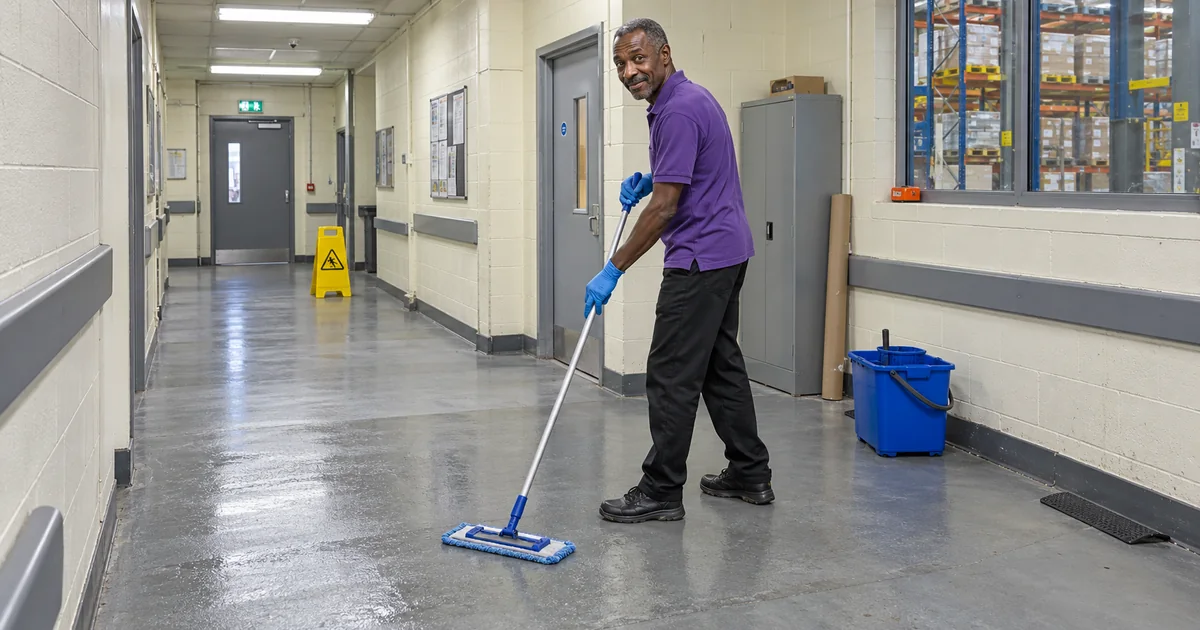
Commercial Cleaner Mopping Warehouse Corridor – Illustrative Image
Staff skills have to match the building
Broad claims about BICSc-trained cleaners need checking against named people and named tasks. A standard office clean, lift cleaning and high level dusting do not call for the same skill record.
The BICSc Cleaning Professional’s Skills Suite, known as CPSS, has more than 40 skills. The BICSc Licence to Practice, known as LTP, is compulsory before candidates progress to Base, Additional, Specialist and most Sector Specific Units. After training, achieved skills are listed on a skills card, which gives you something concrete to ask for during a contract review.
Specialist Units cover tasks such as bodily fluids and sharp objects, bio-hazard decontamination cleaning, cleaning computers, cleaning lifts, high level dusting and cleaning, steam cleaning, pressure washing and machine sweeping. That range is the point. “BICSc-trained” has value when the training fits the work your building actually needs.
Useful buyer questions are simple:
- Assigned staff: Which operatives on this site hold BICSc training or skills records?
- Role fit: Which skills match the routine and specialist tasks in the specification?
- Induction: How are colour coding, site rules and task sequence taught before work starts?
- Records: What training evidence can the facilities or property team see during review meetings?
For providers such as Double Check Security Group, the practical link between standards and service sits in induction, records and regular site checks. Your contract becomes easier to manage when the people on site can be matched to the work on the schedule.

Cleaner dusting clothing rails and shelves inside a fashion boutique – Illustrative Image
Audit evidence makes standards manageable
A standards-led contract still needs proof. Cleaners can follow a schedule for weeks, then drift because access changes, staff move, products run low or a task gets squeezed. A useful audit produces evidence and corrective action, not another completed checklist.
A BICSc cleaning and hygiene audit is an independent evaluation of a site’s cleaning standards by a BICSc Auditor. The audit uses the BICSc Audit App and reviews personnel, equipment, health and safety practices and documentation. That gives the review a wider field of view than a walk round with a clipboard.
The audit report uses red, amber and green grading. Busy facilities and property teams understand that format quickly because it separates acceptable areas from the places that need attention. The colour rating has to connect back to a fix, because a red item with no owner or follow-up date leaves the same problem waiting for the next inspection.
Before an audit can mean much, the paperwork must match the site. BICSc lists audit requirements including the cleaning specification and schedule, scope of works and colour coding policy, training records and compliance documentation, plus site access after cleaning. Contracts run by Double Check Security Group use structured monitoring and client feedback to keep those records visible during the life of the contract, which is where audit evidence becomes useful for day-to-day management.
Managed standards make cleaning easier to control
BICSc has value when your provider can show how the standard changes the work in your building. The stronger buying question is whether the contract turns a recognised standard into scope, training, supervision, audit records and correction that you can actually manage.
That question matters even more across a portfolio. Multi-site cleaning needs enough consistency to compare performance, with enough site detail to account for different layouts, risks and opening patterns. A single badge cannot do that work by itself. A managed system can.
Judge the provider by the evidence behind the words. BICSc Outcome Criteria, training records and a cleaning and hygiene audit all point to the same buying test: can the contractor define the standard, apply it on site and correct it when the work falls short?
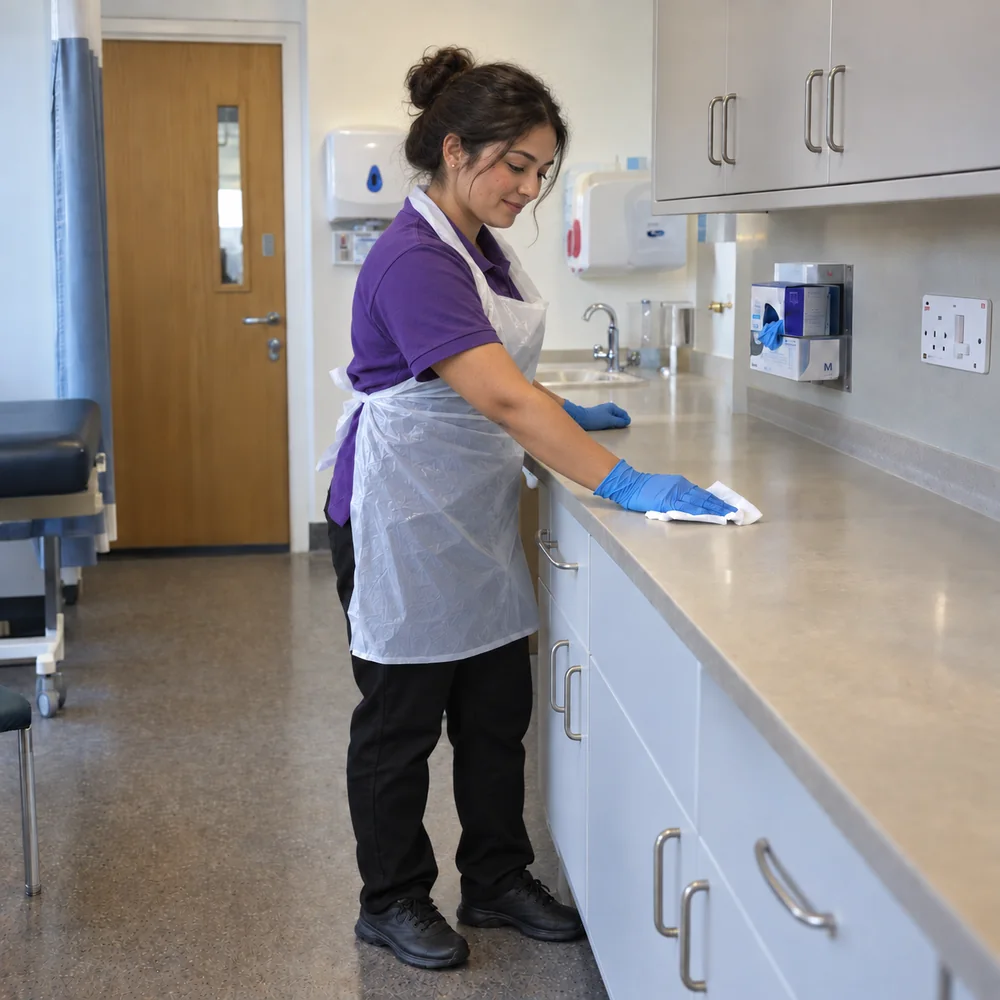
healthcare cleaning treatment room worktop – Illustrative Image
Common questions about BICSc cleaning standards
Is BICSc a legal requirement for commercial cleaning?
BICSc is not a general legal requirement for every commercial cleaning contract. For most offices, retail units and other ordinary commercial premises, it works as a recognised standard that helps you specify, train and check the cleaning service.
What is the difference between BICSc membership and BICSc accreditation?
BICSc membership, BICSc-trained operatives and BICSc Accredited Training Membership refer to different things. Ask the provider which status it holds, which staff have completed training, and what records you can see for the people assigned to your site.
Can BICSc colour coding be used outside healthcare?
Yes, BICSc colour coding can be used in ordinary commercial buildings as a practical control for equipment use between areas. BICSc says compulsory national or international colour coding standards do not exist in the cleaning industry outside healthcare, so your contract needs a clear colour coding policy and site checks.
Do NHS healthcare cleaning standards apply to ordinary commercial premises?
NHS National Standards of Healthcare Cleanliness 2025 apply to healthcare environments, and they should not be applied to ordinary commercial premises as if they were the same setting. NHS England says those standards cover all cleaning tasks throughout the NHS, regardless of which department is responsible.
What evidence should a cleaning standards audit give you?
A cleaning standards audit should give you a clear link between the specification, the site findings, the grading and the agreed correction. Ask for audit records that show what was checked, what needs attention and how the issue is being closed.
