

Why does your business alarm keep activating after hours?
Usually, a business alarm keeps activating after hours because one repeat cause is being missed: an unsecured door, movement near a detector, a close-down error, a fault, or a genuine attempted entry. Treat each callout as evidence, then use the pattern to fix the site, system or instruction behind it.
Your real question is what actually sets off business alarms at night and what you should change if your site keeps having callouts. A useful answer looks past the noise of the siren and asks what the activation is telling you about the building.
One night alarm activation can be an isolated event. Repeated callouts from the same door, stockroom, yard line or detector zone point to a problem that deserves a proper review.
That review does more than reduce disruption. It also protects staff from avoidable night attendance and gives you a better way to judge whether your keyholding and alarm response process is doing its job.
What Do We Cover In This Article?
Repeat night activations have causes
Night alarm activations usually trace back to a small group of causes: site condition, detector environment, close-down routine, system fault or genuine attempted entry. A rear door contact, a passive infrared detector and a perimeter alert each send you toward a different check.
The National Protective Security Authority (NPSA) describes an Intrusion Detection System (IDS) as a system that detects and signals the presence of an intruder or an intrusion attempt. The same guidance treats IDS as one protective layer on a site, used alongside measures such as access control, on-site security officers and CCTV.
High false alarm rates also weaken confidence in the alarm. Once people start assuming the system is wrong, a real activation becomes easier to dismiss. That is why commercial alarm callouts need a cause record, not just an attendance note.
The useful pattern is the repeat cause behind the activation, not the fact that the alarm happened at night. If the same zone activates after close-down, your next check belongs at that zone, in the routine that secures it, and in the instructions given to whoever attends.
False alarm control is managed work
A detector zone that activates on several nights while the rest of the building stays clear gives you a precise place to start. The fault may sit in the detector environment, the way the space is used after hours, or the maintenance route that follows the first report.
BS 8473:2018 is the current British Standard code of practice for managing false alarms from intruder and hold-up alarm systems. Published on 31 October 2018, it applies to remotely notified systems and audible-only systems, except where the standard states otherwise.
Practical causes matter here. NPSA guidance identifies sunlight, heaters, insects, spiders and rodents as causes of false alarms in passive infrared detectors. A passive infrared detector, often called a PIR alarm sensor, reacts to changes in heat and movement in its field of view, so the area around it needs managing.
The first review after repeat false activations should look at the evidence, then turn it into a site action:
- Recurring zone: Check whether the same alarm zone appears in the panel history, because a repeated zone gives you a better lead than a general building alert.
- Detector view: Look for heaters, hot spots, sunlight across the lens, stock movement or hanging material inside the detector’s field of view.
- Pest activity: Treat insects, spiders and rodents near a detector as a site issue, since cleaning and pest control may reduce the trigger.
- Maintenance record: Compare the callout report with the maintenance log so an engineer sees the same pattern the responder has seen.
False alarm management works best when every repeat activation creates an action for the site, the installer or the response provider.
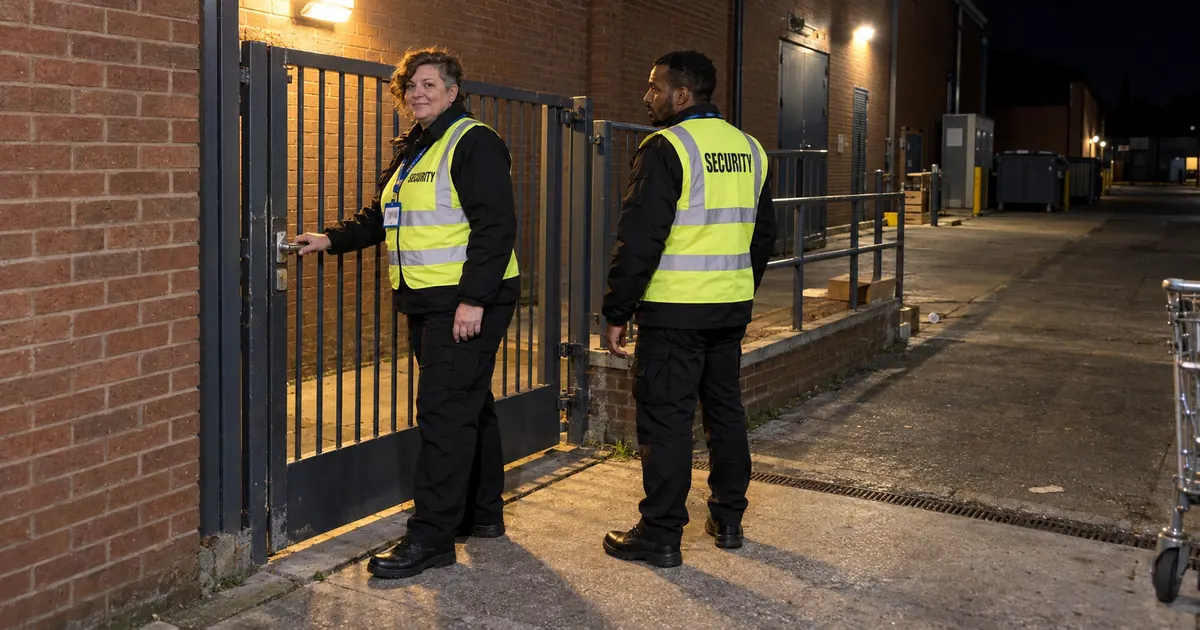
Night Security Patrol Checking an Industrial Site Gate – Illustrative Image
Verification turns alerts into decisions
What happens when a business alarm goes off? A good response process checks what the alarm signal means before the situation is escalated.
BS 7984-1:2016, published on 30 April 2016, covers keyholding attendance requests, site attendance, locating the causes of security and safety alarms, making premises secure, preserving potential evidence, dealing with conflict and site inspections that support keyholding. That scope is wider than turning up with keys.
The table below compares common alarm statuses with the practical meaning for your response decision.
| Alarm status | Practical meaning |
|---|---|
| False alarm | A cause is found that does not indicate attempted entry or an immediate security concern. |
| Unconfirmed activation | The signal needs further checks before escalation. |
| Confirmed activation | Evidence supports a real security event or attempted entry. |
| Incident requiring escalation | The response instruction or verified evidence supports escalation to the agreed route. |
CCTV can help clarify whether a security alert is real, and ProtectUK also notes its value in post-incident investigations. The site operator still has data protection responsibilities for CCTV, so access and viewing instructions need to be set up properly before a night alarm occurs.
Police attendance needs careful wording in your own process. ProtectUK says the NPCC security systems policy sets out police requirements for alarm systems installed by compliant companies to gain a police response. Compliant companies can apply for a Unique Reference Number, or URN, that identifies an individual security system within the police database.
Attendance speed matters, but the response decision comes from verification: panel data, CCTV support where available, site checks and the escalation instruction that tells the responder what to do next.

Mobile Security Patrol Officers in Their Vehicle – Illustrative Image
Accurate keyholder records matter
If access details are out of date, a capable responder still loses time at the gate, the alarm panel or the key safe. A callout can only be resolved cleanly when the person attending has the right keys, codes, routes and authority to act.
GOV.UK says councils can deal with noise from intruder alarms through abatement notices and, for noise between 11pm and 7am, warning notices. Where councils cannot reach a keyholder, they can enter without force to silence an alarm if reasonable steps have been taken to contact the keyholder, the alarm has sounded constantly for 20 minutes or intermittently for 1 hour, and the noise is likely to annoy people nearby.
Keyholder details are therefore more than admin. In alarm notification areas, owners or occupiers with an alarm must give the council details of a keyholder who can enter the property and turn off the alarm. GOV.UK says keyholders must have keys, be able to access the alarm, live or be situated near the premises, know how to turn the alarm off and agree to act as a keyholder. For non-residential premises, a keyholding company can fulfil that role.
Records held for keyholding and alarm response should match the building as it operates now. Staff changes, new access fobs, altered gate codes and panel changes all make old instructions weaker. Double Check Security Group uses regular site visits and in-depth inductions at all sites. That is the kind of process that keeps response instructions tied to the real premises.
Review keyholder records as part of normal alarm response housekeeping, especially after a repeat callout or any change to access.
Better instructions reduce avoidable callouts
After several out-of-hours alarm response visits, the weakest part of the process is often the written instruction. The responder may have attended correctly, but the report may show unclear zone names, vague escalation preferences or access information that has drifted away from the building.
Good instructions tell the responder what matters at that site. A logistics yard needs different verification notes from a retail unit with a stockroom sensor near a heater. A corporate building with several tenants needs a clear handover route when the alarm panel points to a shared area.
Commercial alarm response improves when the report feeds the next change. That change may be a clearer zone name, a tighter close-down procedure, a detector review or a corrected access record. Small fixes add up because they remove the repeated cause from the next night’s attendance.
A 24 hour control centre also matters because night decisions need a live route for handover, escalation and reporting. Double Check Security Group operates a 24 hour control centre 365 days a year, uses site-specific scope for each location, and works with continuous monitoring and structured client feedback. Those details are process evidence: they show how repeat alarm response patterns can be captured and turned into useful actions.
A good response process leaves the site easier to manage after the callout, not merely quieter for the rest of the night. As alarm systems, access control and CCTV become more connected, the difference that matters is the quality of the information your provider returns after every activation.
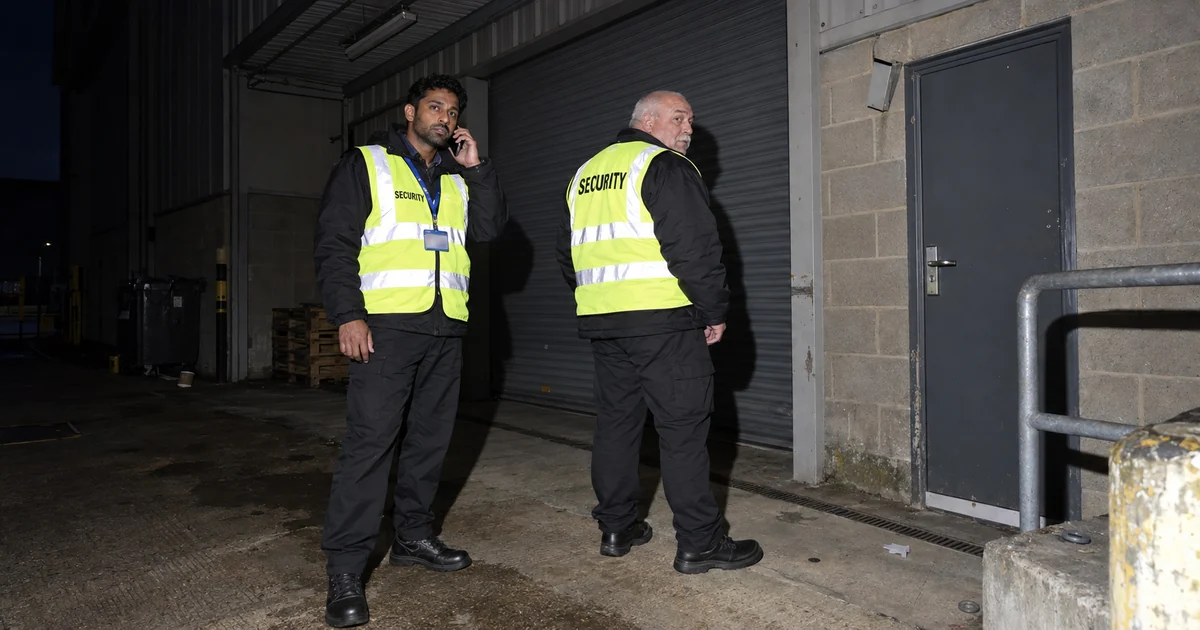
Security Officer Making Call During Night Warehouse Patrol – Illustrative Image
Common questions about business alarm callouts
Can a cleaner or contractor cause an after-hours alarm?
Yes, an after-hours worker can trigger an alarm if they enter outside the expected schedule, use the wrong route or leave an area unsecured. Your alarm response instructions should reflect approved out-of-hours access so a genuine contractor visit is verified quickly.
Do alarm response officers repair alarm faults on the night?
Alarm response officers normally check, secure, report and follow the agreed instruction for the site. A technical alarm fault usually needs the alarm maintainer or installer, but the callout report should give them a clear starting point.
Does a perimeter alert mean someone has entered the building?
A perimeter alert means the outer area or boundary has signalled activity. Verification still matters, because outdoor systems can be affected by animals, weather or technical failure.
Who should receive the callout report after a night activation?
The report should go to the person who can act on it, such as the facilities manager, estates lead or nominated site contact. A report that sits with the wrong person leaves the repeat cause untouched.
