What is the difference between hard and soft facilities management in the UK?
Hard facilities management covers the physical systems and fabric of a building, such as maintenance of lifts, heating, electrical systems, plumbing and fire safety. Soft facilities management centres on people-oriented services, including cleaning, security guarding, reception and waste management. In the UK, distinguishing between hard and soft FM is important for compliance, contract clarity and operational planning.

What Do We Cover In This Article?
Understanding Hard and Soft Facilities Management: Definitions and Core Differences
Facilities management in the UK is structured around two core categories: hard FM and soft FM. The distinction shapes service delivery and legal compliance, but also the day-to-day experience of occupants and building managers.
A side-by-side comparison highlights the main differences:
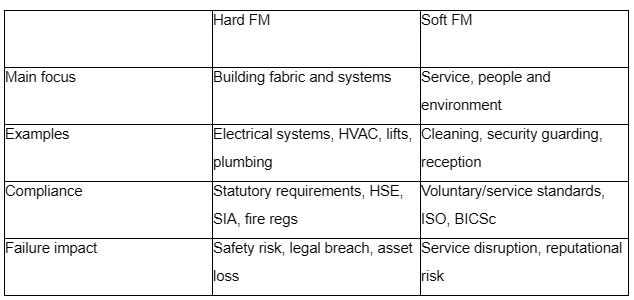
Hard FM tasks, such as electrical maintenance or fire alarm checks, are usually driven by statutory and regulatory frameworks. By contrast, soft FM, including cleaning and hospitality, leans on best practice and voluntary industry standards from bodies such as the British Institute of Cleaning Science. In both commercial and residential settings, confusion can arise where service boundaries overlap, but clear contractual scoping keeps responsibilities well defined.
Recognising the core differences between hard and soft FM supports effective contracts and helps organisations remain compliant with UK regulations. This clarity is the foundation for sound operational and budgeting decisions.
Pro Tip: When separating FM contracts, set clear communication protocols between suppliers to avoid service overlap and compliance gaps.
Discuss Integrated FM Solutions
Explore how an integrated FM approach can streamline your operations and support value for money with our expert advice.
What to Bundle: When Integrated FM Makes Sense
Organisations often face the decision of whether to manage hard and soft FM separately or to integrate them under a single supplier. Integrated FM can be beneficial, bringing a range of practical advantages.
Typical benefits of bundling hard and soft services include:
- Streamlined contract management and reporting, with one main point of contact
- Improved operational efficiency, where processes such as access control and health and safety are standardised across services
- Potential cost savings through economies of scale and shared resources
However, there are important considerations. Bundling can sometimes spread specialist teams too thin or reduce attention to complex areas. Oversight is required to maintain both breadth and depth of service delivery.
A practical example comes from providers like Double Check Security Group, which delivers integrated FM across security, cleaning and building management. By managing both building systems and people-centred services within one operational structure, the process of compliance monitoring and risk management can become more straightforward. For many commercial sites, this integrated approach strengthens control and reduces administrative burden.
While integration offers clear benefits, decision-makers should assess whether bundled delivery meets their specific risk profile and service expectations.

What to Separate: When Specialist or Split FM Delivers Better Value
Should every organisation bundle FM services? The answer depends on context. Separation can deliver better outcomes when specialist skills, higher compliance or sector-specific expertise are required.
Cases where split FM is preferable often include:
- Sites with advanced or high-risk technical systems needing specialist maintenance
- Environments requiring accredited, highly vetted security teams, regulated by bodies such as the SIA
- Properties where cleaning, hygiene or environmental protocols surpass industry norms, for example in laboratories or healthcare
Separating contracts allows more detailed oversight and closer alignment with regulatory frameworks, including ISO 9001 or sector-specific requirements. However, concerns sometimes arise around perceived challenge or fragmented management.
Key factors favouring specialisation over integration include:
- The need for rigorous compliance management
- Requirement for proven technical expertise
- High penalty risk for service failure
Clearly defining scopes and individual provider responsibilities can mitigate potential confusion. Ultimately, organisations must weigh the risk profile and operational needs of their site before deciding.
Pro Tip: Bundling FM services under one provider can simplify reporting and contract management, but always verify the provider’s depth of expertise in each service.
Why the Bundle-or-Separate Decision Directly Affects Cost
The structure of FM delivery has a direct impact on cost, far beyond the initial contract price. Bundling services under one provider sometimes reduces visible costs, but potential hidden expenses must be accounted for.
Key cost factors to consider:
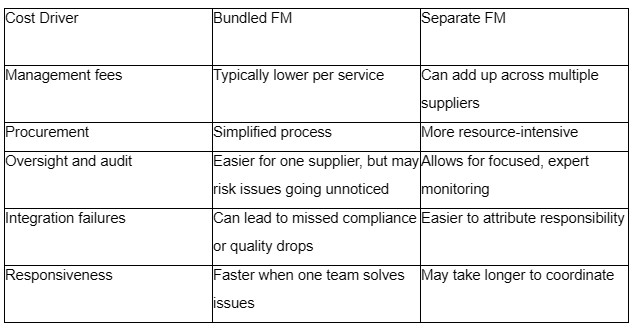
Consider a commercial office with unified FM: costs are centralised, reporting is more straightforward and operational disruption is minimised. However, if a bundled provider lacks adequate expertise in a critical area, unexpected costs can arise through non-compliance or corrective work.
In contrast, working with specialist suppliers might raise headline rates, but seasoned technical teams can often prevent costlier incidents down the line by identifying and addressing risks early. Transparency in pricing, contract terms and service level agreements supports clear expectations, no matter which model is chosen.
Learn About Professional Guard Services
Compliance, Risk, and Operational Oversight: The Hidden Factors in FM Structuring
Compliance and risk management exert a significant influence on FM decisions. Regulatory frameworks, such as SIA licensing, ISO 9001, and health and safety law, shape how services must be structured, delivered and reviewed.
Effective oversight begins with monitoring contract delivery and checking that accreditations remain valid. Key considerations include:
- Regular auditing by qualified teams or external bodies
- Clear documentation of statutory checks, such as fire system testing and security vetting
- Ongoing performance reviews driven by feedback from site managers
- Systems for reporting and correcting near-misses or service lapses
- Continuous improvement, with transparent tracking of actions and outcomes
Providers such as Double Check Security Group structure their operations to meet these demands, with 24-hour control centres, accredited staff, and scheduled performance monitoring as standard practice. Integrating compliance into everyday routines ensures continuity, reduces risk and builds trust over time.
Service continuity, regulatory alignment and operational assurance rely more heavily on these disciplines than on contract price alone. Consistent oversight is non-negotiable in high-stakes environments.
Practical Steps for FM Decision-Makers: Structuring for Value and Assurance
Facilities and property managers seeking the right FM structure benefit from a clear, systematic approach. Consider using the following checklist:
- Define your service needs precisely, list both hard and soft requirements per site
- Assess compliance obligations, including legal, regulatory and accreditation demands for each service
- Evaluate provider competence, review relevant accreditations, sector experience and staff vetting standards
- Compare integration benefits, determine if a single provider can genuinely deliver the required depth across all areas
- Set clear scopes and SLAs, ensure responsibilities are well defined, with agreed performance targets and escalation routes
- Plan for monitoring and review, establish regular review points, feedback channels and audit schedules
- Focus on partnership, prioritise providers with a record of open communication and long-term consistency
Following this process supports informed, confident FM structuring. Each step is designed to balance efficiency, compliance and quality.
Conclusion: Making Informed FM Structuring Choices
Structuring facilities management services is never a one-size-fits-all task. The choice between bundling and separating services should reflect operational needs, compliance standards and cost transparency, supported by strong governance.
- Clear definitions of hard and soft FM underpin effective decision-making
- Bundling can offer operational simplicity, but only if breadth and expertise are maintained
- Separation supports depth and compliance where specialisation is critical
- True cost goes beyond headline rates, including risks, oversight and continuity
The best FM decisions adapt as needs evolve, always grounded in clarity, partnership and assurance.