

What should you expect from a CCTV monitoring company?
A CCTV monitoring company connects your cameras to a staffed monitoring centre, reviews live or triggered footage, checks whether an alert is real, and follows a written response plan. Remote monitoring suits sites where cameras can show the risk clearly and someone can respond when an operator escalates.
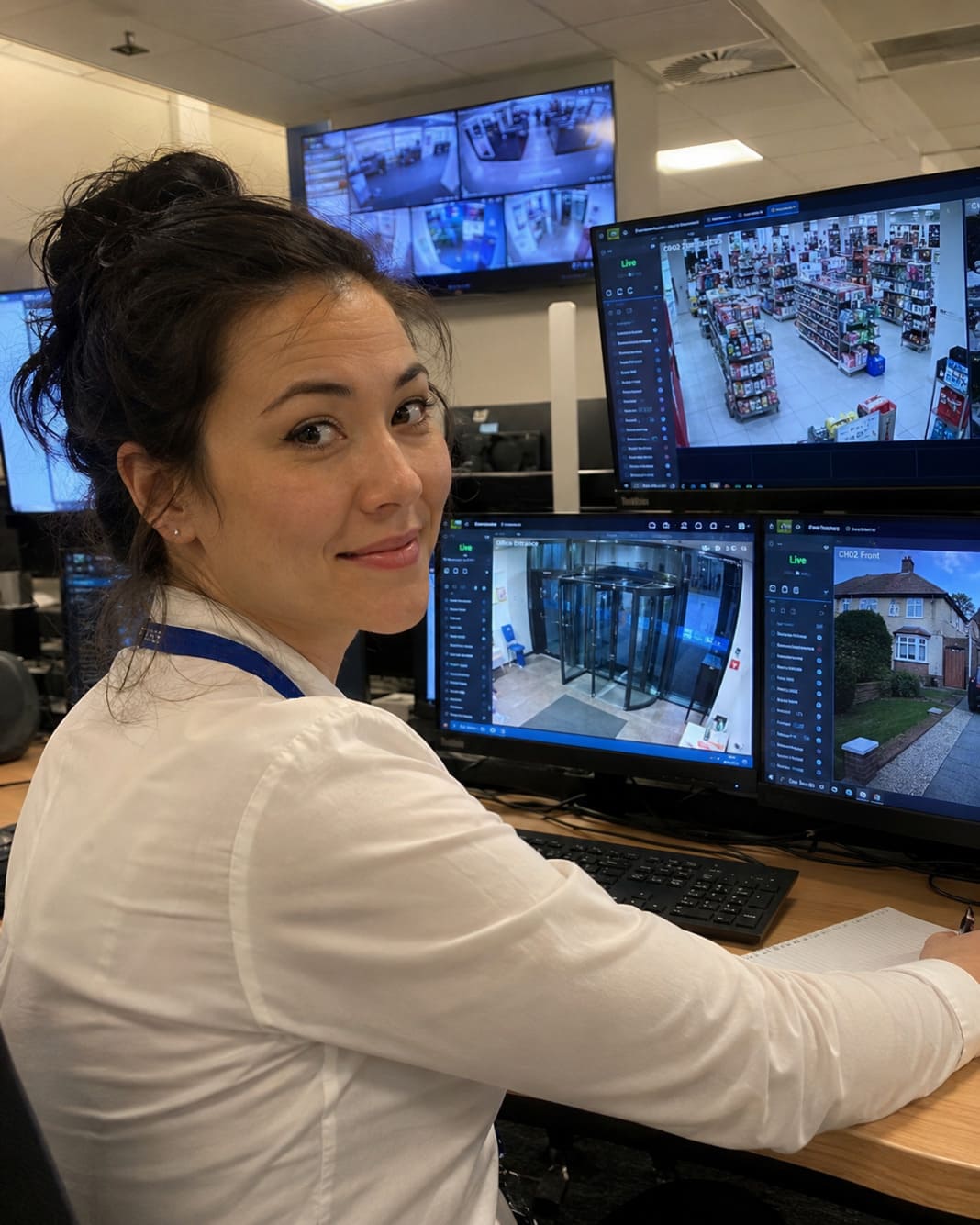
Female CCTV operator manages retail security cameras and real-time incident monitoring systems.
What Do We Cover In This Article?
What a CCTV monitoring company actually does in practice
A closed commercial site gets an out-of-hours activation. If the cameras are only recording, the footage sits on the system until someone reviews it later. With professional CCTV monitoring, the alert goes to an operator who checks the video, decides whether the event needs action, and follows the agreed instructions for your site.
That distinction matters. Passive CCTV records what happened. Remote access lets an authorised person log in and view cameras. A monitored CCTV service gives you an active response function, where trained operators assess events, filter false alarms, log incidents and escalate when the evidence supports it.
Operators do not simply watch every camera all day in the way many buyers imagine. Monitoring can be live, scheduled, detector-activated or a mix of those, depending on the risk and the setup. A logistics yard might rely on perimeter detection after closing. A residential block might need event review around entrances. A retail site might combine monitoring with guarding during trading hours and remote review after lock-up.
A good CCTV monitoring company works from site instructions, not guesswork. The operator needs to know what counts as suspicious, who the keyholder is, whether an audio challenge is available, and what escalation route applies. Without that written plan, even good cameras leave too much room for delay and confusion.
Licensing also sits behind the service. Under GOV.UK guidance from the Security Industry Authority, known as the SIA, a Public Space Surveillance CCTV licence is needed in some CCTV guarding activities where operators use cameras to identify people or monitor their activities for guarding premises or people in the circumstances set out by the guidance. The required licence depends on the work being done, so broad claims about all operators needing the same licence are too crude.
Remote CCTV monitoring follows a verification and response sequence
An alert needs verification before response. The value of remote CCTV monitoring is the judgement applied after activation, because every unnecessary callout wastes time and every missed real event weakens your site security.
Operator review and agreed response
Once a camera, detector or alarm sends an activation, the event is reviewed by an operator at a Remote Video Response Centre, usually shortened to RVRC. The operator checks the live or recorded images linked to that activation and looks for what the camera is actually showing.
A person crossing a boundary line, a vehicle entering a yard, or movement near a protected doorway all need different handling. If audio warning is fitted, the operator can issue a live challenge through speakers. Where the activation is harmless, the operator closes it down and records the outcome. Where it needs action, the response plan decides the next move.
Good response plans avoid vague phrases such as “call someone if suspicious”. They state who is contacted, what information they receive, and which response route applies. That route might involve a keyholder, a mobile patrol, an alarm response officer or another agreed escalation path.
Afterwards, the incident record matters. A useful log shows what activated, what the operator saw, what action was taken and who was notified. That record helps you review recurring faults, check response quality and keep evidence in order if the event becomes part of a later investigation.
Police escalation has evidence rules
Police response is not automatic. The National Police Chiefs’ Council, or NPCC, separates compliant remotely monitored detector-activated CCTV systems from systems that sit outside its police response procedures. Systems installed and monitored to the stated police requirements are Type A systems and can be issued with a Unique Reference Number, or URN. Systems outside those procedures are Type B systems and will not be issued URNs.
For detector-activated CCTV, the NPCC requirements also refer to British Standard 8418, usually written as BS 8418, and monitoring centre standards including BS 5979 category II or BS 8591:2014 category II in the relevant circumstances. You do not need to become a standards specialist, but your supplier should know which route applies to your system.
An RVRC should only call the police where there is sufficient image evidence of unauthorised access and criminal activity, or an attempt, in progress. Filtering techniques are part of that requirement, because police control rooms need useful information, not loose suspicion. Professional monitoring earns its keep at that point, because the operator has to turn an activation into a clear, evidence-based response.
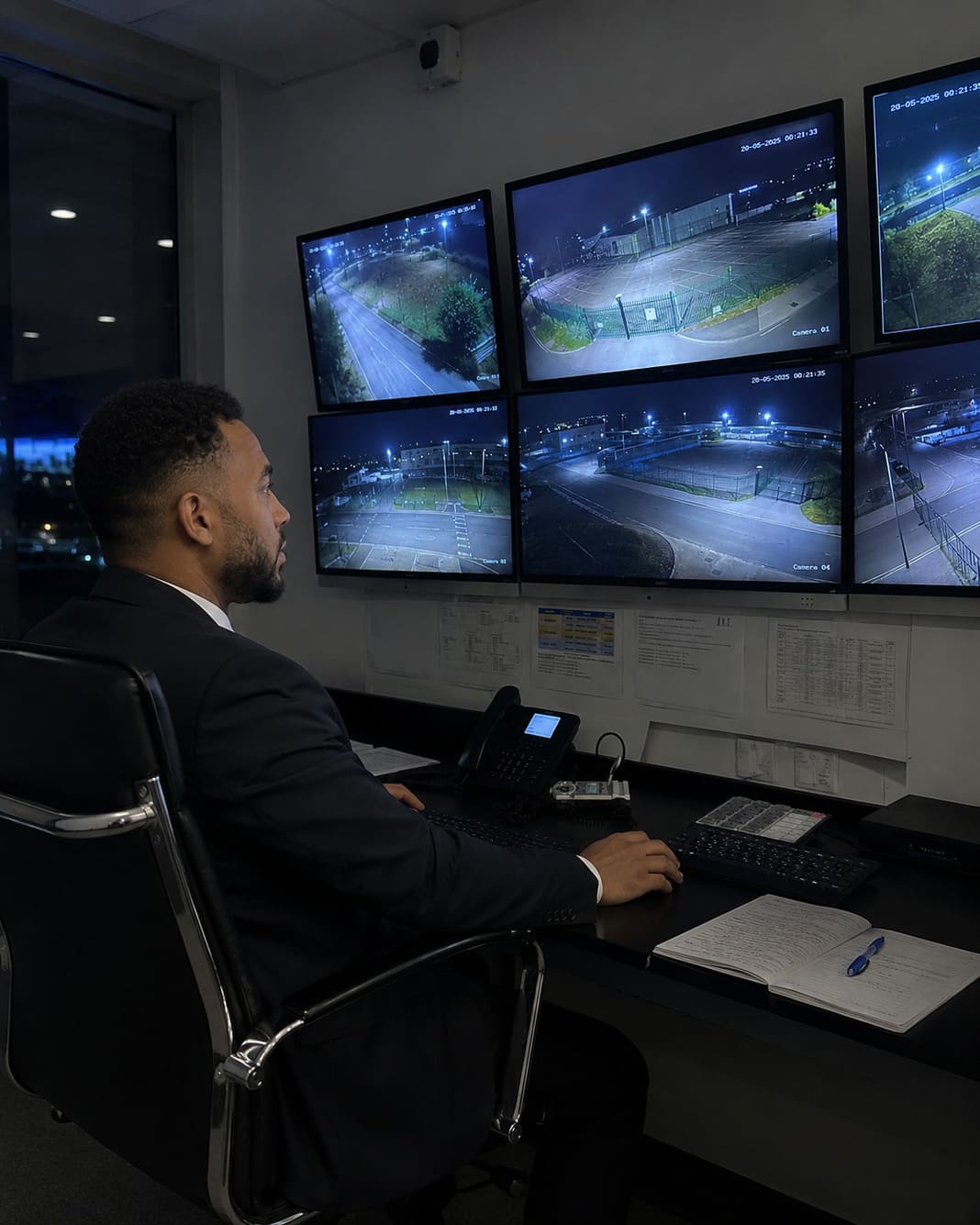
CCTV operator monitors multiple live feeds protecting vacant commercial sites overnight remotely.
Remote monitoring and on-site guarding solve different problems
Could remote CCTV monitoring replace part of your guarding pattern? Sometimes, yes. The better question is what has to happen after something is detected.
Cameras verify and escalate. Guards add physical presence, access control, patrols and immediate on-site judgement. For a vacant site, a perimeter alert backed by monitored video and mobile response can be a strong fit. For a public-facing building with visitors, deliveries and internal movement, a guard may still do work that cameras cannot do.
The comparison below shows the operational difference.
| Security model | Best use | Main limit |
|---|---|---|
| Remote CCTV monitoring | Out-of-hours checks, perimeter alerts, vacant areas and sites where video can confirm the risk | Operators cannot physically intervene on site |
| On-site guarding | Access control, patrols, public-facing support and immediate judgement inside the premises | Guards cover what they can see and reach during their duties |
| Blended model | Sites that need camera verification plus keyholding, mobile response or guarding cover | The model needs clear ownership, so each response route is defined |
Double Check Security Group is a useful example of how this can be set up as one operating model, because its work spans CCTV monitoring, guarding, keyholding and alarm response. That breadth matters where the answer is not a single product, but a joined-up pattern of detection and response.
Price should not be the first sorting tool. A cheaper monitoring setup that leaves nobody available to attend site is weak security. A guard on site without proper camera coverage can also miss perimeter events. The right model starts with the risk, then matches cameras, people and response to that risk.
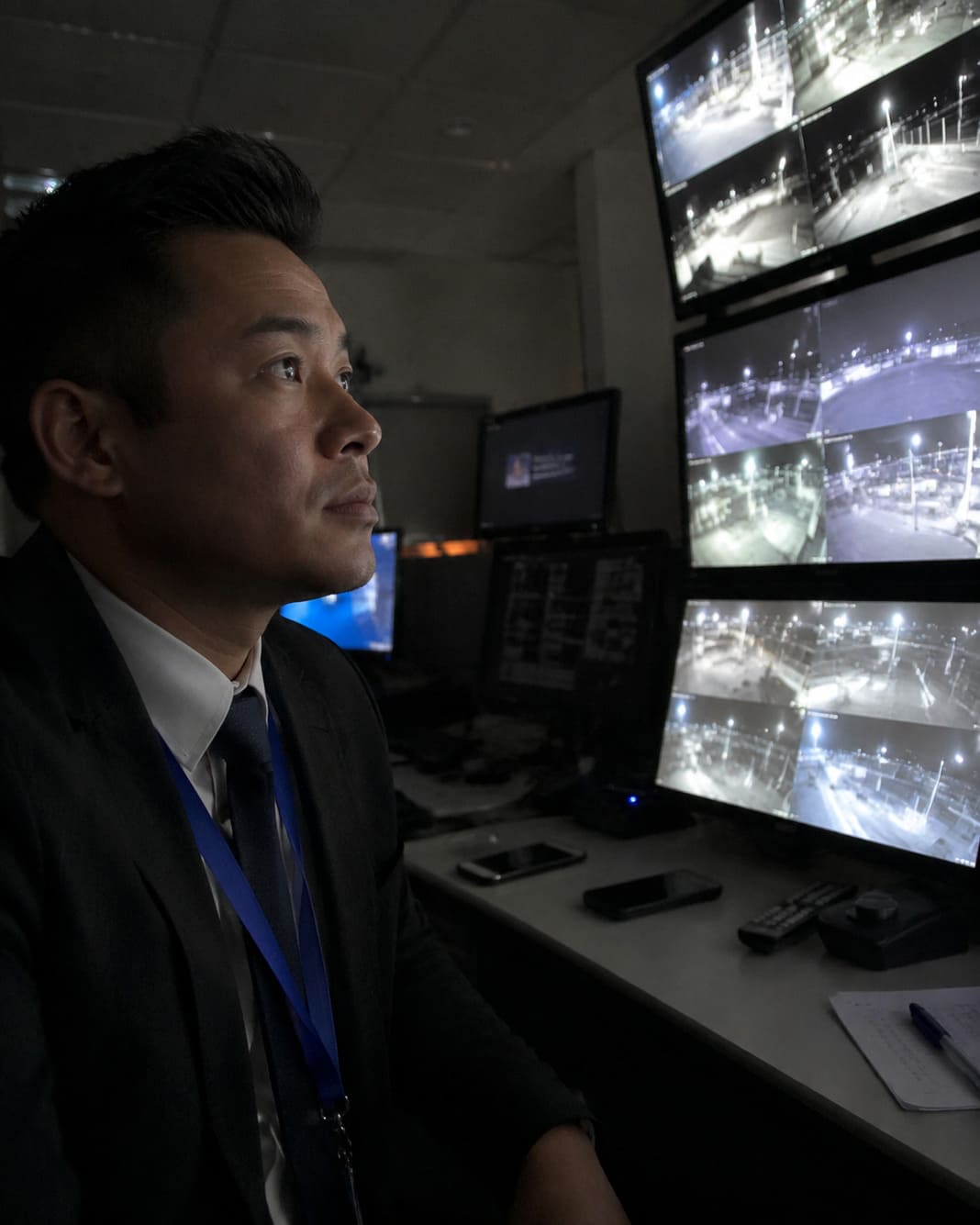
Night CCTV operator verifies suspicious activity across remote commercial surveillance camera feeds.
Site readiness decides whether monitoring works properly
When monitoring disappoints, the problem is often site readiness. Cameras can only support a response if they show the right places, trigger at the right point and give the operator enough information to act.
Existing CCTV can sometimes be connected to monitoring, but connection alone is not the test. The system must be reliable enough for the job you expect it to do. A camera that looks useful in daylight can be far less useful after closing if the lighting, angle or detection zone has not been checked.
Use these readiness checks before treating remote CCTV monitoring as a live service:
- Camera position. Cameras need to cover the routes, entrances and boundary points where risk appears. A wide view of a yard might look impressive, yet a tighter view of the gate may be the one an operator needs.
- Lighting and image quality must suit the monitoring objective. Poor images lead to weak verification, especially where the operator needs to identify whether access is authorised.
- Detection zones. Motion or detector settings should match the protected area. Loose settings create repeated false alarms, and tight settings can miss the event you care about.
- Network resilience needs attention. If the connection drops whenever the site is quiet, the monitoring centre loses the very feed it needs outside normal hours.
- Audio challenge, where fitted, should be agreed before go-live. The operator needs approved wording and a clear rule for when to use it.
- Keyholders and response contacts must be current. A perfect video alert loses value if the first person on the list no longer has keys or does not take out-of-hours calls.
- Signage, access to footage and retention rules need to be set properly. The Information Commissioner’s Office says UK businesses using video surveillance that processes personal data must comply with the UK General Data Protection Regulation, or UK GDPR, and the Data Protection Act 2018. Those laws do not set one fixed CCTV retention period, so retention should match the purpose of processing.
Workplace monitoring deserves particular care. Staff visibility, visitor transparency and access to footage should be handled as part of setup, not added later after someone complains. The Data Use and Access Act 2026 is also a reminder that data handling guidance does not stand still, so policy review belongs inside the operating routine.
In practice, Double Check Security Group treats site assessment and documented procedures as part of the security design, because the monitoring centre can only make good decisions from clear cameras and clear instructions. That is the difference between a connected camera system and a service that is ready to respond.
Remote monitoring works best inside a managed security plan
A site becomes a strong candidate for remote monitoring when the risk is visible on camera, the main gap sits outside normal hours, and the response route is already clear. The setup becomes weaker where the problem needs physical intervention, live access control or constant judgement inside the building.
Two buying habits lead to very different outcomes. One approach adds monitoring to existing cameras and assumes the supplier will work out the rest during the first real alert. The stronger approach defines the risk first, checks whether the cameras can verify it, writes the response plan, and makes one provider accountable for keeping the arrangement working.
Over time, the structured model holds up better because it gives every alert somewhere to go. The operator knows what counts as a real event. The keyholder knows why they are being called. The site owner knows which parts of the security plan rely on cameras and which still rely on people. Remote monitoring is at its best when it is treated as an accountable response service, a passive subscription attached to a recorder.

CCTV operator monitors live cameras protecting buildings, entrances, and perimeter areas remotely.
Common questions about CCTV monitoring companies
Can existing CCTV cameras be connected to remote monitoring?
Existing cameras can be connected if they are compatible, reliable and positioned for the monitoring objective. The bigger test is whether the system gives operators clear images, dependable alerts and enough context to verify an event.
Is CCTV monitored all the time or only after an alarm?
CCTV can be monitored live, at scheduled times or after an alarm activation. The right arrangement depends on your site risk, operating hours and the type of response you need.
Is it legal to monitor staff using CCTV?
Staff monitoring must be handled carefully because workplace video surveillance can involve personal data and employee privacy. You need a clear purpose, suitable transparency and controlled access to footage.
What happens if the keyholder does not answer?
A proper response plan should state the fallback route before monitoring starts. That might mean another named keyholder, an agreed mobile response route or a different escalation path set out in the instructions.
Does audio challenge stop intruders?
Audio challenge can interrupt suspicious activity when speakers are fitted and the operator has a clear rule for using them. It works best as part of the wider response plan, because an operator still needs to verify the event and escalate where needed.
This is general information, not professional advice.
