What should a security SLA include to protect long-term service quality?
A strong security SLA should clearly define service scope, measurable performance standards, site-specific requirements, communication protocols, personnel expectations, response procedures and review cycles. Each element must be specific, structured and enforceable to prevent service degradation over time.

An representative photo of photo of two security managers walking through a logistics yard holding clipboards
What Do We Cover In This Article?
Define the Scope of Security Services Clearly
Ambiguity in an SLA creates space for disagreement and unmet expectations. One of the most frequent causes of tension between clients and providers stems from unclear service boundaries.
Common examples of poorly defined scope include:
- Describing services as “comprehensive” without listing actual tasks
- Assuming alarm response is included when it is not
- Overgeneralising roles such as “guarding”, when duties vary by site
- Failing to define hours, locations or coverage limits
- Leaving risk-relevant areas, such as CCTV monitoring, unspecified
Each site carries its own set of needs, which means that the SLA must match the agreed risk profile and building type. For example, a logistics hub will differ from a corporate office in terms of vulnerabilities, access controls and patrol requirements.
To prevent future disputes, the SLA should draw on insights from formal site surveys and risk assessments. A well-written scope leaves no grey areas. It sets clear expectations for coverage, systems, schedules and deliverables. Audit history, licensing and compliance frameworks such as the SIA Approved Contractor Scheme and ISO 9001 can help anchor this clarity in operational reality.
Pro Tip: Regular SLA reviews linked to measurable data help identify performance drift before it affects safety or reputation.
Book a Site Risk Assessment
Get a professional evaluation of your site to align your SLA with real operational risks and compliance demands.
Set Measurable Performance Standards
Without benchmarks, there is no way to know whether the service is holding its standard or quietly slipping. Effective SLAs do more than promise outcomes. They track them.
Useful performance indicators could include:
- Patrol frequency and route completion (via timestamped logs)
- Incident response times and escalation speed
- Accuracy and timeliness of daily or weekly reports
- Presence verification through digital check-in systems
- Client feedback scores on professionalism and conduct
The key is to focus on meaningful indicators. Vanity metrics that appear impressive but say little about true performance should be avoided. A high number of incident reports, for instance, might indicate activity but not necessarily quality.
Digitally enabled systems, such as central reporting platforms and real-time dashboards, now make it easier to embed performance tracking directly into service delivery. Reviews tied to these metrics bring transparency and help identify issues early, well before they escalate into service failure.
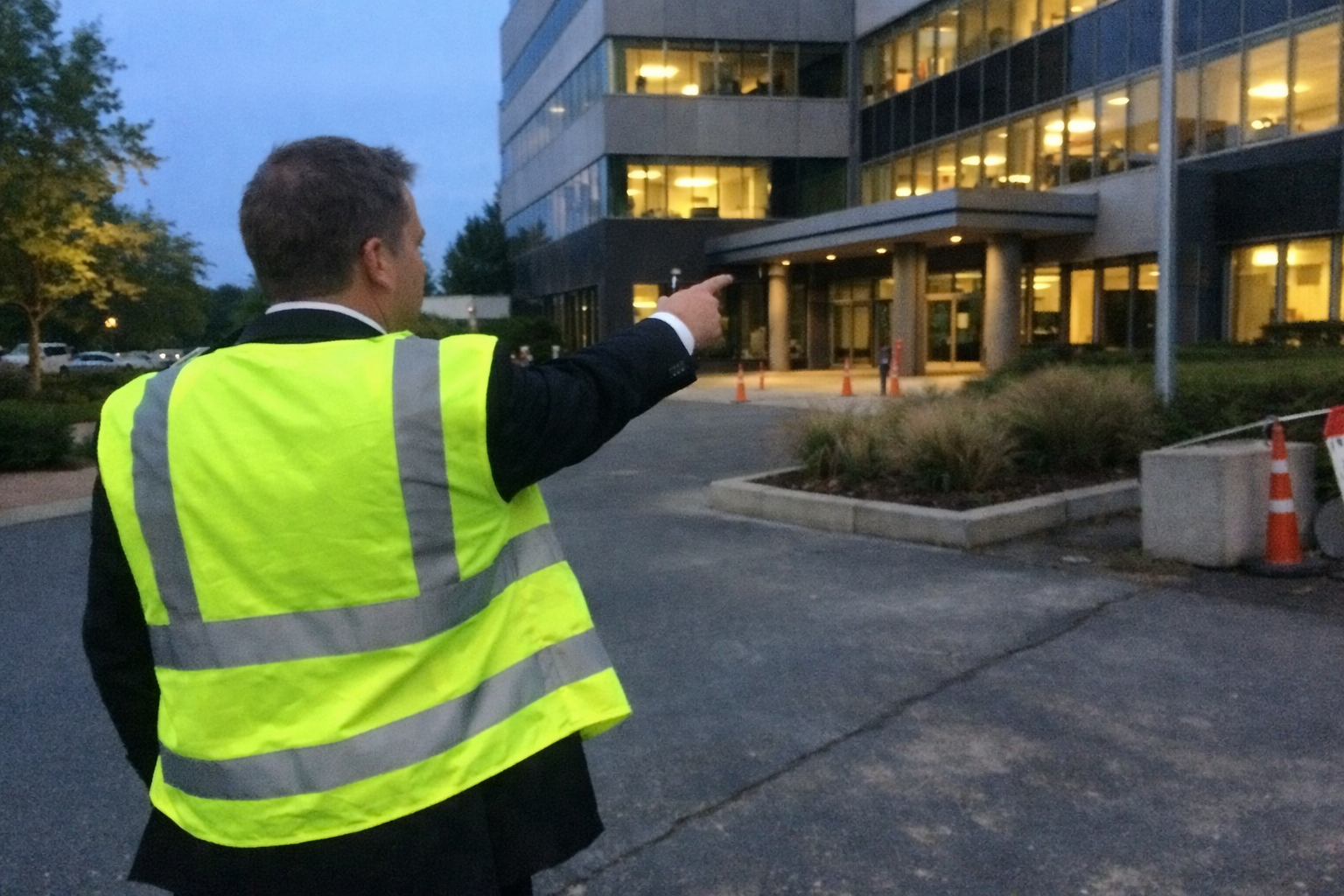
An representative photo of a security officer conducting a site walkthrough outside a corporate office building.
Include Site-Specific Risk and Compliance Requirements
Every premises, be it residential, commercial or high footfall, carries a distinct risk profile. A one-size-fits-all SLA cannot accommodate the legal, operational and reputational stakes involved.
Security risks and compliance responsibilities can vary widely:
- A retail store may require additional customer interaction safeguards and till-point monitoring
- A data centre will prioritise access control and extended vetting
- A residential block might need out-of-hours cover and resident engagement protocols
Legal frameworks also play a role. Environments subject to Martyn’s Law provisions, for instance, must account for public protection measures within their SLAs. Fire safety responsibilities, lone working policies, and emergency evacuation procedures may also need to be folded into the agreement.
Providers such as Double Check Security Group shape SLA content around risk assessments carried out during site onboarding. These allow them to align coverage precisely with context, avoiding generic templates that ignore environmental or legal nuances.
Key elements to include are:
- Risk classification and threat likelihood
- Any mandatory compliance measures
- Site access policies and verification protocols
- Emergency management alignment
- Audit findings or regulatory requirements
Detail Communication and Reporting Protocols
Even strong service delivery can falter if communication is inconsistent. An SLA should act as a blueprint for who communicates what, when and to whom.
Elements that should be clearly defined:
- Reporting cadences, such as daily updates or monthly summaries
- What gets escalated and within what timeframe
- Contact chain in case of incidents or service disruption
- Preferred tools for sharing logs, reports or incident records
- Review meeting frequency and stakeholder attendance
Clear lines of communication prevent delays, reduce friction and make sure that issues are surfaced while still manageable.
Professional suppliers often operate 24/7 control centres with pre-agreed escalation pathways across various incident types. For instance, Double Check Security Group maintains year-round oversight to facilitate continuity and proactive service adjustments.
A well-written SLA integrates communication protocols with reporting disciplines. This structure supports confident decision-making and reduces the risk of misunderstanding, especially in high-stakes or time-sensitive situations.
Pro Tip: Including site-specific risk ratings in the SLA ensures operational alignment and legal defensibility if standards are challenged.

A representative photo of a lone working security guard in a reception area
Specify Training and Vetting Requirements
Security services are only as reliable as the people delivering them. The SLA should lock in the minimum expectations for training, vetting and conduct.
Key components to include:
- Mandatory certifications, such as SIA licensing
- Improved DBS or equivalent background checks
- Site-specific induction training before deployment
- Required knowledge of emergency and escalation procedures
- Behavioural expectations: punctuality, appearance, brand alignment
Long-term professionalism depends on initial qualifications, but also on regular re-briefing and upskilling. Providers should maintain records of continual training cycles and site refreshers, rather than treating induction as a one-time event.
Personnel, particularly those working in public-facing environments like retail or corporate settings, play a visible part in client representation. Leading firms select and train staff with this professional standard in mind. Formal expectations within the SLA remind all parties that service quality starts with individual conduct.
Establish Response Times and Contingency Protocols
Consider an alarm triggered at 2am. How long until someone responds? Who decides whether it is a genuine emergency? What if the assigned guard calls in sick?
Effective SLAs define the actions and timeframes that apply when something goes wrong. Avoid vague expressions like “as needed” or “as soon as possible”. Instead, be specific:
- Maximum alarm response time (e.g. within 20 minutes of activation)
- Backup coverage expectations in the event of staff absence
- On-call supervisor availability during off-hours
- Protocol for escalation to police, fire or medical services
- Temporary coverage plans for planned outages or events
Contingency planning is about incidents. It also accounts for staffing lapses, system failures or public disruptions. A 24-hour control centre, for example, can make the difference between a minor issue and an uncontained risk.
Defining contingency protocols in advance helps clients maintain service continuity while ensuring providers have clear accountability. This clarity becomes important during time-sensitive events when there is no room for delay or improvisation.
Talk to Our Security Advisors
Speak directly with our consultants about building a service agreement that holds up long term.
Define Review, Audit and Improvement Cycles
Even the best-designed SLAs can erode over time if left unchecked. Formal review and improvement cycles provide structure for consistent performance and adaptation.
Key elements to include are:
- Review frequency: typically quarterly or biannually
- Who attends: operational leads, client stakeholders, compliance officers
- Data sources: incident logs, KPI dashboards, client feedback
- Audit scope: procedural compliance, staff conduct, technology usage
- Improvement framework: agreed action plans with timeframes
These cycles are not just opportunities to critique performance. They enable both parties to adjust coverage requirements, respond to new risks or address seasonal variations. They also contribute to continuous improvement, a central feature of ISO 9001 service management.
Providers with structured operational governance, such as Double Check Security Group, already embed these cycles into account management. Doing so creates accountability, pre-emptively addresses drift and reinforces long-term service quality.
Putting these periodic reviews into the SLA ensures that standards are never left to assumption. Instead, they remain visible, trackable and subject to joint oversight.