Key points
- Direct hiring gives you full control, while contracted security gives flexibility and cover.
- Contracted guards can start quickly but need time to learn your site.
- Liability and insurance sit differently in each model.
- A hybrid approach can give you the best of both.
What are the pros and cons of direct hiring compared to contracted security services?
Choosing between managing an in-house security team or relying on a private security firm involves key trade-offs in oversight, financial planning, and operational control. The right model depends on factors like your site’s complexity, how access control is handled, and the level of liability risk your organisation can manage. Each choice shapes threat deterrence, cost structure, and accountability.
What Do We Cover In This Article?

What are the two hiring models?
Direct Hire Security Teams
Direct hiring means your organisation controls every stage of employment, from recruitment and training to scheduling and oversight. It is best suited for environments that need consistency and site-specific knowledge.
Pros:
Guards are more familiar with your site and team
You manage training standards and daily expectations
Easier to build a culture-aligned security team
Cons:
Internal teams require more HR and payroll resources
Scaling or covering shifts can be slow
All legal and operational risks fall on the business
Contracted Security Services
A private security firm provides trained personnel and manages staffing. This model offers fast deployment and reduced admin burden, ideal for businesses needing agility.
Pros:
Guards are ready to deploy quickly
The firm handles recruitment and scheduling
Costs are easier to estimate for budgeting
Cons:
Guards may rotate frequently and lack site familiarity
Oversight is limited to contract terms
Less flexibility to adjust personnel mid-contract
Hybrid Models and Contract-to-Hire
This approach begins with agency guards, often provided through a security staffing agency, and gradually transitions the best performers to permanent roles. It balances flexibility and long term fit.

Pro Tip : A hybrid model offers the best of both worlds but needs clear transition plans to succeed long term.

How do training and retention compare?
Deployment and Familiarity
Agency guards can arrive quickly but often take time to learn routines. In contrast, in-house guards are more likely to stay and develop a deep understanding of your environment. Familiarity with the internal training manual and shift handover protocol reduces risk and confusion.
Guard Morale and Turnover
In-house teams often benefit from stronger morale and lower turnover due to better integration and consistent benefits. Agencies may swap guards frequently, affecting continuity. Site loyalty in security staffing depends heavily on guard morale, access to benefits, and supervisor consistency.
Training Consistency
Direct hires can follow your own internal manual and expectations, while contracted guards may rely on firm-provided general training that may not match your protocols. This can lead to inconsistency in equipment allocation and policy enforcement.

How do the costs compare?
Cost Breakdown and Hidden Fees
Direct hire involves upfront investment but can be more cost-effective over time. Outsourced models may seem cheaper but often come with added charges for coverage gaps or urgent needs, and may lead to benefit mismatch or hidden overhead from agency markups.
What to Include in a Yearly Cost Comparison
Scenario: One 24/7 Security Post (Three Full-Time Equivalents)
Direct Hire: wages, employer National Insurance, holiday and sick cover, pension, training, onboarding and HR admin, plus the cost of covering absence
Contracted: the firm’s charge covers staff costs, supervision, absence cover and a management fee
Hybrid: a mix of agency and internal staff, so both sets of costs apply
Weighing up in-house or contracted security?
Talk to us about how contracted guarding would work on your site.
What are the legal and insurance differences?
Who Carries the Liability?
For in-house teams, the employer takes on all legal and insurance responsibilities. Contracted providers may absorb some liability, but only if specified in the agreement, such as under a vendor agreement with subcontractor coverage.
Must-Have Legal Safeguards
Every security contract should spell out SLA terms, insurance coverage, indemnification, and backup guard arrangements. These protect you if things go wrong. Include a contract renewal review schedule to ensure terms remain aligned with business needs.
Pro Tip : Guard turnover often reflects deeper issues in morale or misaligned benefits. Track patterns quarterly.
How do you vet and manage a security provider?
Key Evaluation Criteria
Evaluate firms by their guard turnover rates, background screening, response procedures, and on-site accountability. Request specific performance data during the tendering process. Ensure you use a complete RFP checklist and compare guard service models to fit your goals.
Monitoring and Management
Log all performance data, gather feedback from site supervisors, and ensure your vendor allows replacement or penalty options for underperformance. Your loss prevention manager should maintain regular audit logs and oversee SLA compliance.
Can you combine both approaches?
Contract-to-Hire in Practice
Begin with a short-term contract. Monitor guard consistency, adaptability, and attitude. Transition the strongest performers to permanent roles through structured onboarding. A clear guard absorption plan ensures smoother transitions.
Culture Fit and HR Integration
Use feedback loops and shared scoring methods to integrate new hires. Provide support during the transition to encourage loyalty and reduce retraining needs. Align onboarding with HR integration procedures and talent pipeline management.

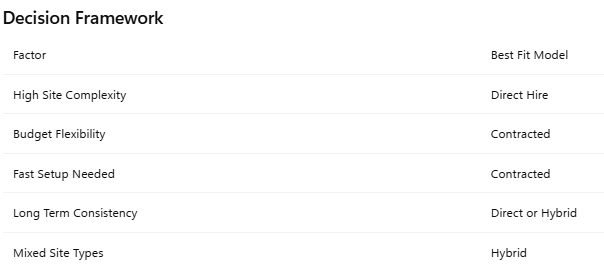
How do you choose the right model?
Key Red Flags
- Unclear performance terms
- Vague or missing insurance coverage
- No process to remove underperforming guards
- High turnover without a mitigation plan
Final Note: Let your operational needs and internal capabilities guide your choice. A collaborative decision, backed by your corporate security director, can help ensure a reliable and cost-effective solution.