How do security guards manage queues and crowds during sales events?
Security guards manage queues and crowds at sales events by combining structured crowd control techniques with real-time behavioural monitoring. Their presence prevents disorder, supports customer flow and ensures event safety through early intervention, coordination and access control.
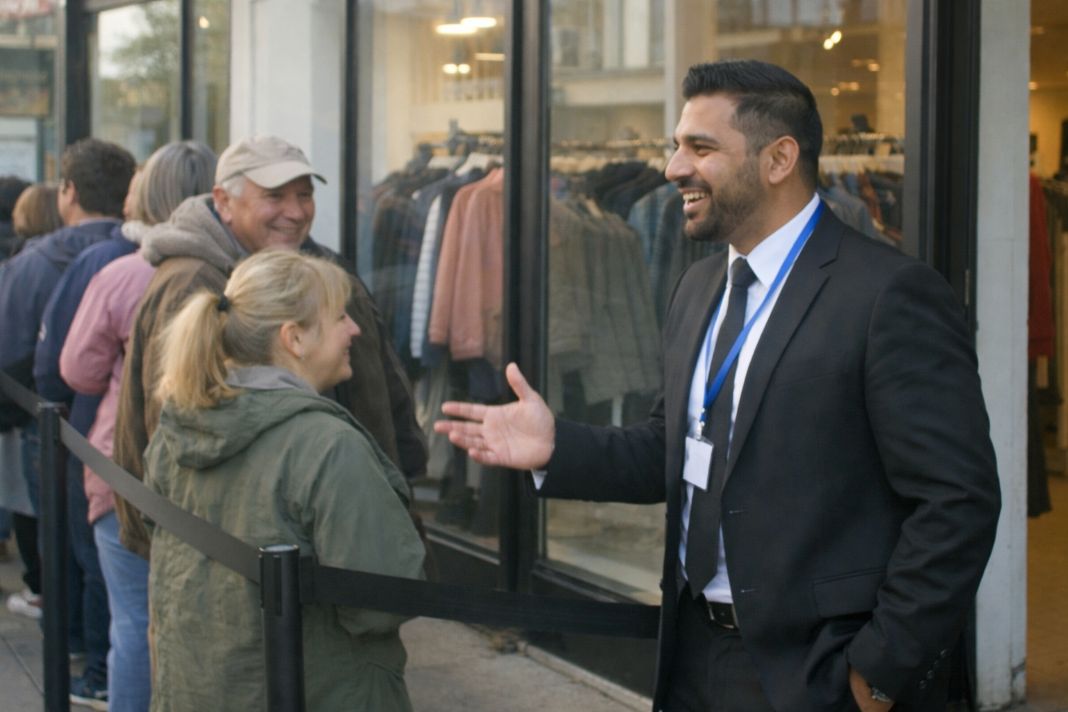
A respresentative image of a security officer managing a queue at a retail clothing store
What Do We Cover In This Article?
Knowing the Crowd Dynamics of Sales Events
Sales events, particularly those promised as limited-time or exclusive, often induce customer behaviours far removed from a standard trading day. Anticipation and urgency shift passive shopping into assertive activity, increasing pressure on entry points, customer interaction and in-store movement.
Several patterns tend to emerge:
- Crowd surges occur at store opening, especially where stock is limited or heavily discounted. Small delays or confusion at entry can cause sudden pressure on doors and staff.
- Queue tension builds when waiting times appear unfair or poorly communicated. Line-cutting remains a regular flashpoint, especially in longer outdoor queues.
- Impatience with control measures such as bag checks or staggered access can escalate quickly without proper signage and verbal guidance.
- Customer assumptions around entitlement or urgency can lead to disputes, particularly if expectations have not been clearly set in pre-event materials.
Knowledge of these behaviours informs not just how guards respond in the moment, but how entry, staffing and communications are structured well before customers arrive.
Pro Tip: Positioning a calm, attentive guard near the start of the queue subtly influences customer tone and patience throughout the line.
Strengthen Your Queue Management Plans
Discover how our experienced teams support orderly and safe customer flows during high-footfall periods.
Queue Management as a Frontline Security Function
Queue management sits at the core of retail event security. It does not simply maintain order; it shapes the entire customer experience from first contact. Guards manage physical lines, spacing and movement, but also set the tone for calm, predictable progression.
Effective queue control includes several elements:
- Visible security presence discourages queue jumping and supports adherence to entry procedures.
- Physical infrastructure such as belt barriers and signage provides structure and removes ambiguity about direction or order of service.
- Consistent, polite verbal directions help de-escalate frustration and reassure customers.
- Adaptability to setting is key. Outdoor queues may require shelter provisions and active re-routing, while indoor layouts demand attention to aisle clearance and proximity to stock areas.
Poorly managed queues often contribute to surges, bottlenecks and disputes. A steady, well-structured queue protocol demonstrates that the event is under control, reducing the likelihood of aggressive behaviour.
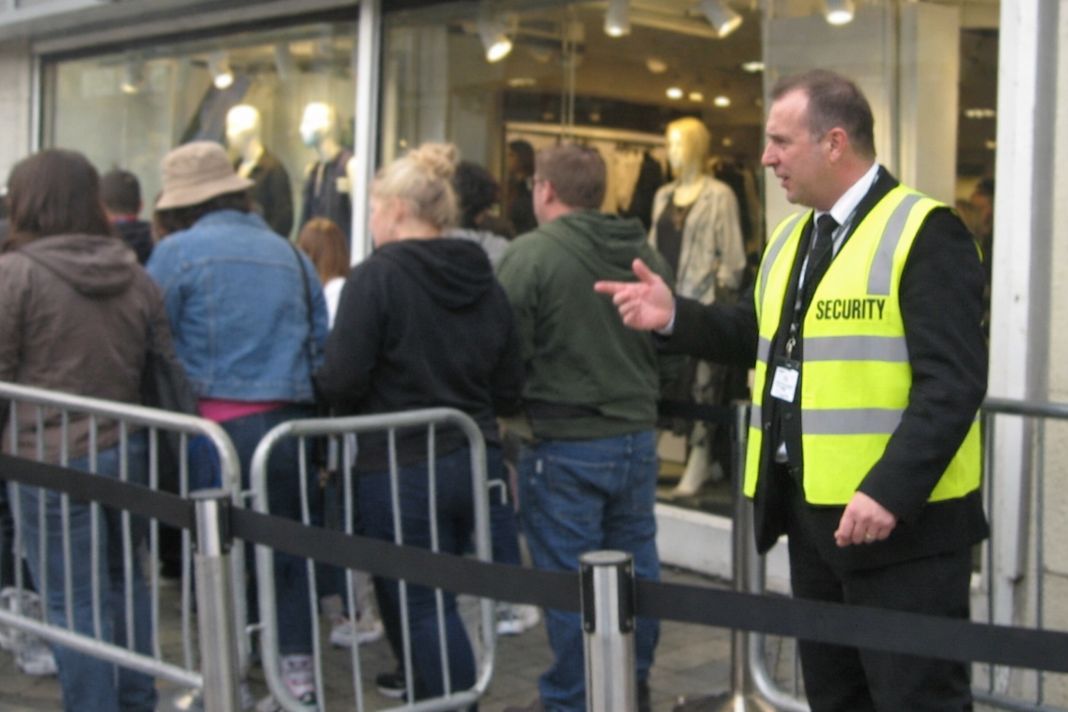
A representative image of an outdoor queue outside a clothing store with barriers and a visible staff member
Preventing Escalation Through Early Intervention
A security guard’s ability to identify rising tension and act before it escalates defines effective crowd safety. Successful intervention often happens long before most customers notice an issue.
Typical triggers include:
- Raised voices or pointed body language between customers
- Someone repeatedly stepping out of queue or attempting to bypass lines
- Shift in crowd mood, such as audible complaints spreading in one area
- Focused attention on a particular staff decision or product location
The techniques guards use in these moments are subtle but firm:
- Proximity and presence without direct confrontation can remind individuals they are being observed.
- Light, confident verbal redirection restructures behaviour without causing embarrassment.
- Supportive body positioning, such as standing between parties or near perceived flashpoints, can defuse rising energy.
- Calm tone and steady messaging protect the broader crowd mood.
Handled early, these moments dissolve without incident. Left unmanaged, they can ripple across the space and compromise the entire event flow.
Pro Tip: Integrating guard radios with store staff channels prevents communication gaps during surge and incident response.
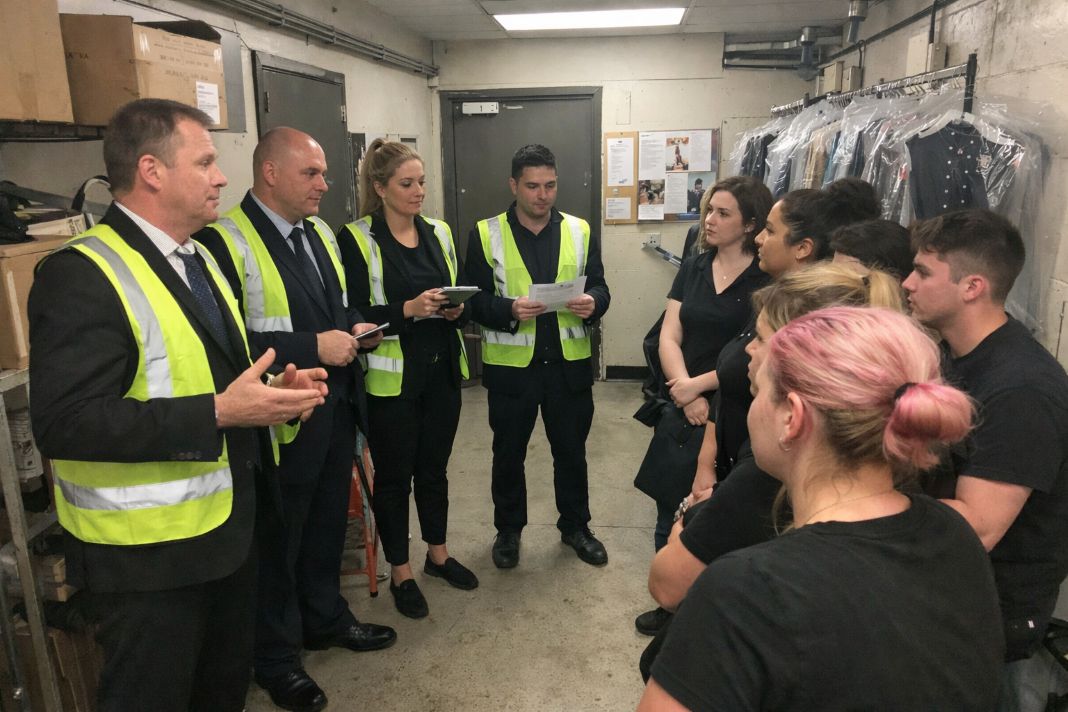
A representative image of a small team in black suits and reflective vests holding a briefing with clothing store staff in a back corridor
Coordinating with Retail and Facilities Teams
Security is most effective when embedded within a wider team effort. Sales event planning must integrate security, store staff and facilities teams from the outset, not bolt coordination on once doors open.
Key coordination practices include:
- Pre-event briefings that clarify entry strategies, responsibility lines and emergency protocols
- Shared radio communications to streamline responses and reduce double-handling
- Defined escalation routes, so that difficult interactions move to the appropriate staff member swiftly
- Mutual task clarity to prevent confusion over who manages which areas or customer issues
For example, in a store managing high volume over a weekend sale, entry control may be led by security, while promotional product availability is handled by in-house staff. Their combined movements must be aligned to avoid customers receiving conflicting information.
Speak with a Retail Security Specialist
Learn how tailored crowd control solutions can protect your retail events from disruption and risk.
Managing Entry and Exit Points Safely
Access control is not just a customer convenience. It is a safety measure. Entry and exit points regulate crowd flow and prevent pressure from building inside the venue.
Several practices support safe access management:
- Staggered entry: Allowing timed arrival slots limits surges. Customers understand when their access window begins.
- Physical barriers: These prevent lateral crowd movement and make movement predictable.
- Guarded exits: Prevent reverse flows and maintain compliance with fire and safety regulations.
- Capacity monitoring: Guards tally entrants to ensure occupancy stays within legal and safe limits.
- Clear signage: Exit-only doors should be marked obviously to reduce crowd drift toward incorrect points.
Neglecting these controls leads to confusion, haphazard movement and increased risk. Guards must stay alert, particularly during peak times, to ensure these systems remain functional under live conditions.
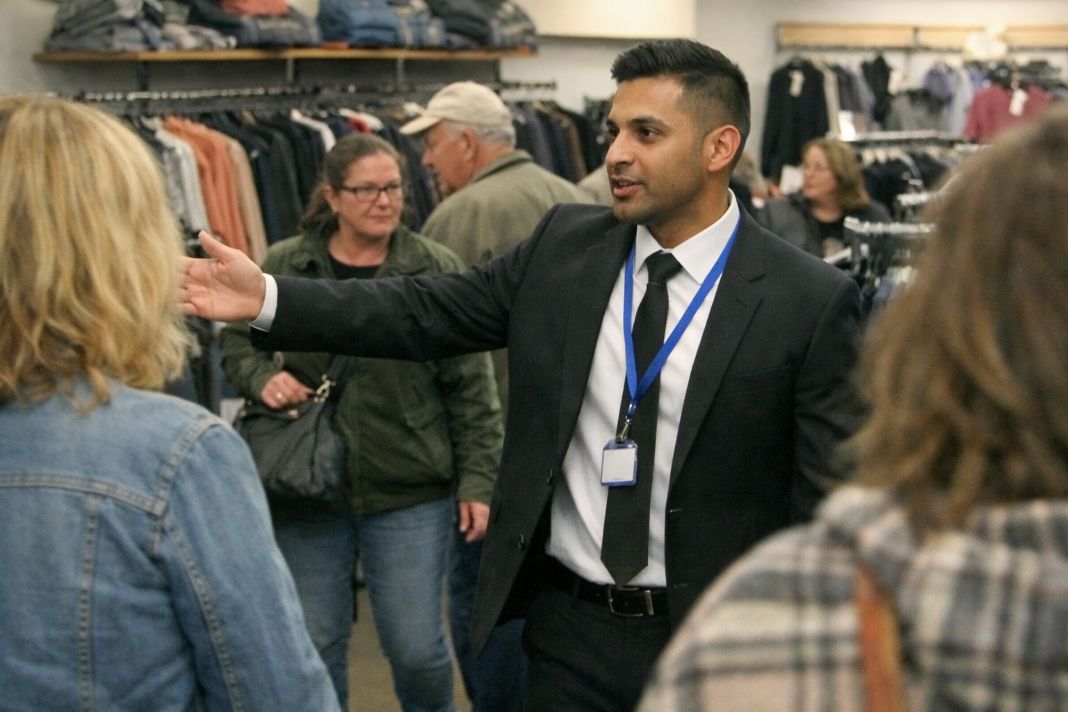
A representative image of security guiding people through a narrow indoor retail clothing aisle ensuring safe spacing
Supporting Emergency Preparedness and Incident Response
Sales events bring higher footfall, and with it comes increased risk of incidents unrelated to customer behaviour. Medical situations, fire alarms or unplanned disruptions all require calm, organised response from those on the ground.
Security guards are trained to:
- Activate site-specific emergency protocols immediately, including clearing zones or supporting evacuation
- Guide emergency services through crowded or obstructed areas to reach those in need
- Redirect crowds away from affected areas while avoiding panic or confusion
- Use radios, alarms and signage to support coordinated evacuation if required
- Participate in drills that simulate likely scenarios under high-occupancy conditions
Such actions are only effective if guards have been briefed in advance and those around them understand their role. Calm, firm control in these moments protects both lives and reputation.
The Value of Professionalism and Visibility
Customers often take cues from what and who they see at store entrances. A known security presence communicates preparedness, reassurance and fairness. This goes beyond uniform alone. It includes tone, conduct and consistency.
At a luxury retail event, for instance, staff from Double Check Security Group are routinely positioned to align with brand expectations. Their posture, verbal delivery and cohesive appearance reinforce the store’s attention to detail and customer safety.
This visible professionalism influences behaviour. It deters line-cutting, tempers aggressive language and builds confidence in the environment. Importantly, it also minimises the need for actual intervention by discouraging disorder at the outset.
Well-presented guards become a visible assurance that the venue is both secure and respectful of its customers’ experience. For facilities managers and operational leads, ensuring this level of visibility is not an aesthetic concern. It is operational strategy.