What should you do if a security guard on your site is not performing?
You should identify the problem early, assess the reason behind it, document specific concerns, and address it through a structured feedback process. If the issue continues, follow formal escalation procedures and review whether wider site processes or provider management are contributing to the problem.
A security guard who is not performing can create operational gaps long before a serious incident occurs. Missed patrols, weak incident reporting, poor punctuality, or visible disengagement can affect safety, tenant confidence, staff morale, and the credibility of the site team.

A representative image of a contracts manager and two security officers have a discussion
What Do We Cover In This Article?
Recognising the signs of underperformance
Underperformance in a security role usually shows up in observable behaviour, not vague impressions. A facilities manager or site lead should focus on patterns that can be seen, logged, and checked against expected duties.
Common signs of poor security include:
- repeated lateness for shifts or handovers
- missed patrols or incomplete patrol schedules
- poor incident reporting, including missing details or delayed entries
- lack of vigilance at access points, CCTV stations, or during routine rounds
- disengagement with staff, visitors, or site procedures
- failure to follow assignment instructions or escalation routes
- inconsistent appearance or conduct where standards are clearly set
One missed patrol does not always mean an underperforming security guard. A single error may relate to an unusual incident, unclear instructions, or a change in site priorities. Ongoing problems are different, especially where incident logs, supervisor notes, or shift records point to the same issue more than once.
Misconceptions can make early signs easy to dismiss. Quiet periods do not reduce the need for vigilance, and a familiar site does not remove the need for proper reporting. Security work often appears uneventful from the outside, yet the standard still depends on attention, presence, and reliable execution.
SIA licensing confirms legal eligibility to perform certain roles, although it does not remove the need for site supervision, ongoing monitoring, or role-specific standards. That is why local oversight matters. Site supervisors and managers usually spot decline first through day-to-day operational detail, including incomplete logs or unusual gaps in patrol timing.
Pro Tip: Audit your site’s induction and supervision processes if multiple guards struggle, as wider operational changes may be needed.
Assessing the root causes
Once concerns appear, the next step is diagnosis. A poor shift should not trigger an immediate assumption that the individual is careless or unsuitable.
Several different causes can sit behind the same outward problem. Missed patrols, for example, might relate to fatigue, poor induction, unrealistic patrol expectations, confusion about site priorities, or weak supervision. A guard who seems disengaged may be dealing with unclear instructions, an unresolved conflict on site, or a post that offers too little support for a lone worker.
Capability and motivation are part of the picture, although they are not the whole picture. Managers should also consider:
- whether the guard received a proper site induction
- whether training records show gaps in site-specific instruction
- whether operational procedures are clear and up to date
- whether communication between site management, the provider, and the officer has broken down
- whether site-specific risks have changed without duties being adjusted
Another factor is role fit. Some posts demand detailed report writing, calm visitor handling, and strong front-of-house communication. Others place more weight on perimeter patrols, alarm response, or access control discipline. A guard may hold the right licence and still struggle if the post demands skills that were never properly assessed or supported.
Pressure from the site itself can also affect performance. If staffing levels are too lean, handovers are rushed, and patrol routes are unrealistic for the time allowed, underperformance may reflect a flawed operating model rather than a single employee issue. HR, site management, and operational leads all have a role in testing that possibility before moving further.
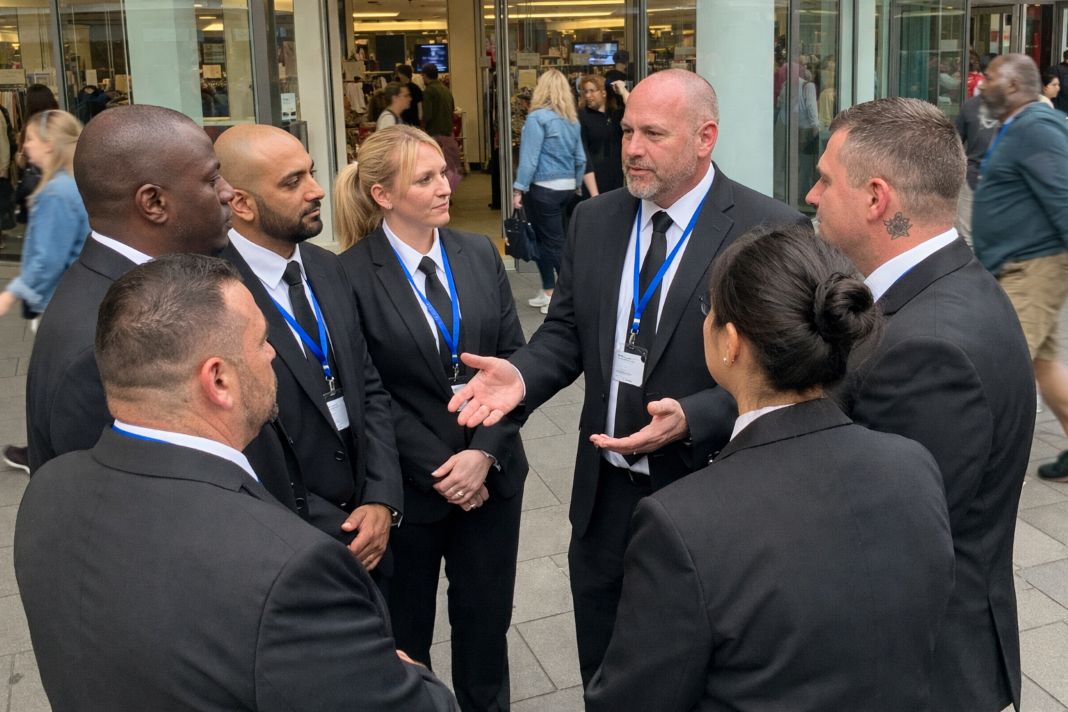
A representative image of a security briefing taking place outside of a shopping centre
Documenting performance concerns
Good documentation protects everyone involved. It creates a fair record of what happened, when it happened, and how the issue was addressed.
Subjective language weakens the process. A note stating that a guard was “lazy” or “uninterested” says very little and may create unnecessary dispute. A record stating that the officer failed to complete the 18:00 and 20:00 patrols on two dates, with no entry in the incident report and no explanation given at handover, is much more useful.
A simple approach usually works best:
- Record the date, time, location, and specific behaviour or omission.
- Link the concern to the relevant assignment instruction, HR policy, or operational procedure.
- Note any immediate impact on the site, such as delayed access control checks or incomplete incident logs.
- Record what was done at the time, including any instruction, support, or supervisory follow-up.
- Keep all records factual, contemporaneous, and free from emotional language.
Documentation should include both concerns and responses. If a manager gave extra guidance, arranged refresher training, or adjusted duties after a feedback meeting, that should also be recorded. Balanced records are more credible than files that contain only faults.
Employment law, HR policies, and SIA standards all point in the same general direction here. Organisations should rely on clear evidence, consistent process, and an audit trail that can be reviewed later if the matter becomes formal. Incident reports, performance logs, and written warnings each have their place, although they should sit within a fair process rather than replace one.
Pro Tip: When documenting security guard issues, include precise times, behaviours, and impacts rather than general comments.
Addressing issues through structured feedback
A constructive conversation should happen early, in private, and with a clear purpose. The aim is to correct performance, confirm expectations, and give the guard a fair opportunity to improve.
An effective feedback meeting usually follows a straightforward sequence:
- Set out the concern using specific examples from patrol records, reports, or supervisor observations.
- Explain the expected standard for the role, referring to assignment instructions, performance review templates, or site procedures.
- Invite the guard to explain any practical issues, gaps in training, or obstacles affecting performance.
- Agree an action plan with measurable points, such as punctual attendance, complete incident reporting, or full patrol completion.
- Set an improvement timeline and confirm when progress will be reviewed.
Tone matters here. A confrontational discussion can push the guard into defensiveness, which makes the real issue harder to fix. Respectful, direct language usually produces better information and a stronger basis for improvement.
Support should be practical rather than vague. A line manager might arrange refresher training, shadowing on a complex site, clearer handover notes, or temporary closer supervision. If the issue relates to report writing, the support should address report writing. If the issue relates to patrol discipline, the action plan should focus on patrol completion and verification.
The SIA Code of Conduct and internal HR protocols both support an approach based on professionalism, fairness, and accountability. Feedback should never feel like an ambush. It should feel like a documented performance conversation with a clear route forward.
Talk to a Security Specialist
Connect with our experienced team to discuss tailored security solutions for your site.
Escalating the issue: when further action is needed
Escalation becomes appropriate when informal action has been tried and the problem continues, or when the performance issue is serious enough to justify immediate formal review. Repeated missed duties, serious reporting failures, or behaviour that creates a direct site risk will usually require a higher level of response.
The escalation path should follow established lines. Site management may raise concerns first with the supervisor or contract manager. If the guard is supplied by an external provider, the service provider should be notified through the agreed reporting route. HR involvement may be necessary where formal warnings, reassignment, or disciplinary procedures are being considered.
A structured process often looks like this:
- Confirm that the concern has been documented clearly.
- Check that previous feedback, training, or support measures were recorded.
- Notify the relevant supervisor, contract manager, or provider contact.
- Review contractual obligations, including service level agreements and reporting terms.
- Move into formal performance management if improvement has not followed.
Escalation should not be treated as a personal conflict. It is an operational and employment process, with fairness and due process at its centre. If the guard is employed by a contractor, site leaders should avoid bypassing the provider’s procedures unless there is an immediate safety issue that requires urgent intervention.
In practice, a structured provider will usually have a clear route for this. An organisation such as Double Check Security Group, for example, would normally involve operational management, site review, documented feedback, and formal HR processes where required, rather than relying on ad hoc decisions or verbal complaints.

A representative image of security officers completing a staff induction
Reviewing site processes and provider performance
Persistent security guard issues sometimes point to a wider weakness in the service model. Looking only at the individual can miss the source of the problem.
A broader review may cover induction quality, site supervision, assignment instructions, patrol verification methods, and the frequency of management visits. If more than one officer has struggled on the same site, the post itself may need attention. A weak handover process, unclear emergency procedures, or unrealistic expectations can produce avoidable errors even with experienced staff.
Key areas worth reviewing include:
- induction content and whether site-specific risks are properly covered
- frequency of audits, spot checks, and supervisor visits
- quality of communication between site management teams and service providers
- contract reviews, including whether the scope still matches the site’s needs
- compliance checks linked to licensing, training, and post instructions
Provider accountability matters as much as individual accountability. A contractor should be able to explain how officers are briefed, supervised, performance-monitored, and supported over time. SIA Approved Contractor Scheme accreditation may indicate a commitment to managed standards, although site-level execution still needs active review by the client and provider together.
Regular audits can reveal useful patterns. A post with frequent report-writing errors may need better templates or clearer expectations. A site with recurring lateness might have a scheduling or handover problem rather than a conduct problem. Those distinctions are easier to see during a proper process audit than in a single complaint email.
Request a Site Security Review
Ensure your site’s security measures and staff performance meet your operational needs. Arrange a confidential site review by our specialists
Preventing future performance issues
Prevention depends on clarity, consistency, and regular oversight. Sites that set expectations early and review them often are usually in a stronger position than sites that wait for a visible failure.
Practical steps include clear onboarding, up-to-date staff handbooks, refresher training, regular supervisor contact, and routine performance monitoring against agreed duties. Managers should also make room for ordinary feedback, not just corrective conversations after something has gone wrong.
A healthy performance culture in security work usually includes prompt reporting, realistic patrol schedules, role-specific instruction, and support that matches the post. One site may need stronger front-of-house standards. Another may need tighter incident logging and access control discipline. Ongoing training works best when it reflects those real site demands rather than generic material.
Security staff perform better where the role is treated as an active function, with professional standards that are checked and reinforced over time. That approach reduces avoidable gaps, gives managers better visibility, and keeps the focus where it belongs, on a site that is properly watched, properly recorded, and properly run.