

How can you protect a 24-hour warehouse without paying for more security than you need?
A warehouse that runs day and night needs security that matches its actual risks, staffing patterns and operating hours. The most cost-effective approach starts with a proper warehouse security assessment, then combines the right level of guarding, technology, staff awareness and regular review. Spending more does not automatically create better protection. Spending with precision usually does.
What Do We Cover In This Article?
Understanding 24-hour warehouse security risks
A warehouse with continuous operations faces a different pattern of risk from one that closes each evening. Activity never fully stops, which means that access points stay in use for longer, shift handovers create moments of reduced attention, and lone working may occur in quieter parts of the site. Round-the-clock protection has to support movement, deliveries and safety without slowing the operation itself.
Night-time is often treated as the main concern, yet many incidents happen during ordinary working hours. Day shifts can bring frequent visitors, open loading areas, busy yards and a larger number of people moving through shared spaces. Quiet overnight periods may increase the chance of unauthorised entry, but busy daytime periods can create operational blind spots that are just as significant.
Consider a typical 24/7 site over one full day. Early morning may involve agency staff arriving, lorries queuing and doors opening in quick succession. Midday can bring contractors, missed sign-ins and pressure to keep goods moving. During the late shift, fewer supervisors may be present, and a poor handover can leave one team assuming another has already checked a gate, an alarm panel or a restricted area.
Common risk points often include:
- access points that stay open longer than expected
- shift handovers where accountability is unclear
- lone working in isolated aisles, yards or plant areas
- unauthorised entry through delivery zones or side doors
- gaps between health and safety duties and site security routines
Health and Safety Executive guidance, SIA requirements for licensed operatives and insurance conditions all shape how these risks should be viewed. Security in a 24/7 warehouse is tied closely to safety, supervision and site discipline, particularly where high-value stock, vehicle movements or restricted goods are involved.
Assessing security needs without overcommitting resources
The fastest way to overspend is to buy a generic security package before examining how the site actually works. Right-sizing security depends on a site-specific review of stock value, building layout, staffing levels, opening patterns, incident history and insurance guidelines. A proper security audit should test assumptions, not confirm them.
Some warehouses are under-protected because managers focus only on perimeter risk and ignore internal vulnerabilities. Others are over-protected in the wrong places, such as paying for permanent guarding on a low-risk entrance while leaving weak stock controls in dispatch areas. Cost-effective security planning starts by identifying where loss, disruption or unsafe access would do the most damage.
A practical assessment process usually covers three points:
- Map the site by risk, including gates, loading bays, pedestrian access, storage zones and blind spots.
- Review how the warehouse operates by shift, including staffing levels, handovers, visitor movements and periods of reduced supervision.
- Compare current controls against compliance checks, incident history and insurance requirements.
Periodic reviews matter because warehouse risk changes over time. A new client contract, higher stock turnover, seasonal staffing or altered delivery schedules can all shift the level of exposure. Firms that follow structured audit processes, including those aligned with ISO 9001, often treat this review as an operational discipline rather than a one-off document exercise.
In practice, a provider such as Double Check Security Group would usually examine both visible and hidden pressures on a site, including how security duties interact with daily warehouse routines, before proposing staffing or system changes. That kind of measured assessment is often where unnecessary cost gets stripped out.
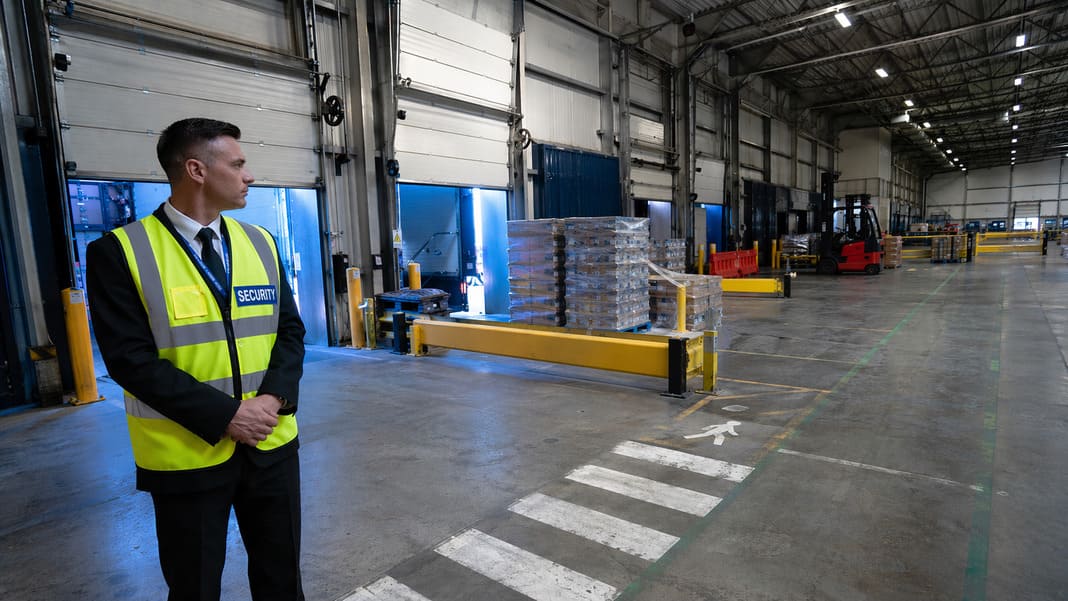
Warehouse Security Guarding Services On An Industrial Warehouse Floor – sample image
Using technology for efficient 24-hour coverage
Technology can extend coverage across long operating hours without placing a person in every corner of the site. CCTV monitoring, access control systems and alarm monitoring are often the backbone of warehouse security technology because they record activity, limit entry and alert teams to problems outside direct line of sight.
A simple comparison shows where technology adds value:
| Security measure | Best use | Main limitation |
|---|---|---|
| CCTV systems | Monitoring loading bays, yards, corridors and entrances | Cameras still need positioning, review and maintenance |
| Access control | Restricting who enters doors, zones and out-of-hours areas | Permissions must be kept current |
| Alarm systems | Alerting teams to intrusion or unauthorised opening | False alarms can waste time if settings are poor |
| On-site guarding | Responding, checking and intervening in real time | Labour costs rise if deployment is too broad |
Remote monitoring can reduce the need for constant on-site presence in lower-risk periods, especially across external areas or quiet internal zones. Incidentally, remote coverage works best when escalation routes are clear. An alert has little value if nobody knows who attends, how quickly they respond or what happens if a door is forced outside normal dispatch hours.
System integration is where many sites gain efficiency. Access control logs can be checked against CCTV footage. Alarm activations can be linked to remote monitoring. Entry permissions can be adjusted for shift patterns or contractor access windows. Joined-up systems usually provide stronger evidence trails as well, which may support insurance queries or internal investigations.
Technology on its own is still not enough. Cameras do not challenge tailgating, and alarms do not manage a confused shift handover. Maintenance schedules also matter. A camera with poor night coverage, a door reader with inconsistent permissions or repeated false alarms can leave a warehouse with the cost of a security system but little practical benefit.
Optimising security guarding for 24/7 operations
Guarding works best when it follows the warehouse rhythm instead of fighting it. A common overspend appears when sites add people to every shift without asking where attention is genuinely needed. Efficient security shifts rely on coverage at pressure points such as opening periods, dispatch peaks, visitor arrival windows and overnight patrol times.
Scheduling should account for fatigue as well as headcount. Twelve-hour patterns may look efficient on paper, yet concentration can drop if the role involves repeated patrols, gate checks, report writing and lone worker monitoring. Shorter overlap periods at handover can be more effective than broad duplication across whole shifts, particularly when duties are clearly split.
Key points for warehouse guard scheduling include:
- Define each post by purpose, such as gate control, patrol, control room support or loading bay oversight.
- Match staffing levels to operational peaks instead of keeping the same rota all day.
- Build formal handover protocols into each shift, including outstanding incidents, access issues and temporary permissions.
- Review lone worker policies for both guards and warehouse staff working in quieter zones.
- Include site supervision, spot checks and refresher training so that standards hold over time.
Training and induction should reflect the site, not just the licence requirement. SIA licensing matters, but an effective warehouse guard also needs to understand traffic routes, fire procedures, restricted stock areas, incident reporting and the difference between normal night activity and suspicious movement. Once those practical details are built into the role, guarding becomes more precise.
Some operators also use rota management tools to track attendance, shift coverage and overtime patterns. That does not replace supervision, though it can reveal where overstaffing or poor planning is increasing cost. Double Check Security Group is one example of a provider that places emphasis on site visits and operational oversight, which is often what keeps a rota efficient after the initial plan has been written.
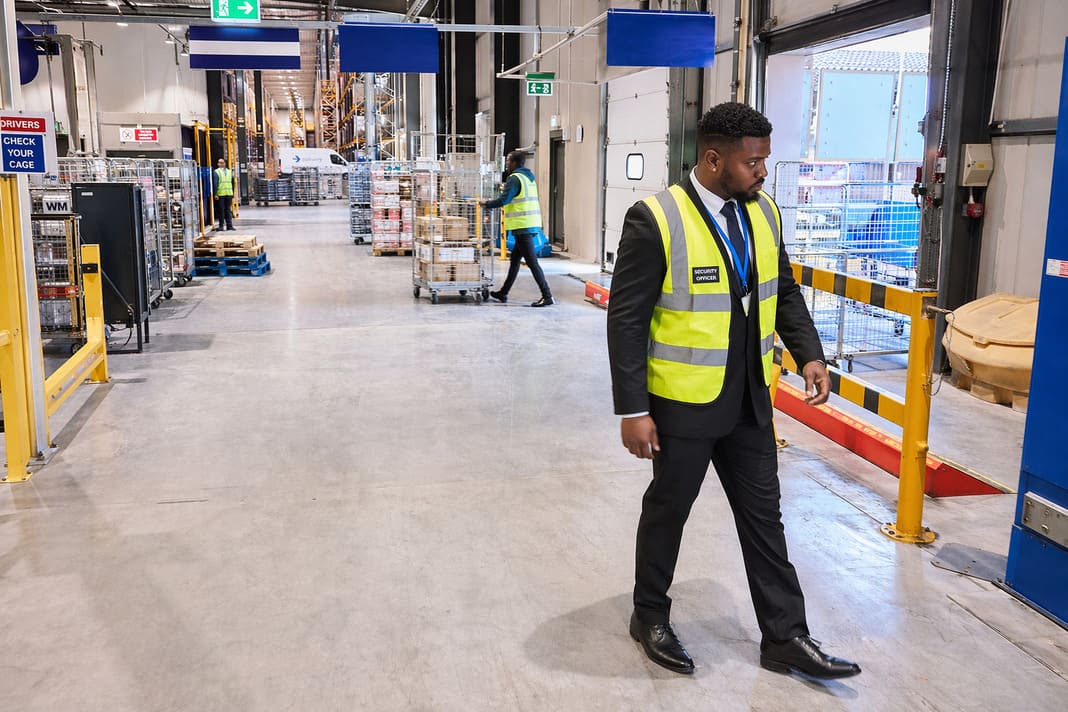
Warehouse Security Services On An Industrial Warehouse Floor – sample image
Integrating facilities management and security
Warehouses often treat security, cleaning and building management as separate functions, even though the day-to-day tasks overlap. A propped fire door, poor yard lighting, missed waste collection or blocked corridor can become a security issue as quickly as a facilities issue. Integrated facilities management can reduce duplication where the site has enough challenge to justify a joined-up approach.
Take a simple overnight example. A cleaner notices that a side entrance is no longer closing properly after a delivery trolley has clipped the frame. If reporting lines are fragmented, that information may sit with one contractor while security remains unaware. In a combined services model, the fault, the access risk and the repair route are more likely to be handled within one process.
Overlap commonly appears in these areas:
- building management and door security
- cleaning schedules and access to restricted areas
- lighting, visibility and safe patrol routes
- compliance audits across health, safety and site control
- contractor attendance, sign-in records and out-of-hours access
This approach is not right for every warehouse. Smaller sites with limited traffic may prefer specialist providers with clear boundaries. Larger operations, mixed-use premises or multi-tenant buildings often gain more from integration because audit trails, responsibilities and reporting lines are easier to follow. Standards linked to SIA requirements, ISO 9001 processes and, where relevant, British Institute of Cleaning Science practice can support that consistency.
Building a culture of security awareness among staff
A 24-hour warehouse depends on staff vigilance as much as systems and guards. Security lapses often begin with ordinary habits: doors left unsecured during busy loading periods, unfamiliar faces waved through, badges shared for convenience, or minor incidents left unreported because the shift is under pressure.
Good security awareness training keeps those habits visible. It also reduces the idea that security belongs only to the person on the gate. Warehouse teams, supervisors, agency workers, cleaners and drivers all influence how secure the site feels in practice.
Useful behaviours to reinforce include:
- challenging unknown visitors through the correct reporting route
- following sign-in and access procedures even during busy periods
- reporting damaged locks, doors, fencing or lighting promptly
- logging suspicious activity, near misses and irregular stock movement
- paying close attention during handovers, especially after long shifts
Induction matters, but refresher briefings matter too. Staff turnover, seasonal pressure and fatigue can erode standards if security messages appear only in a one-off training session. HSE expectations around safe systems of work sit close to this issue, particularly where lone working, vehicle movements or restricted areas are involved.
A stronger security culture usually looks ordinary from the outside. People report issues early, supervisors take concerns seriously, and temporary shortcuts are less likely to become permanent habits.
Regular review, audit, and continuous improvement
A set-and-forget approach usually leads to drift. Access permissions stay active after roles change. Cameras end up covering old traffic patterns. Incident logs build up without anyone checking whether the same door, bay or process keeps appearing. Warehouse security review should be routine, because the operation itself never stands still.
A useful audit cycle is straightforward. Start with incident logs and performance reviews. Compare those records against current controls, staffing patterns and compliance updates. Then adjust the plan, brief the people affected and review the impact after an agreed period.
Picture a warehouse that records repeated false alarms from one dispatch door during the early hours. An audit might show that the alarm is not the real problem. The underlying issue could be a cleaning schedule that clashes with access settings, combined with a handover note that nobody reads consistently. The cheapest fix in that case is process correction, not new equipment.
Frameworks linked to ISO 9001 can support this kind of review by giving teams a repeatable method for checking performance and recording actions. SIA standards, internal audit frameworks and updates from programmes such as Action Counter Terrorism may also shape what gets reviewed, especially where threat profiles or regulatory expectations shift.

Industrial Warehouse Security Services In A Warehouse Reception Area – sample image
Rethinking security spend: value over volume
Higher spend can buy more guards, more cameras and more reporting, yet that does not automatically create better security. Cost-effective warehouse security comes from fit, timing and control. The strongest plans are usually the ones that match the site as it really operates, including its risks, people and pressure points across the full day.
A value-driven approach tends to focus on:
| Volume mindset | Value mindset |
|---|---|
| Add more coverage everywhere | Strengthen coverage where risk is highest |
| Keep the same staffing all day | Adjust deployment to shift patterns and activity |
| Buy systems in isolation | Integrate systems with procedures and response |
| Review only after a problem | Audit regularly and refine before costs rise |
Future needs may change with stock profile, staffing models, customer requirements or compliance expectations. A warehouse that reviews its security through that lens is usually in a better position to control budget without weakening protection. In practical terms, the aim is simple: secure the operation well enough to support it every hour of the day, without paying for security that the site does not truly use.
