

What does a warehouse security risk assessment need to include?
A warehouse security risk assessment should cover the site’s physical defences, day-to-day security procedures, asset and stock protection, technology systems, compliance duties, and the process for regular review. Its purpose is to identify real risks in the context of that specific warehouse, then measure whether current controls are suitable for the building, the goods stored there, the people on site, and the way operations run each day.
A warehouse security risk assessment can go wrong before anyone steps on site. The usual problem is scope. If it is too broad, it turns into a generic document that says little about the actual premises. If it is too narrow, it can miss the loading bay, night shifts, temporary staff, or the way stock moves through the building.
Warehouses need a different lens from a standard workplace assessment because the risks are shaped by movement, storage, timing, and access. A small unit storing boxed consumer goods has one profile. A large distribution centre holding high-value stock, running late dispatches, and managing contractor traffic has another.
A useful starting point is to separate general risk concerns from warehouse-specific security requirements:
- General assessment points often include fire safety, slips, trips, and broad health and safety duties linked to HSE guidance.
- Warehouse security assessment objectives focus on risk identification for theft, unauthorised access, stock loss, perimeter weakness, control of visitors, and vulnerabilities linked to deliveries and dispatch.
- Site-specific scope should reflect asset mapping, the threat landscape, insurance providers’ conditions, compliance obligations, operating hours, and stakeholder input from managers, supervisors, and security staff.
Standards such as ISO 31000 can help frame risk in a structured way, but a framework alone does not define the right scope. The size of the warehouse, the type of goods, the local environment, and the insurance position all shape what must be examined. A site near a busy industrial route may need stronger perimeter and vehicle controls than an equivalent building in a more secluded location.
Physical weaknesses are usually the first things people think about, so that is where most assessments begin.
What Do We Cover In This Article?
Physical security: perimeter, access, and surveillance
Picture the route from the street to the stock room. Every gate, fence line, roller shutter, side door, and staff entrance creates a point where control either holds or slips. A proper warehouse physical security review follows that route in practical detail.
Perimeter
Perimeter security starts with boundaries that clearly define the site and make unlawful entry harder. Fencing, gates, barriers, and external doors need to be assessed for condition as well as presence. A damaged fence panel or a gate that never closes properly tells a very different story from a site with a complete, maintained boundary.
Lighting matters here as much as hardware. Poorly lit service yards, hidden corners, and rear access roads can reduce the value of otherwise good physical measures. Signage also plays a part, particularly where it supports access restrictions, visitor instructions, and surveillance notices.
Access points
Entrances and exits should be examined one by one. Staff doors, vehicle gates, loading bays, reception points, and emergency exits all need different controls. An access control assessment should look at who can enter, how entry is authorised, whether logs are kept, and how exceptions are handled during busy periods.
Visitor management often exposes weak spots. Contractors, drivers, agency staff, and maintenance teams can create routine gaps if sign-in procedures are inconsistent or poorly supervised. Entry and exit logs are useful only if someone checks them and if the process reflects real site movement.
CCTV and surveillance
A warehouse CCTV review should go further than asking whether cameras are installed. Coverage, image quality, retention, positioning, and blind spots all matter. Cameras that watch entrances but miss loading activity or stock transfer areas leave obvious gaps.
Patrols and surveillance should also support operations rather than obstruct them. If a vehicle queue builds because checks are slow, staff may start bypassing the process. Good assessments balance deterrence with workable movement across the site, including local police liaison where the surrounding area presents known risks.
Internal processes and security protocols
Buildings do not secure themselves. Daily routines, staff habits, and procedural discipline shape warehouse security just as much as fences or cameras.
Across a normal shift, several moments deserve close attention. Opening procedures, shift handovers, delivery intake, key control, contractor access, and end-of-day lock-up all affect risk. A site can have strong hardware and still struggle with loss or unauthorised access if these routines are informal.
A sound review of warehouse security procedures usually covers three practical areas:
- Staff security training and induction, including site rules, reporting lines, and response expectations.
- Key holding, alarm response, and access permissions, with clear records of who can enter where and when.
- Incident reporting, handover notes, and internal audits that show whether procedures are actually followed.
Training deserves more than a passing mention. New starters, temporary workers, and agency staff may not know site-specific risks unless induction is structured and repeated when roles change. Security awareness also needs to reflect the warehouse itself. A picker on a night shift may need guidance that differs from a daytime administrator or a forklift operator working near dispatch.
Deliveries provide a good example of how protocols can either support or weaken security. If drivers arrive early, paperwork is rushed, seals are not checked, and contractors move freely without escort, small lapses can stack up quickly. By contrast, a site with consistent checks, controlled movement, and proper shift handover records tends to leave a much clearer trail when something goes wrong.
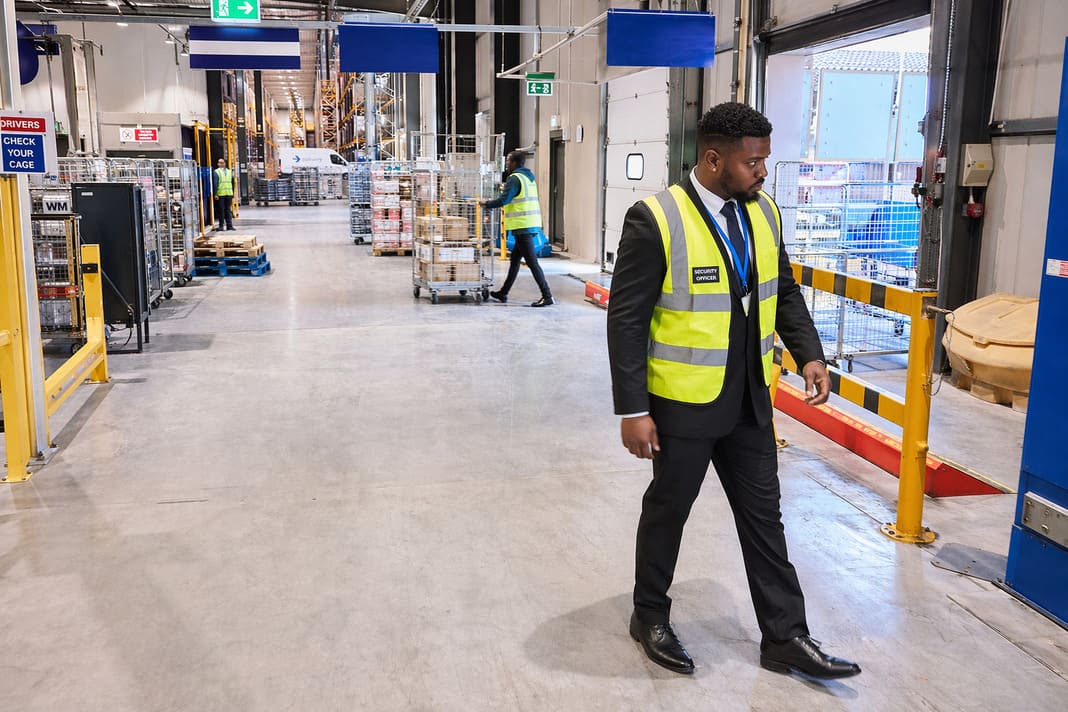
Warehouse Security Services On An Industrial Warehouse Floor – sample image
Asset protection and inventory security
Once the perimeter is assessed and internal procedures are mapped, attention usually turns to what the warehouse is actually protecting. That includes stock, machinery, handheld devices, keys, documents, and any sensitive or regulated goods stored on site.
An inventory security assessment should focus on movement as much as storage. Loss often happens during receiving, picking, packing, transfer, or return handling rather than from a dramatic break-in. Shrinkage can come from repeated small failures that seem minor in isolation.
Key areas worth testing include:
| Area | What the assessment should check |
|---|---|
| Stock accuracy | How stock audits are carried out, how often discrepancies are reviewed, and who signs them off |
| High-value items | Whether restricted zones, separate storage, or tighter authorisation rules apply |
| Goods in and goods out | Whether counts, seals, and paperwork match physical movement |
| Staff permissions | Whether one person can order, receive, adjust, and release stock without oversight |
| Tracking methods | Whether asset tagging, location control, or system records support traceability |
Segregation of duties is often overlooked. If the same person can receive goods, amend inventory records, and approve dispatch changes, the control environment may be weak even if software is in place. Tamper-evident seals, locked cages, and restricted access rooms can add useful protection, especially where certain items attract higher theft risk.
Insurance guidelines may also shape warehouse asset protection measures, particularly for high-value stock or goods that require documented controls. A practical assessment therefore checks whether procedures on paper match the conditions under which goods are actually stored and handled on a wet Tuesday afternoon, not just during a scheduled audit.
Technology, systems, and integration
Security technology works best when systems support each other instead of operating in isolation. A camera may record an incident, an access system may show who entered, and an alarm may flag the time, but the real value appears when those pieces can be read together.
Integrated security systems in warehouses commonly include CCTV, intruder alarms, access control, intercoms, remote monitoring, and control centre oversight. The assessment should ask whether those systems are aligned, maintained, and understood by the people using them. If one system generates frequent false alarms or another is ignored because it is awkward to operate, the whole arrangement becomes less reliable.
A straightforward way to view system integration is to look at the links between:
- detection, such as alarms or sensors
- verification, such as CCTV images or remote checks
- response, such as on-site staff, key holding, or control centre action
Connected systems also introduce digital concerns. Remote access permissions, password control, data protection, and network resilience matter when surveillance and access systems rely on software and internet connectivity. ISO 27001 can offer a useful reference point for information security, particularly where video footage, access logs, or remote administration are involved.
Maintenance is often less glamorous than installation, but it matters more over time. A warehouse alarm monitoring setup is only as useful as its testing routine, escalation process, and service records. In practice, experienced operators such as Double Check Security Group tend to treat system testing and oversight as part of day-to-day delivery rather than a background technical detail.
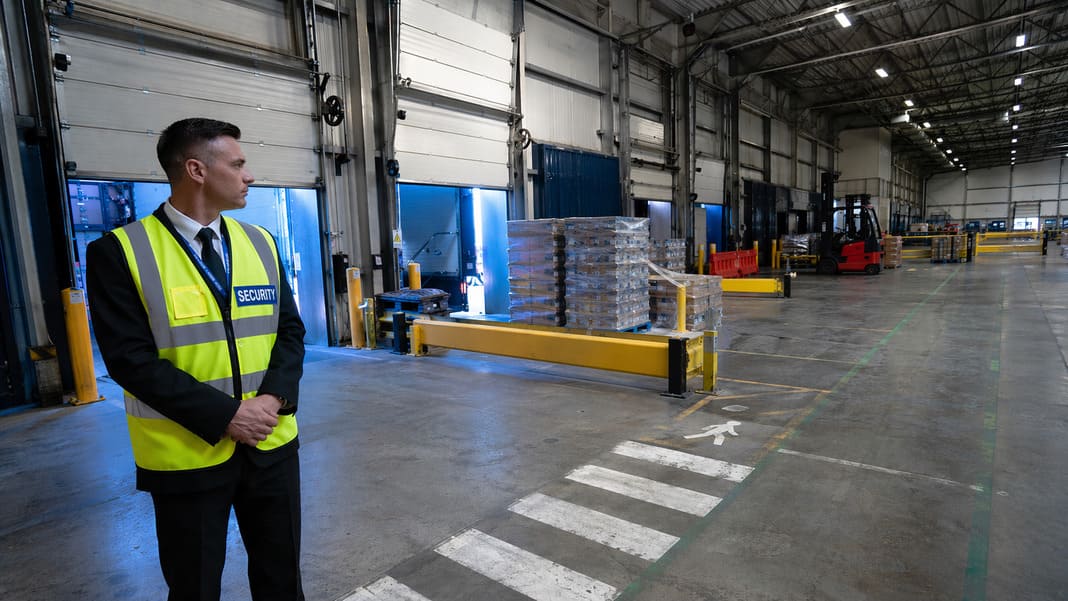
Warehouse Security Guarding Services On An Industrial Warehouse Floor – sample image
Compliance, accreditation, and regulatory requirements
Warehouse security compliance is not a side issue. It shapes how the assessment is written, what evidence is kept, and how controls are maintained over time.
Some requirements are mandatory. SIA licensing applies where licensable security activities are carried out. Fire safety duties, health and safety responsibilities, data protection rules, and employment checks may also affect how security is organised on site. Other standards are voluntary, but they still matter because they can influence insurer expectations, procurement decisions, and audit readiness.
Common reference points include:
- SIA licensing and approved contractor expectations for security personnel and service standards
- ISO 9001 for documented processes, quality control, and review discipline
- SAFEcontractor for health and safety governance in contracted environments
- British Institute of Cleaning Science standards where cleaning and hygiene services overlap with secure site operations
- Martyn’s Law preparations, particularly where a warehouse includes public access, mixed-use functions, or heightened threat considerations
Documentation is a major part of compliance in practice. Audit trails, incident records, training logs, patrol records, access reports, and review notes all show whether controls are active and consistent. Without those records, a warehouse may have good intentions but poor evidence.
Accreditation should never be treated as a badge with no operational weight. It matters because standards influence routines on the ground, including inductions, supervision, and review cycles. In that sense, firms such as Double Check Security Group are useful examples of structured delivery because compliance is built into oversight, training, and record keeping rather than left as an afterthought.
Reviewing and updating the security risk assessment
A warehouse risk assessment should be treated as a live document. Operations change, stock profiles shift, staff turnover affects routines, and new threats emerge. A document written once and filed away quickly loses value.
Several triggers usually justify a review. An incident or near miss is an obvious one, but quieter changes can matter just as much. New tenants in neighbouring units, different delivery hours, rising stock values, software upgrades, or changes in contractor use can all alter the site’s risk profile.
A simple review cycle often includes:
- Record incidents, near misses, audit findings, and feedback from supervisors or security staff.
- Compare those findings with the current assessment, control measures, and site procedures.
- Update the document, assign actions, and keep version control so changes can be tracked.
- Recheck the site after changes are made, then fold the result into the next review cycle.
Imagine a warehouse that extends dispatch into late evening during peak trading. The original assessment may have assumed most outbound movement finished before dark. Once that pattern changes, external lighting, staffing levels, gate supervision, and alarm timings may all need fresh review. The issue is not that the first assessment was poor. The issue is that the site no longer operates in the same way.
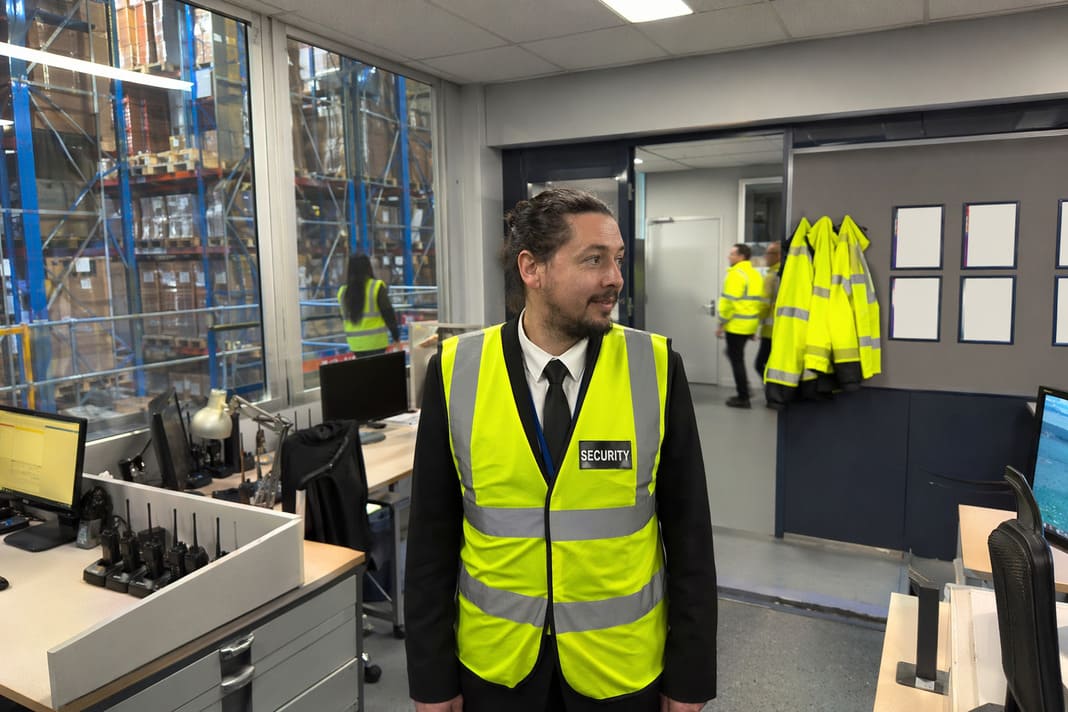
Industrial Warehouse Security Services In A Warehouse Office – sample image
Common oversights and forward-looking considerations
Many warehouse security oversights sit in the space between departments. Operations may focus on throughput, facilities may focus on maintenance, and security may focus on access, yet risks often appear where those priorities overlap.
Some of the most common gaps include:
- insider risk being reduced to a vetting issue instead of an ongoing supervision and permissions issue
- supply chain vulnerabilities at collection, transfer, and returns stages
- old cameras, access readers, or alarm components staying in place long after reliability has declined
- regulatory change being noted but not translated into revised site procedures
- too much trust in technology without checking whether staff actually follow the process around it
Looking ahead, warehouses are likely to face more blended risks, with physical and digital issues affecting each other. A connected access system, a remote monitoring platform, or a stock control tool may improve visibility, but each one also introduces dependency on maintenance, permissions, and data handling. Criminal tactics shift as operations shift, particularly where time pressure, agency labour, and high stock turnover create opportunities for exploitation.
The strongest assessments leave room for that movement. They do not try to predict every future threat in detail, but they do build in enough awareness, review discipline, and operational honesty to keep pace with change. In a warehouse setting, that kind of realism is often the difference between a document that sits on a shelf and one that continues to reflect how the site actually works.
