

What should your business budget for CCTV monitoring each month?
Expect commercial remote CCTV monitoring to start at about £15 to £30 per monitored camera per month, before installation, new hardware, repairs, maintenance, keyholding and response charges are added. For UK buyers, the useful comparison is the service scope behind that figure.
Many quotes look similar at first glance because they all use a monthly fee. Problems start when one price covers remote monitoring only, another includes camera support, and a third adds response arrangements under a separate line.
Your aim is to compare a live service, so the quote needs to describe how that service behaves. A good quote makes the monitored cameras, cover hours, escalation route and support position clear enough for you to see what happens when an alarm activates.
That distinction matters most for commercial sites, where a missed incident can create work for your own team fast. The rest of the article separates the main budget lines so you can read a CCTV monitoring quote without guessing what sits behind the number.
What Do We Cover In This Article?
The monthly fee is only one budget line
Commercial CCTV monitoring cost starts with the monthly service charge, then moves quickly into what the site actually needs. A published guide from Double Check Security Group uses the same market starting point of around £15 to £30 per monitored camera per month, which gives you a practical anchor for early budgeting.
Monitoring fees
Per-camera pricing remains common because the monitoring centre is reviewing signals from defined cameras. A small office with limited out-of-hours cover has a different service load from a vacant property, warehouse or estate with several monitored areas and a firmer response plan.
The monthly monitoring charge pays for remote oversight, not for every camera, repair, call-out or keyholding arrangement unless the quote says so. Read the monitoring line as the cost of operator review and agreed escalation, then check the separate lines that make the service work in practice.
Equipment and installation
New camera hardware belongs in a different part of the budget. The G-Cloud 14 pricing document lists example camera management and support at £15 to £30 per camera per month, separately from camera hardware and installation, which shows why a monthly figure should never be treated as the whole project cost.
Hardware can vary widely. The same document lists example fixed cameras from £275 to £1,500 per camera and PTZ cameras, which can move and zoom, from £1,500 to £7,500 per camera before specialist options. Your existing CCTV system may reduce disruption if it connects cleanly, although upgrades, repairs or better positioning can still add cost.
Response and support
Monitoring becomes far more useful when the response route is clear. Keyholding, call-outs, remote support, maintenance and repairs may sit inside the same proposal, or they may appear as separate charges with their own conditions.
Cloud storage also needs checking because recording and monitoring are different services. A quote that looks low can still be fair, provided it tells you exactly what happens when a camera activates and who pays if the equipment needs attention.
What changes a CCTV monitoring quote?
A small office and a vacant building can have the same number of cameras and still need different monitoring arrangements. One may need simple out-of-hours review, while the other may need closer escalation and a firmer response route because the risk is different.
In practice, Double Check Security Group prices CCTV monitoring after looking at camera count, monitoring hours, site risk and response needs. Those same details are the ones you should gather before you judge a business CCTV monitoring quote.
- Camera count. More monitored cameras add more operator workload, especially where several cameras cover separate access points or high-risk areas.
- Hours of cover. Out-of-hours monitoring, event-triggered monitoring and 24-hour monitoring create different staffing and service demands.
- Site risk. A retail site, warehouse, vacant property and residential development each needs its own escalation plan because the likely incident and response route differ.
- System compatibility. An existing CCTV system can reduce setup work if remote connection is straightforward, but poor image quality or unreliable alerts can push the project into upgrades.
- Response arrangements. Audio challenge, keyholder notification, guard response and false alarm handling should appear plainly in the proposal.
Price makes sense only after those details are visible in the quote.

CCTV operator monitoring security cameras – Illustrative Image
Compare monitoring levels before prices
A CCTV monitoring price comparison works only after you know which monitoring model you are buying. Self-monitoring, event-triggered monitoring, out-of-hours cover and 24-hour monitoring place very different demands on people and systems.
The table below compares self-monitoring, event-triggered monitoring, out-of-hours cover and 24-hour monitoring across best fit and likely cost effect.
| Monitoring level | Best fit | Cost effect |
|---|---|---|
| Self-monitoring | Low-risk sites where someone is genuinely available to act | Lowest direct fee, with more responsibility left with your own team |
| Event-triggered monitoring | Sites using alerts from detector-activated CCTV | Cost follows the number of activations, camera setup and escalation route |
| Out-of-hours monitoring | Premises occupied during the working day and exposed after closing | Often more focused than all-day cover because monitoring is tied to risk periods |
| 24-hour monitoring | Sites with continuous exposure, complex occupancy or higher-value assets | Higher service demand because cover runs across the full day and night |
Professional standards help you ask sharper questions here. British Standard BS 8418 applies to detector-activated CCTV, while BS 9518 and BS EN 50518 matter where alarm receiving centres handle signals and monitoring centre activity.
Manned guarding belongs in the same buying conversation where presence on site matters. CCTV monitoring can support a response plan remotely, while guards add physical presence, access control and direct intervention within the agreed service.
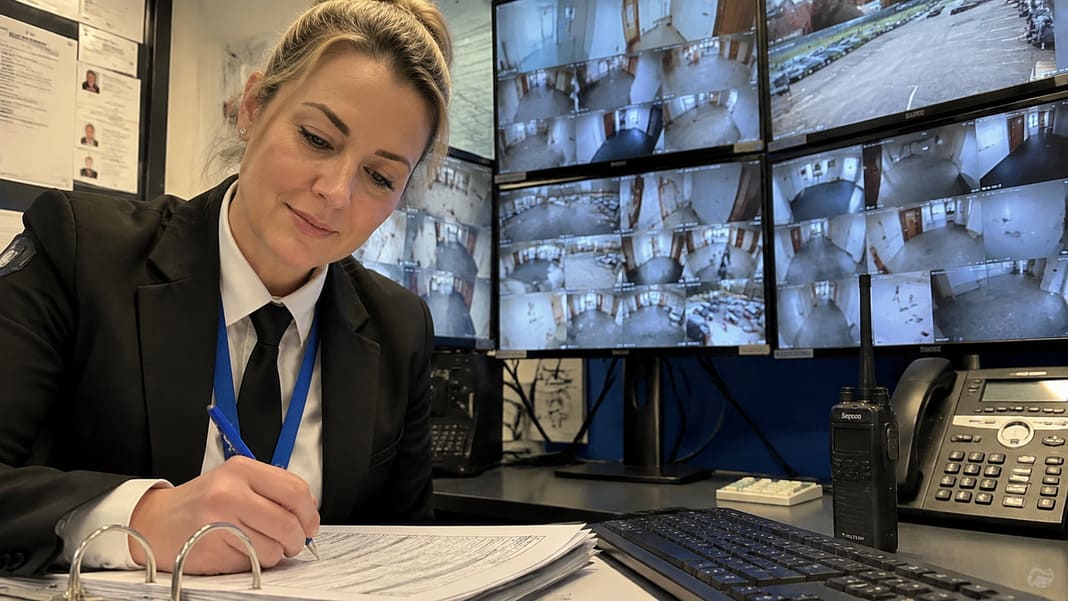
CCTV monitoring officer records incidents while reviewing timestamped surveillance footage and reports – Illustrative Image
Professional monitoring needs clear governance
A monitored CCTV service needs clean accountability from the start. You need to know who can view footage, why they are viewing it and what they do after an activation.
Business CCTV involves personal data, so the ICO expects registration and a data protection fee unless an exemption applies. People also need to be told that recording may take place, which usually means clearly visible and readable signs at the site.
Viewing permissions need the same discipline. A system installed for crime prevention needs to be used for that purpose, with access to recordings limited to the people who have a proper reason to see them.
SIA licensing also matters where contracted private security work involves licensable CCTV activity. Where operators identify people or monitor activity to guard premises or people from unlawful conduct, the provider needs to understand the licensing position and apply it correctly.
Standards can make the service easier to compare. BS 7958 relates to CCTV system operation, and the alarm receiving centre standards mentioned earlier help you judge whether the monitoring centre has a recognised operating framework. For the buyer, good governance should show up as clear instructions, named responsibilities and a usable audit trail.
Cheap CCTV monitoring is an incomplete answer
Cheap CCTV monitoring can be good value when the site is low-risk, the cover hours are modest and the response route is simple. Trouble starts when the fee looks attractive because the parts you actually need sit outside the monitoring line.
The common mistake is judging CCTV monitoring by the lowest monthly figure, not by the cover, escalation and response that figure actually buys. A strong proposal tells you which cameras are monitored, when they are watched, how activations are handled and what support is included if the system fails.
The misconception to drop is simple: the cheapest monthly CCTV monitoring fee is automatically the best deal. The best value is the price that leaves no gap between the incident and the response.
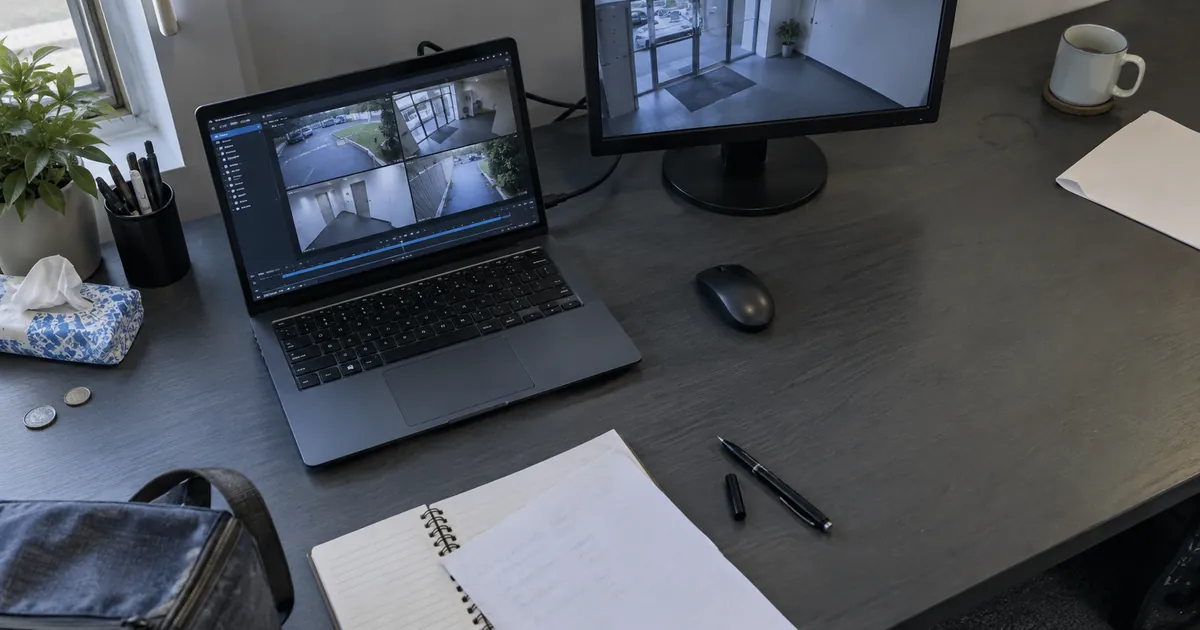
CCTV monitoring desk security review – Illustrative Image
Common questions about CCTV monitoring costs
Can one site use different monitoring hours for different cameras?
Yes, a site can be set up that way where the CCTV system and monitoring platform allow it. The agreement needs to state which cameras are watched at which times, because mixed cover becomes messy when the instructions are vague.
What happens if a monitored camera develops a fault?
A fault should be logged and passed through the agreed support route. Repairs, replacement parts and call-outs need clear treatment in the service terms, because monitoring staff cannot review a camera that is offline.
Can remote monitoring cover more than one site?
Yes, multi-site monitoring is common where cameras can connect securely to a professional monitoring setup. Each site still needs its own escalation route, because a retail unit and a vacant property demand different responses.
Is an audio challenge always needed?
No. Audio challenge is useful where an operator needs to warn someone away from a restricted area, while other sites need silent escalation through keyholders or responders.
Should access instructions sit inside the monitoring agreement?
Yes. Responders and keyholders need clear permissions, entry details and limits before an incident occurs, so the operator knows the correct route to follow.
