

How can you tell whether your cleaning company is meeting its promises?
You can tell by comparing the original service agreement with what is happening on site, then checking the results, records, supervision and response to issues. A reliable cleaning service should show clear standards, visible consistency, accurate reporting and a sensible way to fix problems when they arise.

Retail Cleaning Services In A Modern Store Interior – sample image
What Do We Cover In This Article?
Understanding the service agreement: what was promised?
The starting point is always the cleaning contract or service specification. Many disputes about cleaning quality begin with vague wording, unclear frequencies or assumptions that were never written down.
A useful agreement usually sets out:
- the areas to be cleaned
- the cleaning schedule and frequency
- the tasks included in each visit
- any agreed standards or inspection criteria
- consumables, washroom duties or waste removal responsibilities
Generic contracts often create confusion. A phrase such as “clean all communal areas regularly” sounds clear until someone asks whether that includes skirting boards, lift buttons, internal glass or bin surrounds. By contrast, a more detailed service specification gives you a proper benchmark.
Look closely at the wording around frequency as well. Daily cleaning may mean every weekday, seven days a week, or one pass through a building each day. Periodic tasks can also slip into the background if nobody has defined whether they happen weekly, monthly or on request. British Institute of Cleaning Science guidance and wider facilities management standards tend to favour clarity here because deliverables are easier to assess when they are written plainly.
Visible results: spotting signs of consistent cleaning
A building usually shows you quite quickly whether cleaning is being done well. You do not need specialist training to notice patterns.
High-traffic areas tell the story first. Entrance floors, reception desks, washrooms, kitchens and lift interiors tend to show wear and dirt sooner than quieter spaces. If those areas look presentable early in the day but decline sharply without attention, the cleaning frequency may not match the building’s actual use.
Smaller details often reveal more than obvious ones. Corners, door frames, skirting, touchpoints and the edges of hard floors can show whether the service is thorough or simply cosmetic. Surface shine on a desk means very little if fingerprints remain on handles and dust sits behind monitors.
Useful signs to watch for include:
- consistent cleanliness across busy and quiet areas
- stocked washrooms with no obvious build-up around fixtures
- bins emptied without residue or leaking liners left behind
- touchpoints that look clean rather than just quickly wiped
- no repeating missed spots in the same location week after week
Patterns matter more than a single off day. Every service can have the occasional lapse, especially after heavy footfall, adverse weather or an unusually busy site. Repeated issues in the same places point to a gap in routine, supervision or time allocation.
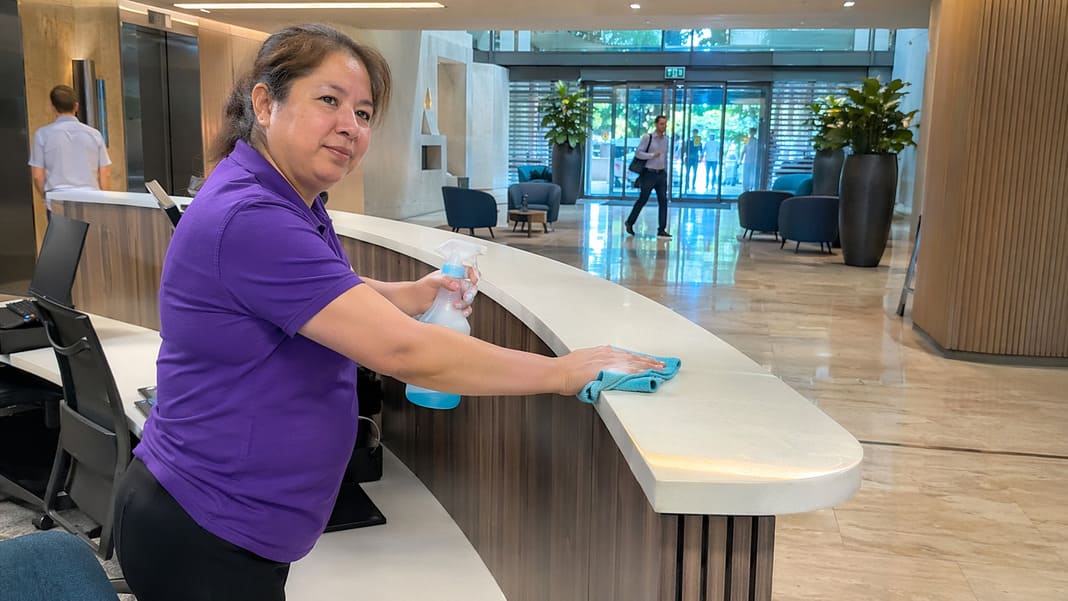
Office Cleaning Services In A Corporate Building Lobby – sample image
Monitoring systems and reporting: how is performance tracked?
Good cleaning is easier to trust when the work leaves a trail. Reporting does not need to be complicated, but it does need to be meaningful.
Some providers use digital tools, and others rely on paper logs or supervisor reports. Either approach can work if the records are consistent, easy to review and linked to actual site activity. Token paperwork, by contrast, often looks tidy but tells you very little about what happened on the ground.
What matters most in performance monitoring is whether records answer practical questions. Was the site attended on the agreed day and time? Were any issues raised? Did someone inspect the work? Was a missed task recorded and corrected? Cleaning logs, service reports and audit trails should support those answers instead of obscuring them.
A sensible reporting process often includes scheduled inspections, spot checks and a way to record remedial actions. ISO 9001 is often associated with documented processes and quality management, which means that a provider working within that kind of framework should usually be able to show how performance is reviewed, not just claimed. In practice, that may be as simple as supervisor notes linked to a cleaning schedule and signed site audits that match the service level agreement.
Staff training and supervision: who is actually doing the work?
A spotless site on one day and a patchy one on the next often points to a people and process issue. Cleaning quality depends heavily on induction, supervision and team consistency.
Well-managed teams are usually given clear instructions for the specific building, including safe use of products, task order, access arrangements and reporting procedures. That matters because office cleaning, residential block cleaning and regulated environments all have different demands. In buildings with restricted access or security requirements, wider vetting and site rules may also shape who can work where.
You can often judge the strength of supervision by looking for a few practical signs:
- Staff seem familiar with the site and its routines.
- A supervisor or account manager carries out regular checks.
- Training records or method statements are available if needed.
- Cover staff know the expected standard rather than improvising.
- Issues raised by occupants feed back into the way the team works.
High staff turnover does not automatically mean poor service, but constant changes can affect standards if handovers are weak. A stable team tends to notice recurring issues, seasonal pressures and building-specific quirks that a revolving rota may miss. Some operators, including Double Check Security Group in integrated facilities settings, place a strong emphasis on structured oversight because consistency usually comes from management discipline as much as individual effort.
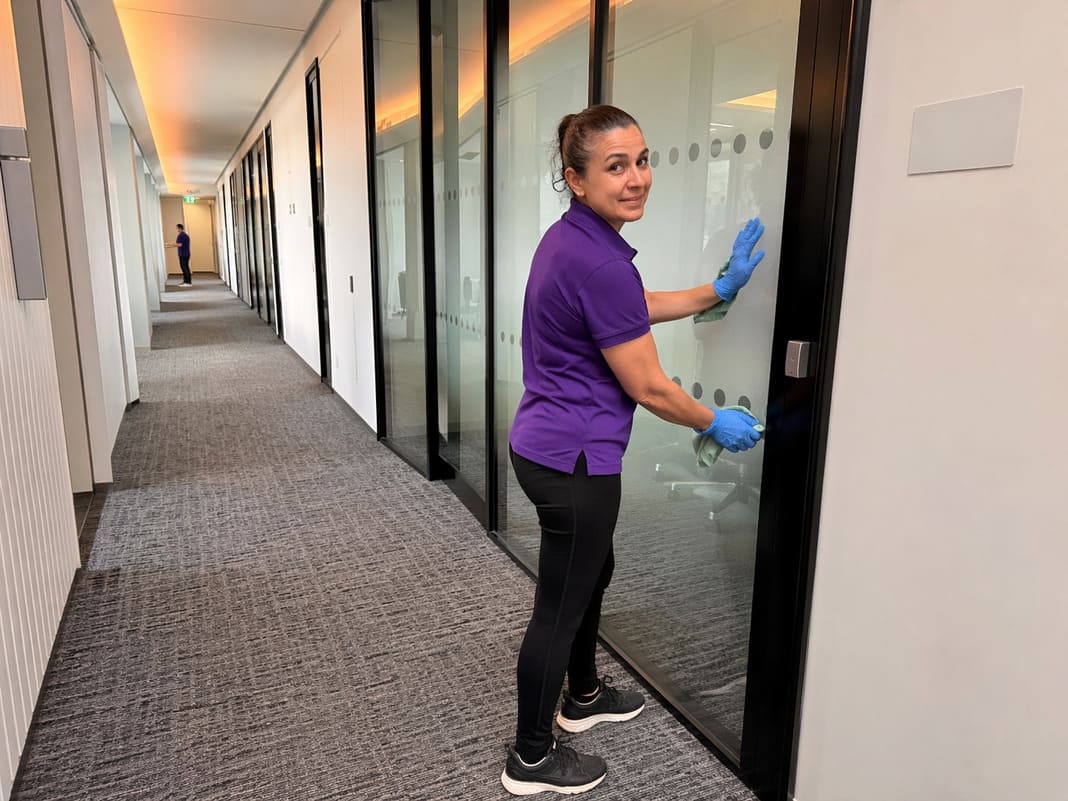
Office Cleaning Services In A Commercial Corridor – sample image
Communication and responsiveness: are issues addressed promptly?
Even a solid cleaning arrangement needs a clear way to report missed areas, stock shortages or hygiene concerns. Silence is rarely a good sign.
Healthy communication usually includes a named contact, a service desk or reporting route, and an agreed way to escalate urgent issues. Some clients prefer regular review meetings, while smaller sites may rely on concise email updates and periodic inspections. The format matters less than whether problems are acknowledged and acted on.
Common touchpoints include:
- daily or weekly communication logs
- site communication books or digital notes
- issue reporting by email or service desk
- supervisor follow-up after complaints
- periodic review meetings with the client
Proactive providers tend to spot and report issues before the client has to raise them. That might include flagging damaged dispensers, unusual waste volumes, recurring washroom problems or areas that need a more detailed clean outside the routine scope. A reactive service waits for complaints and treats each one in isolation, which gradually weakens trust in the arrangement.
Accreditation and compliance: are industry standards being met?
Accreditation matters, but only if it connects to day-to-day practice. A logo on a brochure is less useful than evidence that standards are being applied properly on site.
Relevant credentials may include British Institute of Cleaning Science affiliation or training pathways, ISO 9001 for quality management, and SAFEcontractor where health and safety processes form part of the wider service environment. In some mixed-use or high-security settings, SIA-related controls may also sit alongside cleaning operations where access, guarding or out-of-hours attendance overlap.
Those credentials can suggest that a provider takes procedures, documentation and training seriously. They do not prove that every site will be immaculate. What they can indicate is a stronger framework for audits, supervision, corrective action and compliance checks.
Verification is usually straightforward. Ask to see current certification, check expiry dates and look at whether the scope is relevant to the service being delivered. A provider with a mature compliance culture should be comfortable showing how audits, inductions and quality reviews feed into daily operations. Double Check Security Group, for example, operates within a compliance-led model across security and facilities work, which gives a practical illustration of how accreditation should support service structure rather than sit apart from it.
Reviewing value for money: are you getting what you pay for?
Price tells only part of the story. A cheaper contract can become expensive if standards slip, complaints rise or your team spends time chasing basic tasks.
Value usually sits across several factors:
- consistency of cleaning results over time
- reliability of attendance and cover arrangements
- quality of supervision and reporting
- speed of response when issues are raised
- effect on staff, visitors, residents or customers using the site
Poor cleaning often creates hidden costs. A reception area that looks neglected may affect first impressions. Repeated washroom complaints can absorb management time. Missed tasks may lead to re-cleans, ad hoc call-outs or internal friction between occupiers and site teams. None of those costs sits neatly on the cleaning invoice, yet they still affect the building’s operation.
A sensible review looks at whether the agreed service level matches the building’s needs and whether the provider is delivering it consistently. Some sites need a basic routine and little more. Others need stronger supervision, more frequent touchpoint cleaning or better reporting because the environment is busier, more public-facing or more sensitive.

Retail Cleaning Services In A Store Display Area – sample image
Moving beyond assumptions: building a culture of accountability
Cleaning works best when it is treated as a managed service rather than background noise. Problems often begin when the arrangement is left on autopilot for months at a time.
Common pitfalls include:
- assuming a clean-looking area means every task was done
- relying on verbal expectations instead of the service specification
- ignoring recurring minor issues until they become normal
- treating complaints as isolated incidents with no follow-up
- focusing on price alone and overlooking service discipline
Accountability grows from regular review, transparent reporting and realistic standards. Facilities teams do not need to inspect every corner personally, but they do need a clear line of sight between what was promised, what was delivered and what happened when something slipped. Seen that way, cleaning becomes less about trust by assumption and more about trust supported by evidence, which is a far stronger basis for any long-term service relationship.
