

How much does corporate security cost in the UK?
Corporate security costs in the UK vary widely because pricing depends on the type of service, the risk profile of the site, staffing requirements, technology, contract terms, and location. A simple daytime guarding arrangement on a low-risk site will be priced very differently from a 24-hour service covering multiple access points, strict reporting duties, and specialist response capability. For most businesses, the useful question is not just the hourly rate, but the full cost of running a security arrangement that is compliant, reliable, and suited to the site.
Corporate security pricing in the UK is rarely a flat, standard figure. A headline rate may cover a guard on site, but it may not reflect supervision, holiday cover, management oversight, training, equipment, reporting, or out-of-hours response. That gap is often where confusion starts.
Several factors usually shape business security costs from the start:
- Service type, including manned guarding, mobile patrols, CCTV monitoring, reception security, and specialist support
- Site conditions, such as public access, opening hours, building layout, and incident history
- Compliance requirements, including SIA licensing, vetting, and documented procedures
- Contract structure, namely whether the service is short-term, fixed-term, or highly flexible
- Regional and sector pressures, which can affect labour costs and baseline risk
Standards and accreditations also play a part. Providers operating within recognised frameworks, including the SIA Approved Contractor Scheme and management systems aligned with ISO 9001, may price differently from firms offering a basic service model. That difference reflects process, oversight, and accountability, rather than branding alone.
What Do We Cover In This Article?
Type and scope of security services
A business needing one front-of-house officer during office hours will face a very different cost structure from a site requiring overnight patrols, access control, alarm response, and incident reporting across several buildings. Security service types directly affect staffing levels, scheduling, and supervision.
Static guarding often carries the clearest ongoing labour cost because it places a licensed officer on site for set hours. Mobile patrols can reduce that spend on lower-risk premises, although they offer intermittent attendance rather than a constant presence. CCTV monitoring may lower the need for physical coverage in some settings, but it introduces equipment, monitoring, and maintenance costs of its own.
Bundled services can change the picture again. A provider handling security alongside reception, concierge, or cleaning may create a more joined-up operating model, although the value depends on how clearly each service is scoped. In practice, firms such as Double Check Security Group are often referenced in this context because integrated delivery can simplify oversight where a building needs more than one support function.
Specialist support will usually sit at a higher price point. Close protection, surveillance, dog handling, and high-readiness response require specific personnel, extra planning, and, in many cases, tighter operating procedures. A standard guarding rate does not translate neatly into specialist security pricing.
Coverage hours matter just as much as service category. An eight-hour weekday arrangement is easier to resource than a 24/7 rota that must account for handovers, annual leave, sickness cover, and unsociable hours. Once round-the-clock coverage enters the scope, the budget often rises sharply because the service stops being a single shift and becomes a full staffing system.
Site risk profile and challenge
Security for high-risk premises costs more because the site itself demands more attention, more planning, or more control. Risk-based security pricing usually begins with an assessment of what could happen, how likely it is, and what the consequences would be.
Some sites appear straightforward on paper but become more complex after a proper site audit. A small office with one entrance may still hold sensitive information, attract protest activity, or share access with other occupiers. A warehouse on a quiet industrial estate may have low daytime footfall but high exposure to theft after dark.
Risk assessments often focus on factors including:
- Number of entry and exit points
- Public access and visitor flow
- Previous incidents or known vulnerabilities
- Building layout, blind spots, and perimeter conditions
- The need for access control, screening, or rapid escalation
High-profile locations often need a broader response plan. Busy retail, corporate headquarters, transport-adjacent premises, and publicly accessible venues can require tighter procedures, stronger incident management, and staff briefed on threat awareness. Action Counter Terrorism guidance and the direction of travel around Martyn’s Law have increased attention on preparedness, especially for premises where public safety planning is already part of daily operations.
Challenge also affects deployment. A single officer on a compact, well-designed site may be enough. A larger property with several floors, loading bays, contractors, and visitor traffic may need overlapping roles, supervisory support, and a more detailed reporting structure. In those cases, the difference in cost often comes from coordination as much as from headcount.

Corporate Receptionist Services In A Modern Office Lobby – sample image (3)
Staffing, training, and accreditation requirements
Security personnel costs are shaped by more than wages. SIA approved security staff must be properly licensed for their role, and that requirement sits within a wider framework of vetting, induction, assignment instructions, supervision, and ongoing training.
Accredited security companies often charge more than providers operating at the lowest end of the market because they carry the cost of compliance and quality control. A business paying for that structure is usually paying for documented procedures, management checks, audit trails, and staff development, not just for someone standing at a door.
Training has practical consequences on site. An officer who understands access control, incident escalation, visitor handling, conflict management, and reporting is more likely to fit into the client’s operation smoothly. Poorly briefed staffing can create operational friction in reception areas, loading points, and customer-facing spaces long before a serious incident occurs.
Accreditations also give some insight into how a provider is run. Alignment with ISO 9001, SAFEcontractor, or sector-specific standards can indicate that the service is managed through formal processes rather than informal habit. That does not automatically guarantee excellent delivery, but it does suggest that performance is being measured and reviewed.
Retention matters as well. High turnover can lead to repeated handovers, weaker site knowledge, and patchy continuity. By contrast, providers with stronger induction and support systems often build more consistent teams. In practical terms, that means fewer avoidable gaps in familiar routines, whether the assignment involves corporate reception duties or a more sensitive access-controlled environment. Double Check Security Group is one example of a provider often associated with that structured approach to training and oversight.
Contract length, flexibility, and service level agreements
Contract structure can change the total cost almost as much as the service itself. A short-term arrangement often carries more flexibility, but that flexibility may come at a higher rate because the provider has less certainty over staffing and planning.
Longer fixed-term contracts can create better cost efficiency where the scope is stable. Predictable hours, agreed staffing levels, and a clear service level agreement make it easier to plan rotas, supervision, and management input. Rolling contracts can work well for changing estates, although they sometimes include a premium for that adaptability.
Service level agreements deserve close attention because detail affects price. A basic guarding brief will cost less than an SLA requiring frequent patrol records, formal incident reports, KPI tracking, regular review meetings, and strict response times. None of those items is unreasonable, but each one adds labour or management time.
A useful way to think about contract terms is through trade-offs:
- Shorter terms usually offer agility, but they may produce higher monthly costs.
- Longer terms can improve pricing, although they rely on a well-defined scope.
- Detailed SLAs increase accountability, yet they can also increase administration and supervision.
- Loose wording may look cheaper at first, but disputed expectations often become expensive later.
Break clauses, notice periods, and renewal terms matter too. A contract that seems attractively priced can become awkward if the business changes occupancy plans or site hours. Clear terms do not eliminate every risk, though they make the service easier to budget for when operations shift.
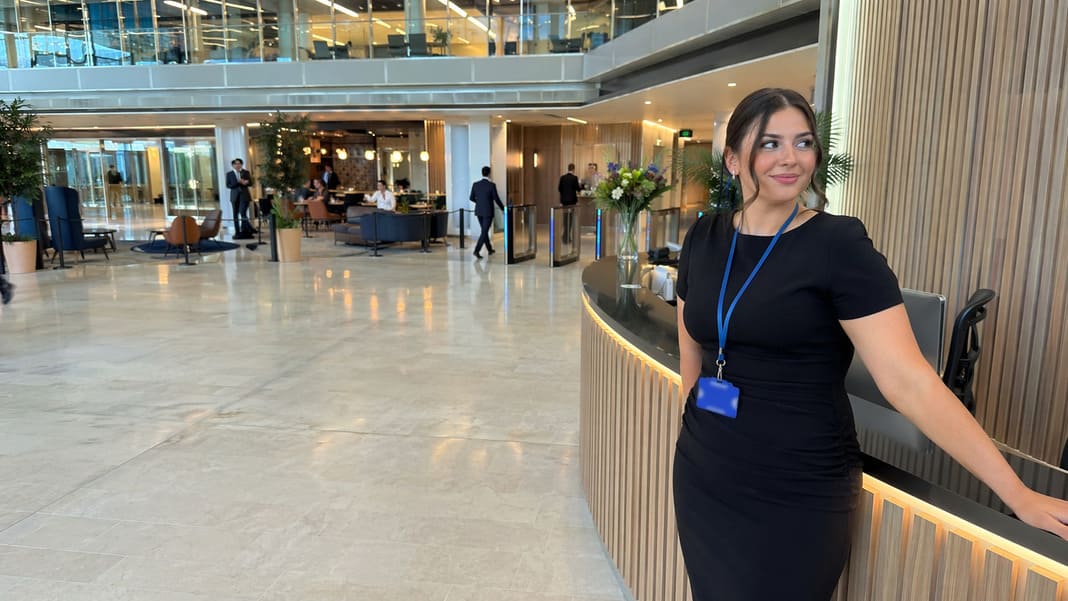
Corporate Reception Services In A Large Office Atrium Lobby – sample image
Technology and equipment integration
Technology changes security cost structures, but it rarely removes them altogether. CCTV installation price, access control systems in the UK, and alarm monitoring charges all involve a mix of upfront and ongoing spend.
A business may pay initially for cameras, readers, alarms, cabling, software setup, and installation. Ongoing costs can then include monitoring, maintenance visits, repairs, user administration, upgrades, and eventual replacement. British Standards Institution guidance and recognised installation standards can influence specification and, by extension, price.
Integrated security solutions often work best where technology supports people rather than trying to replace them entirely. Cameras can widen visibility, access control can reduce unauthorised entry, and alarm systems can shorten response time. Even so, someone still needs to review alerts, manage exceptions, investigate incidents, and make decisions when conditions on site change.
Consider a multi-tenant office building. Access control may handle daily entry well, and CCTV may cover shared spaces, but contractors, deliveries, visitor issues, and emergency procedures can still call for on-site personnel. In that setting, technology can reduce duplication and sharpen coverage, although it does not turn security into a purely remote function.
Equipment lifespan is another cost factor that is often missed during procurement. Systems age, software versions change, and compatibility issues appear over time. A cheaper installation can become expensive if maintenance is poor or if the system cannot scale with the building’s needs.
Regional and sector variations
Regional security costs in the UK are not uniform. London security prices are often higher because labour, travel, and site operating conditions tend to be more expensive in and around the capital. Other metropolitan centres can show similar patterns, especially where recruitment pressure is strong.
Rural and semi-rural sites may benefit from lower wage pressure in some cases, but distance can introduce different costs. Mobile response times, supervisor travel, and limited local staffing pools can all affect the price.
Sector-specific security also changes the model. Retail premises may need visible deterrence, loss prevention awareness, and customer-facing skills. Logistics sites often focus more on perimeter control, vehicle movements, gatehouse duties, and out-of-hours coverage. Corporate offices may place greater weight on reception presentation, access management, and confidentiality.
The same basic service can therefore be priced differently depending on context:
- City centre office: higher staffing costs, stronger emphasis on front-of-house presentation, tighter visitor flows
- Distribution hub: broader perimeter coverage, shift-based operations, vehicle access management
- Retail environment: public interaction, shrinkage concerns, incident logging, peak trading pressure
Local labour markets also matter. Providers competing for licensed staff in busy areas may need to offer higher rates to recruit and retain suitable people. A contract benchmarked against another region can therefore produce misleading expectations if the operating conditions are not comparable.
Hidden and additional costs to consider
Headline pricing does not always show the full spend. Hidden security costs often appear in the margins of the contract, in exceptional call-outs, or in items that were assumed rather than stated.
Common additional security charges can include:
- Overtime and unsociable hours cover
- Emergency call-outs or short-notice redeployment
- Uniforms, radios, body-worn equipment, or replacement items
- Site-specific training or additional vetting
- Insurance-related costs
- Temporary uplift during incidents, events, or seasonal peaks
- Extra reporting, audit support, or compliance administration
Invoice structure matters here. A clear breakdown helps a facilities manager see what is fixed, what is variable, and what triggers extra charges. Without that level of detail, a low monthly figure can mask a much higher total cost over the life of the contract.
Procurement teams should also watch for regulatory or standards-related changes that affect the service after the contract starts. If a site requires revised procedures, more training, or extra supervision because of changing risk conditions, the price may need to move with it. Transparency in reporting is what separates a manageable variation from a budget shock halfway through the year.

Corporate Reception Services At A Front Desk – sample image
Making sense of value: beyond the price tag
Corporate security should be judged as an operating function, not as a commodity line item alone. Cost matters, but value comes from whether the service matches the site, supports compliance, and performs consistently under normal pressure as well as under strain.
Lowest-price procurement can look efficient at the start, yet it may produce weaker supervision, higher turnover, vague reporting, or limited resilience when staffing problems appear. By contrast, a well-run service often includes the less visible features that keep a contract stable, including competent management, documented procedures, reliable cover, and regular review against agreed standards.
That broader view becomes more relevant as expectations rise across safety, accountability, and public-facing risk planning. The SIA Approved Contractor Scheme, ISO 9001 frameworks, and the direction of travel under Martyn’s Law all point to the same idea: professional security outcomes depend on preparation, governance, and consistent delivery.
A sensible buying decision looks at price in context. The right benchmark is whether the service gives the business a workable, compliant, and sustainable security model for its actual risks, sector demands, and operating hours.
