

Is your office cleaning schedule shaped by real building use or by routines that no longer fit?
An office cleaning schedule should reflect how people actually use the building, including footfall, shared spaces, hybrid working patterns and hygiene priorities. If cleaning still follows a routine set years ago, it may be wasting time in quiet areas while missing pressure points such as kitchens, washrooms, receptions and busy meeting rooms.
A familiar pattern plays out in many offices. Cleaning teams follow the same plan each week because that is how it has always been done, even though staff attendance has changed, layouts have shifted and certain spaces now sit empty for days at a time.
That kind of routine is easy to maintain. It is harder to stop and ask whether the schedule still matches the building.
Usage-based cleaning and habitual cleaning are not the same thing. One responds to occupancy patterns, hygiene standards and operational need. The other tends to survive through operational inertia, even after the workplace has moved on.
Key differences usually look like this:
- Habitual cleaning follows fixed tasks and fixed frequencies, even if room use has changed.
- Usage-based cleaning adjusts cleaning frequency according to footfall, space utilisation and current occupancy.
- Habitual cleaning often relies on long-standing checklists with limited routine reviews.
- Usage-based cleaning is more likely to involve cleaning audits, user feedback and building management systems.
Facilities management teams often inherit routines from previous staff, previous contractors or earlier occupancy levels. Once a pattern is written into rotas and cleaning checklists, it can remain in place for years without serious challenge, including in offices where flexible working has changed the building more than the schedule suggests.
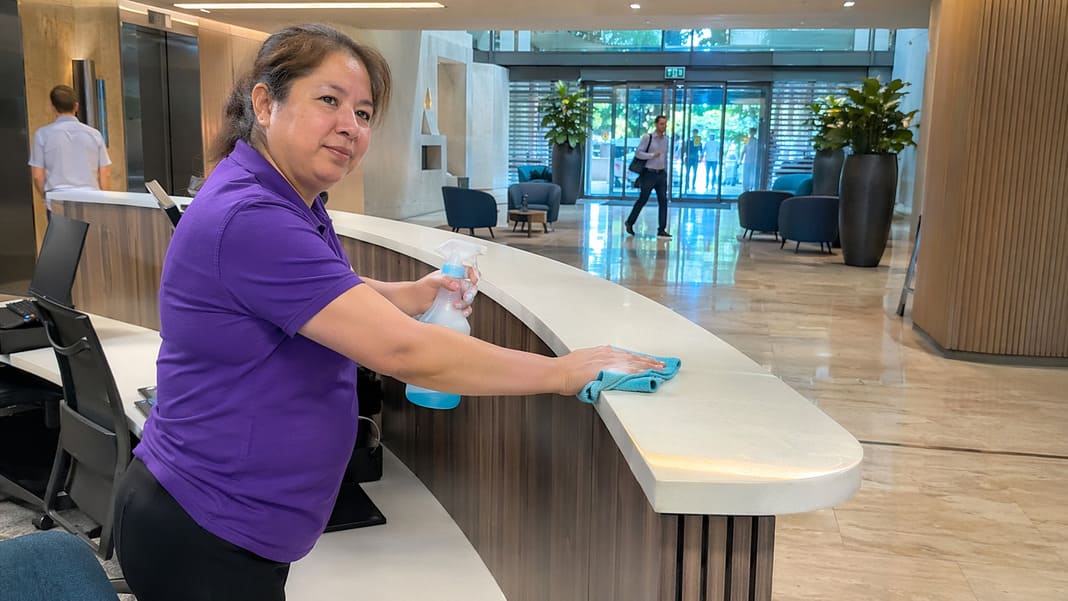
Office Cleaning Services In A Corporate Building Lobby – sample image
What Do We Cover In This Article?
How building usage patterns should shape cleaning frequency
Cleaning needs are created by people, movement and activity, not by the calendar alone.
A meeting room booked all day needs more attention than a boardroom used twice a month. A quiet archive may need less frequent cleaning than a breakout area that sees constant traffic, food waste and touchpoints. Once that principle is clear, a cleaning schedule review becomes much easier to approach.
Occupancy-based cleaning does not need to be complicated. Some organisations use facilities management software, occupancy analytics or desk booking data. Others rely on simpler signals such as reception logs, room bookings, staff feedback and direct observation from cleaning operatives and supervisors.
Several practical factors tend to matter most:
- Footfall in entrances, lift lobbies, kitchens, washrooms and shared circulation routes
- Space utilisation across meeting rooms, hot-desking zones, private offices and storage areas
- Time-specific patterns, including busy mornings, visitor days or part-week office attendance
- Feedback from building users about hygiene, presentation and recurring problem areas
Hybrid working has made this even more relevant. A floor that appears fully occupied on Tuesday and Thursday may be quiet on Monday and Friday. If the same cleaning frequency is applied every day without adjustment, the result can be over-servicing on low-use days and missed pressure points when attendance peaks.
Under-cleaning creates obvious concerns in high-use spaces, especially around washrooms, touchpoints and food preparation areas. Over-cleaning creates a different problem, namely wasted labour, unnecessary consumable use and less time available for areas that need closer attention. A schedule that mirrors actual use tends to be more accurate than one copied from a previous year.
Common pitfalls of habit-driven cleaning routines
An office may look orderly on paper and still be misaligned in practice. Daily attention goes to empty cellular offices, yet the shared kitchen runs short on hygiene checks by lunchtime and the informal meeting pods carry heavy use without any mid-day refresh.
Those gaps usually appear gradually. Because the routine feels familiar, nobody notices that the building has changed faster than the cleaning plan.
Common warning signs include:
- Frequent cleaning of low-use rooms simply because they sit on an old rota
- Busy communal areas receiving the same attention as rarely used spaces
- Repetitive tasks that staff complete out of habit, despite limited value
- Compliance gaps where cleaning records no longer reflect real operational risk
- Difficulty adjusting the schedule after refurbishments, team moves or changes in occupancy
- Reduced staff morale when operatives are asked to repeat tasks that no longer make sense
Health and safety regulations do not prescribe one universal office routine, but they do require workplaces to be maintained in a clean condition appropriate to their use. If cleaning frequencies ignore real activity levels, that mismatch can show up during facilities audits, internal inspections or complaint reviews.
A stale schedule can also distort resource allocation. Hours are spent where they are easiest to assign, rather than where they have the greatest effect. In a busy office, that often means the visible but less-used areas look fine, while the spaces people rely on every day feel neglected by mid-afternoon.
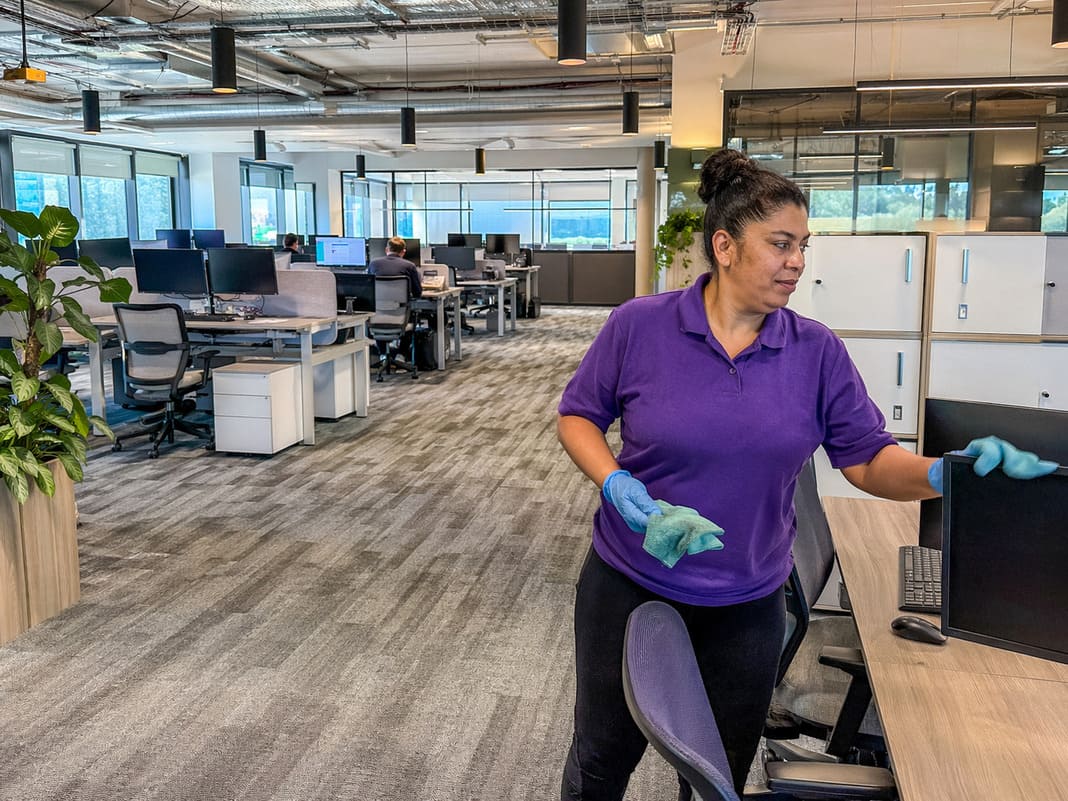
Open Plan Office Cleaning Services In A Modern Office – sample image
The role of compliance, standards and auditing in cleaning schedules
Cleaning schedules work best when they are documented, reviewed and tested against what happens on site. Compliance is part of that structure, because standards are easier to maintain when expectations are clear and records are consistent.
Industry frameworks, including ISO 9001 and guidance associated with the British Institute of Cleaning Science, reinforce the value of documented procedures, training, quality checks and policy review. Health and safety legislation also shapes expectations around workplace cleanliness, welfare facilities and safe working practices.
Useful compliance elements often include:
- Clear cleaning logs that show what was done, where and when
- Defined cleaning standards for different space types and risk levels
- Routine compliance checks by supervisors or site managers
- Audit trails that compare written schedules with actual site conditions
- Periodic policy review after occupancy changes, complaints or inspection findings
An audit can be revealing in a very practical way. A schedule may state that touchpoints are cleaned at set intervals, yet cleaning logs and site observation may show that demand is highest in different areas or at different times. That does not always mean the team is underperforming. Sometimes it means the written plan no longer reflects the building.
In structured service environments, accredited providers use that gap between policy and practice as a prompt for improvement. Double Check Security Group, for example, operates with formal oversight, documented standards and auditing processes that support regular review rather than fixed assumptions. The value lies in the discipline of checking what the schedule says against what the site actually needs, which is often where the most useful adjustments begin.
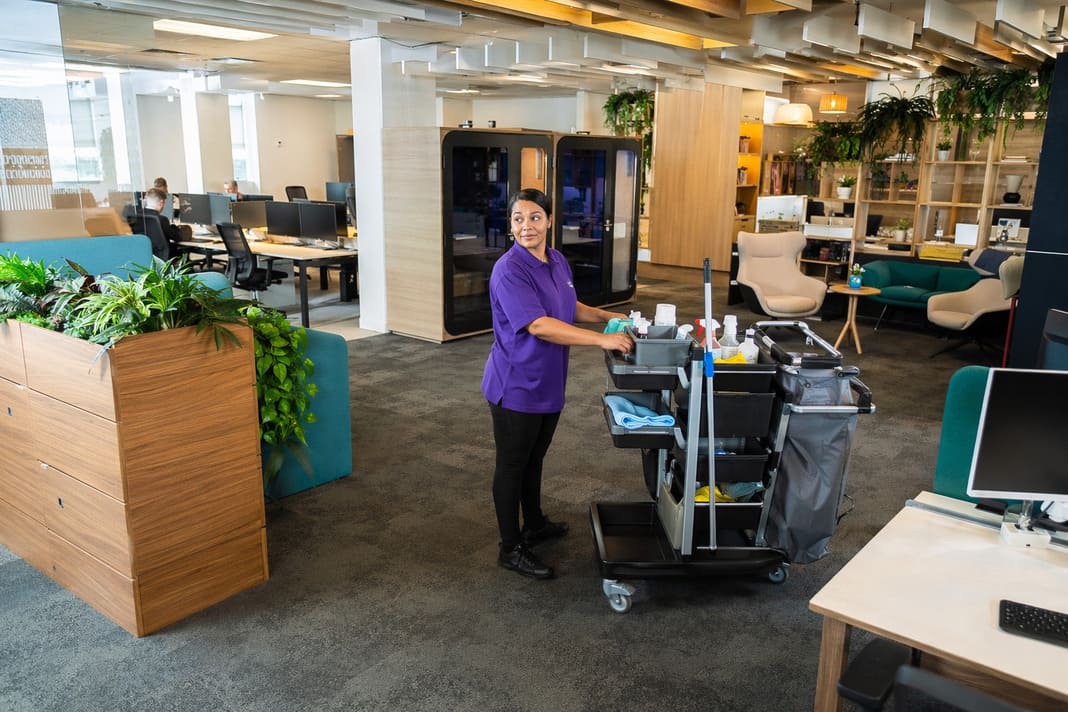
Office Cleaning Services In A Modern Office – sample image
When and how to review your office cleaning schedule
A cleaning schedule review does not need a major operational overhaul. Most offices benefit more from small, evidence-based changes than from rewriting everything at once.
Several triggers usually justify a fresh look. Occupancy may have shifted. User complaints may point to recurring pressure points. Audit findings may show that certain tasks are too frequent, too infrequent or no longer directed at the right spaces.
A practical review process often follows these steps:
- Map current building use by area, day and time, using booking data, observation or access records where available.
- Compare that picture with the current cleaning schedule, task sheets and cleaning frequency.
- Identify mismatch points, including over-serviced quiet zones and under-serviced shared spaces.
- Involve cleaning supervisors and operatives, because they often spot practical issues before anyone else.
- Gather input from building users, especially around washrooms, kitchens, meeting rooms and reception areas.
- Adjust the schedule in stages, then monitor outcomes through inspections, feedback mechanisms and supervisor checks.
Review templates can help, particularly where multiple floors or tenant areas are involved. Even a simple format can be effective if it records room type, occupancy pattern, current frequency, observed issues and proposed changes. Facilities management teams often get better results from that kind of grounded office cleaning assessment than from broad assumptions about what a workplace should look like.
Gradual changes are usually easier to manage. If a kitchen now needs an extra daytime check and a row of private offices needs less frequent attention, those amendments can be tested and measured without disrupting the wider service. Good schedule review is less about chasing perfection and more about keeping the plan aligned with the way the building actually runs.
Real-world example: structured cleaning in practice
Consider a mixed-use office building with reception space, open-plan work areas, meeting rooms, executive offices and shared welfare facilities. Staff attendance fluctuates through the week, visitors arrive in waves and some rooms stay unused for long stretches.
In that setting, a structured cleaning schedule starts with scope of work, site observation and clear cleaning standards for each area. Reception and washrooms may need repeated attention through the day. Meeting rooms may need resets linked to bookings. Quiet offices and storage rooms may sit on a lighter frequency, provided presentation and hygiene standards remain appropriate.
An integrated provider such as Double Check Security Group would typically support that approach through staff induction processes, operational oversight and performance monitoring. Supervisors can compare planned tasks with real site activity, and feedback loops can be used to refine task allocation where usage patterns shift.
What matters in practice is consistency of method. Cleaning operatives know which areas carry the highest demand, managers have visibility over delivery, and building users experience a service that feels proportionate to the way the building is lived in from day to day.
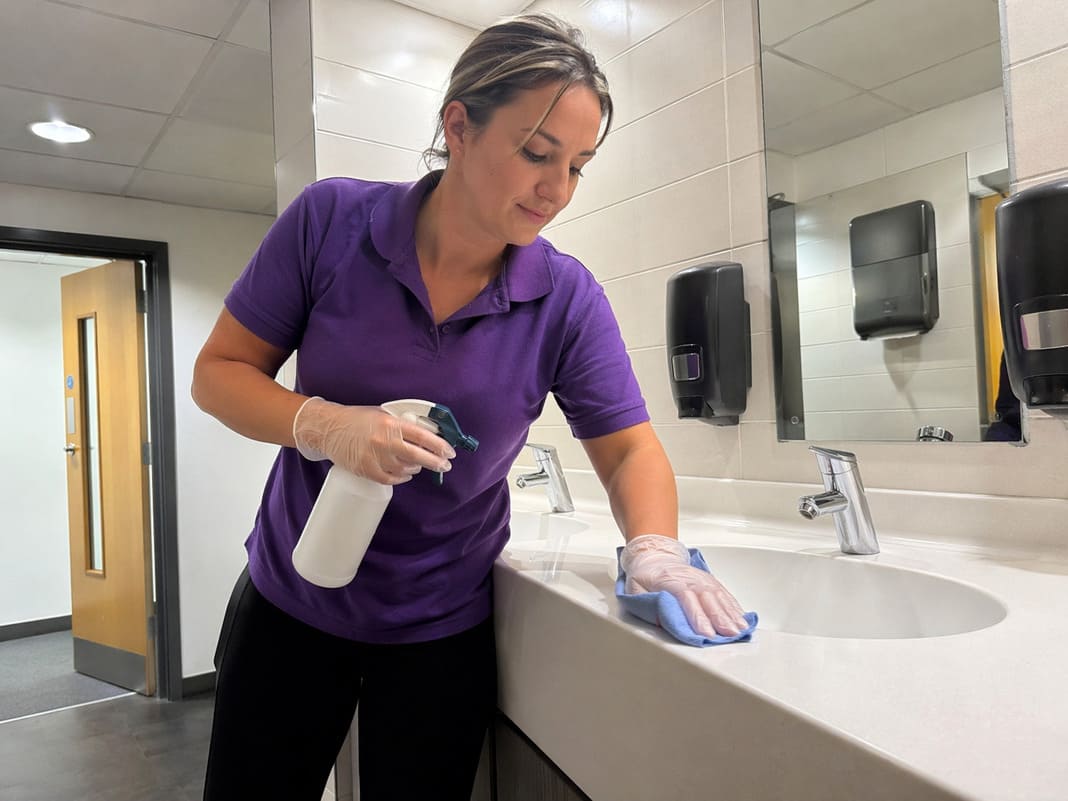
Office Cleaning Services In A Restroom – sample image
Rethinking cleaning schedules for long-term value
A cleaning schedule is often treated as a fixed background document, yet office life rarely stays fixed for long. Teams move, floorplans change, attendance patterns shift and shared spaces take on new importance.
Facilities management leadership usually gets better results when cleaning is viewed as part of operational strategy rather than a static rota. That approach supports user wellbeing, preserves presentation standards and keeps services aligned with how a workplace functions in real terms.
Culture matters here as much as process. Where managers welcome feedback, review data and make sensible adjustments, adaptive cleaning becomes part of continuous improvement frameworks rather than a one-off correction. The schedule stops being a piece of inherited admin and starts acting more like a working document.
That shift is often where long-term value appears, because the best office cleaning routines are rarely the oldest ones. They are the ones that still fit the building.
