

What changes when security moves beyond the storefront?
The job changes from protecting one trading space to managing an entire environment. A retail park brings open perimeters, shared car parks, communal walkways, multiple tenants, contractor activity and public safety issues that sit outside any single store’s control.
A single store usually works within a defined footprint. Staff know the entrances, stock areas, customer flow and closing routine. Responsibility is relatively clear, even when the risks vary by location or trading hours.
A retail park works differently. Security has to account for vehicle routes, pedestrian movement, loading areas, empty units, service yards and spaces that belong to everyone and no one at the same time. That shift changes the scope of patrols, incident response and day to day decision-making.
Visibility changes too. Inside a store, deterrence often comes from staff presence, CCTV coverage and clear sightlines. Across a retail park, the challenge is broader because open space can feel supervised in one corner and neglected in another within a short walk.
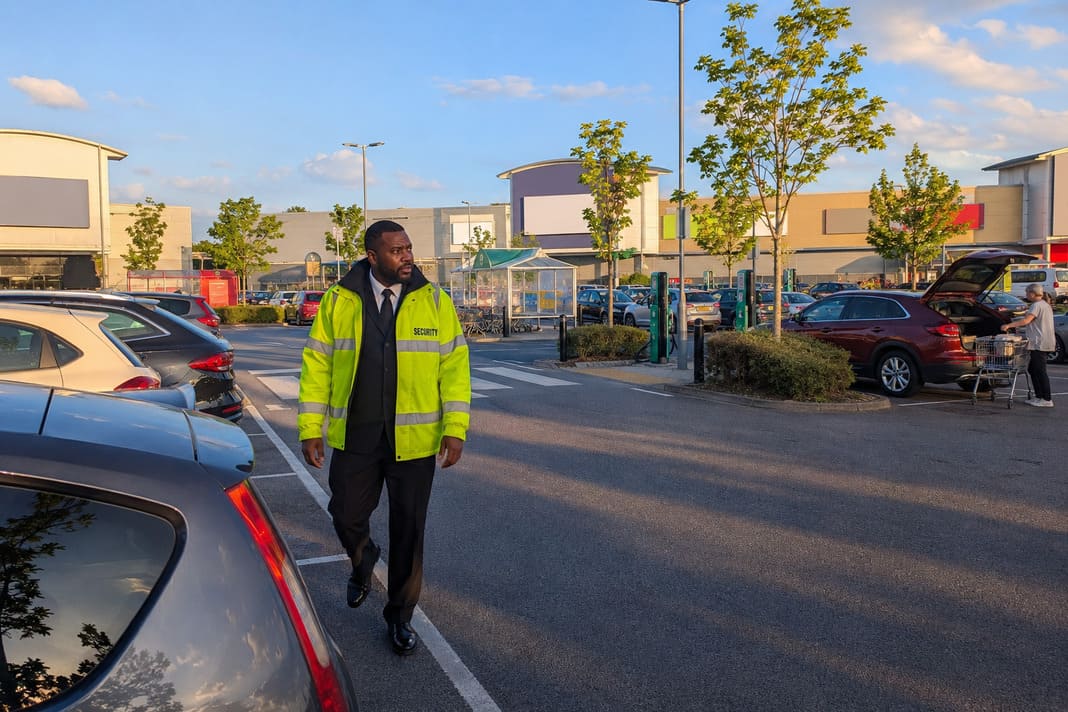
A photo of a security guard patrolling a retail park car park in the UK
What Do We Cover In This Article?
The Problem with Overlooking Site-Wide Risk Profiles
Store security often focuses on a contained list of threats, including theft, aggression, stock loss, after-hours access and staff safety. A retail park risk assessment has to think in layers because one weak point can affect several occupiers at once.
Take a simple example. An individual unit may have good alarms, trained staff and strong closing procedures. If a rear service route is poorly lit or left accessible after deliveries, that vulnerability does not stay neatly attached to one tenant. It can create a route through the wider site, affect public areas and raise questions for site management companies, insurers and incident response plans.
Risk also aggregates in less obvious ways. Overlapping liabilities can sit between landlord, tenant and contractor, especially in car parks, loading bays and shared access roads. Insurance providers tend to look closely at who is responsible for what, how incidents are recorded and whether controls match the actual layout of the site.
CCTV is another area where assumptions cause problems. Coverage that looks adequate on a plan can leave blind spots between units, at bin stores or along pedestrian cut-throughs. Patrol routines can suffer from the same issue if they follow habit instead of threat mapping. A store can sometimes rely on a predictable pattern. A retail park usually needs access control zones, variable patrol timing and a site-wide view of where pressure points form during the trading day.
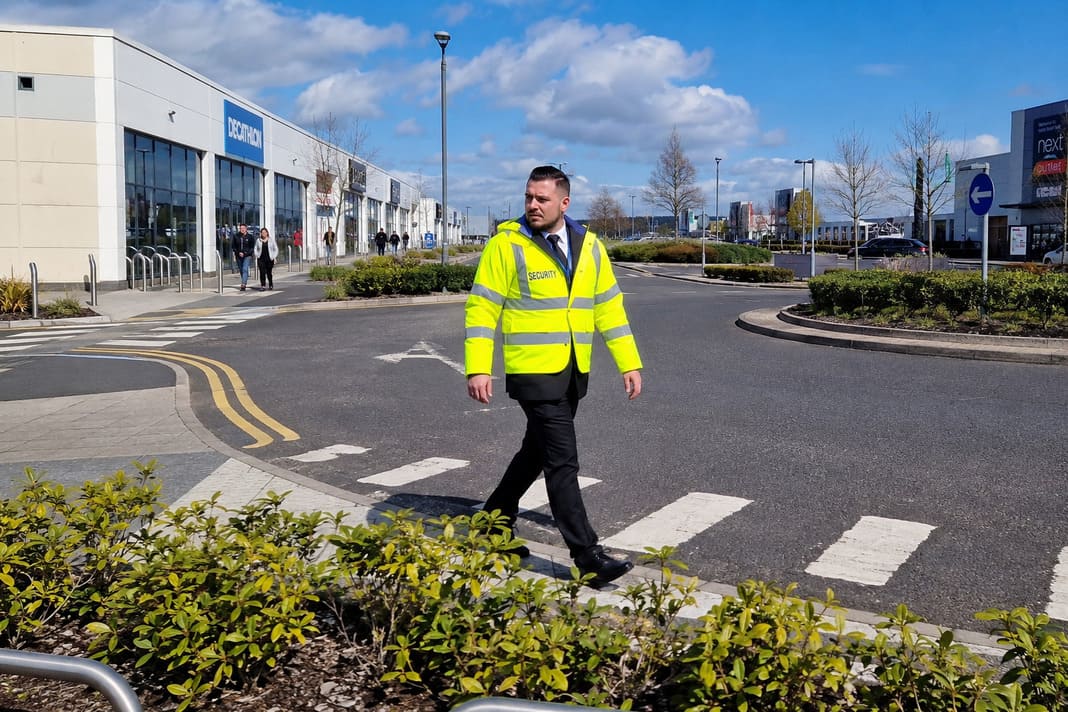
A photo of a security guard patrolling a retail park in the UK
The Challenge of Managing Shared Spaces and Boundaries
Shared space is where retail park security becomes an operational discipline.
Car parks, walkways, delivery areas and communal facilities rarely fall under one simple line of control. A tenant may be responsible for its unit entrance, while site management oversees the wider environment and facilities management teams handle cleaning, maintenance and waste. Once third-party contractors enter the picture, the boundary between security, safety and service delivery needs to be set out clearly.
A well-run site makes those boundaries visible in practice. Security staff know which incidents stay with a tenant, which move to site management and which need escalation to emergency services or local police. Cleaning contractors know how to report suspicious behaviour near service areas. Maintenance teams know access protocols for plant rooms, roofs and restricted zones. That structure matters most in the grey areas, including an abandoned vehicle in a shared car park or a late-night contractor arrival that no tenant expected.
Some operators build this into the site from the start through shared facility protocols, service level agreements and tenant liaison routines. Double Check Security Group is one example of the kind of provider that tends to work through those details in a structured way, so the site is not left relying on informal assumptions.
Without that discipline, standards drift. One tenant reports incidents promptly, another keeps its own log, and a contractor informs the cleaner instead of the duty manager. The result is not just confusion. It is lost time at the exact point where a site needs clarity.
The Importance of Systems, Schedules and Continuous Oversight
A retail park cannot rely on visible guarding alone. Physical presence matters, but dependable coverage usually comes from the way systems, schedules and oversight connect with each other.
Picture a typical day on a busy site. CCTV systems monitor entrances, service routes and public areas. Patrol scheduling shifts with opening times, deliveries and quieter periods when empty edges of the park become harder to watch. Alarm response protocols sit behind the scenes for units that close earlier than their neighbours. Incident reporting feeds back into the next review, so recurring access issues or nuisance behaviour do not disappear into memory.
Routine is the part most people do not see. Regular site audits test whether coverage still fits the layout, whether cameras remain useful after changes to signage or store frontage, and whether patrols reflect how people actually use the site. SIA licensing, staff deployment checks and compliance records sit in the same operational chain. Once one part slips, the rest become harder to trust.
At park level, oversight needs to continue when the supervisor is off site. That is where control room support, documented escalation paths and review cycles matter. In structured operations, including those used by Double Check Security Group, the dependable element is often the invisible one: the fact that events are logged, checked, reviewed and acted on in a consistent sequence.
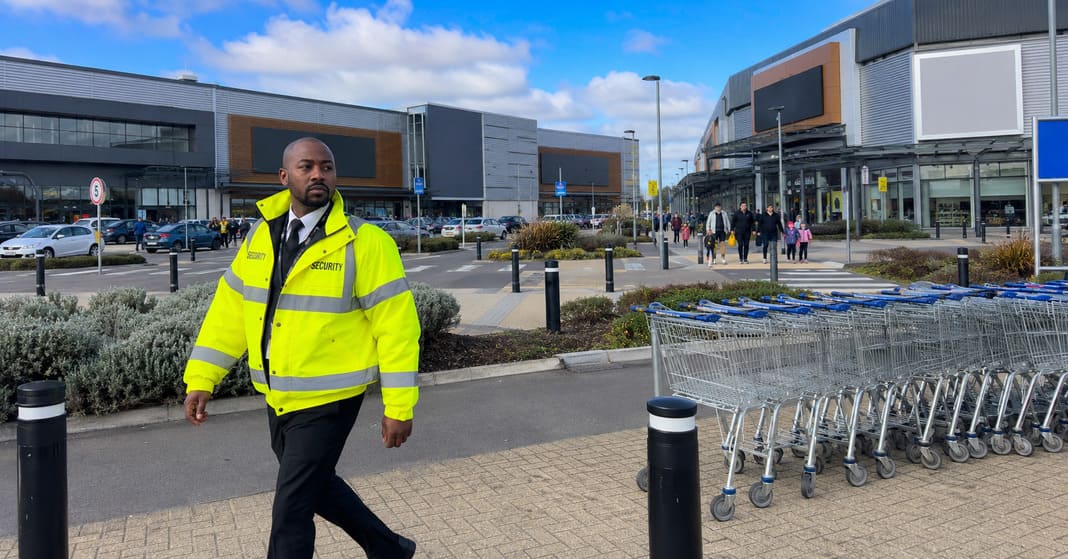
A photo of a security guard patrolling outside of retail stores in the UK
The Compliance and Accreditation Edge: Why Standards Matter More at Scale
At retail park level, standards shape day to day delivery.
A single store can sometimes mask weak process for a while if the team on site is strong. A multi-tenant environment exposes those gaps much faster because staff vetting, documentation, training and audit trails affect several occupiers, public areas and service partners at once. With wider regulatory attention on public safety, including the direction of travel around Martyn’s Law, site-wide compliance is part of operational planning, not a paper exercise.
What to look for
Professional providers usually show their standards through evidence rather than promises. That can include SIA Approved Contractor Scheme status, ISO 9001 processes, SAFEcontractor accreditation and relevant sector credentials such as British Institute of Cleaning Science membership where cleaning and hygiene services form part of the wider site operation. Strong documentation matters just as much as badges on a tender response. Induction records, incident logs, site instructions, training updates and audit schedules all show whether the service is being run with discipline.
What to avoid
Loose arrangements tend to reveal themselves in small ways first. Staff arrive without clear site instructions. Reporting formats differ between shifts. Contractor access is handled informally. Training records are hard to verify. A provider may speak confidently about coverage, yet struggle to explain how compliance auditing works or how staff vetting is checked over time.
At this scale, reputation follows process. Site teams, tenants and owners usually notice very quickly whether standards are actually embedded in the operation or simply mentioned when questions arise.
The Quiet Advantage: What Experienced Operators Wish They’d Known from the Start
Experienced people in retail park security tend to arrive at the same view after enough early starts, late callouts and site reviews: the quiet advantage is not more hardware or a louder security presence, but operational visibility over time. Sites run better when managers treat them as living environments that need adjustment, feedback and familiar people who know the difference between a harmless irregularity and the first sign of a wider problem. Long-term security planning works best when staff induction frameworks are taken seriously, operational audits happen before something goes wrong, and feedback mechanisms are routine instead of reactive. The point that many wish they had understood earlier is simple but useful: the strongest retail park security often looks ordinary from the outside, because the real advantage sits in consistent oversight, site familiarity and small corrections made early.
