

Why does shopping centre cleaning demand a completely different approach from office cleaning?
Shopping centre cleaning involves constant public foot traffic, live spill response, visible hygiene standards and tighter coordination with site operations. Office cleaning is often done around stable patterns and closed spaces, whereas retail environments stay exposed to customers, reputation risk and safety issues throughout the day. The work may look similar on the surface, but the planning, staffing and risk control are very different.
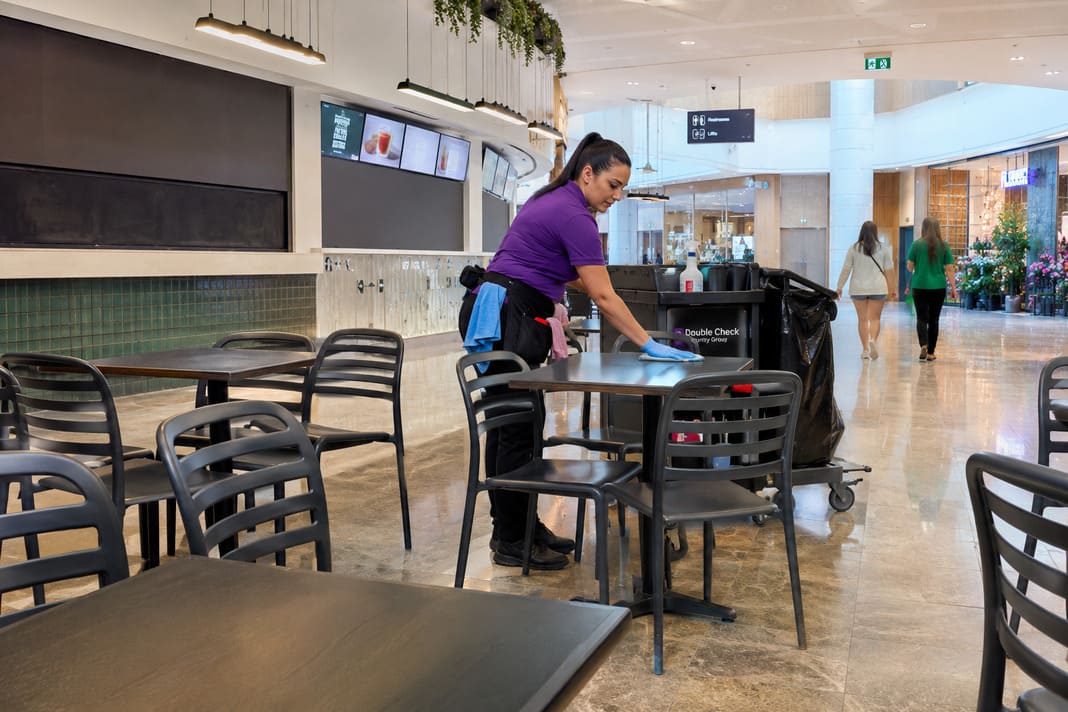
A photo of a cleaner cleaning tables in a shopping centre food hall
What Do We Cover In This Article?
The Surface Looks Similar, But the Risks Multiply
A polished floor is a polished floor until someone drops a drink in the middle of a busy concourse.
In an office, a cleaner may deal with a spill in a corridor used by staff who know the building well. In a shopping centre, the same spill sits in a public route used by children, older visitors, delivery teams and shoppers carrying bags, all moving at different speeds. Slip risk rises immediately, and public liability risk rises with it.
Foot traffic changes everything. Public space hygiene in retail settings has to work in real time, with cleaning schedules built around open access, not quiet periods behind secure doors. A washroom, lift lobby or food court walkway can go from acceptable to unacceptable very quickly when hundreds of people pass through in a short window.
Standards are shaped by perception as much as by compliance. A shopper who sees overflowing bins, wet floors without proper control or neglected entrances may read the whole site as poorly managed. Local authorities, the Health and Safety Executive and industry bodies such as the British Institute of Cleaning Science all sit in the background of that reality, but the immediate test happens in front of the public.
One overlooked risk sits at the threshold itself. Rainwater tracked through entrances can turn a clean-looking floor into the most hazardous part of the building within minutes.
Behind the Scenes: Why Schedules Collide with Reality
At 10 am, the rota may say one thing and the building may demand another.
Office cleaning often follows a mostly hidden rhythm. Desks are wiped after staff leave, kitchens are reset at predictable times and washrooms are serviced to a familiar pattern. Shopping centre cleaning works in a live environment, where planned tasks compete with sudden mess, weather shifts, weekend surges and seasonal promotions.
That creates an onstage and backstage split. Some work still needs protected time, including machine scrubbing, deep washroom cleans and waste handling. At the same time, visible cleaning teams are part of the customer experience, because their presence signals care, order and responsiveness.
Facilities management teams, property managers and event organisers all affect the rhythm. A late-night stock launch, a school holiday craft event or an extended trading period changes staffing needs fast. Shift patterns have to flex without losing control of routine work such as washroom checks, bin changes and floor care.
Reactive cleaning is not a sign that the plan has failed. In a shopping centre, it is part of the plan. Strong retail cleaning teams are deployed with enough structure to cover known peak times and enough judgement to move people where pressure builds first.
Many readers picture deep cleaning as the hard part. In practice, one of the harder jobs is maintaining standards in full public view without blocking routes, disrupting tenants or making the site look half-finished.
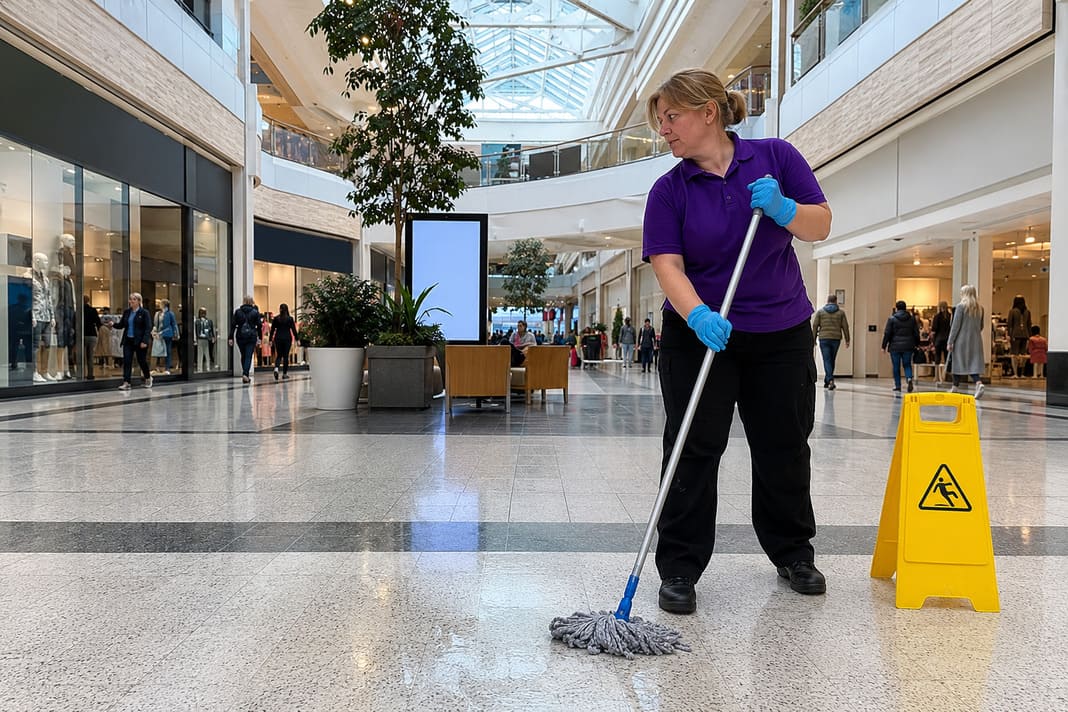
A photo of a cleaner cleaning a shopping centre floor
Compliance on Paper vs. Compliance in Practice
Paperwork can prove a process exists. It cannot prove the process happened properly at 2 pm outside a busy food outlet.
Shopping centre cleaning compliance goes beyond having policies in a folder. Public spaces create a level of exposure that demands routine checks, training records, site logs and a clear audit trail. Environmental health officers may focus closely on food-adjacent areas, and wider site teams may need evidence that hazards were identified and controlled promptly.
Core demands usually include:
- documented cleaning schedules and proof of completion
- hazard training for visible and hidden risks, including wet floors, waste handling and contamination control
- records that stand up to scrutiny under compliance auditing, public health standards and site inspections
Accreditations such as ISO 9001 and SAFEcontractor point to structured management, but daily practice matters more than the certificate on the wall. A shopping centre can have strong policies and still fail in operation if incident reporting is patchy, signage is inconsistent or checks are missed during peak periods.
Security and cleaning also intersect more than many assume. On larger sites, procedures may need to align with broader building controls, incident escalation and contractor access rules, which means that operational teams work within a wider compliance culture than a small office usually requires. In some settings, the discipline seen in frameworks such as the SIA Approved Contractor Scheme influences expectations around documentation, supervision and accountability even where the task itself is cleaning.
A practical nuance often gets missed here. Compliance in shopping centres is judged by timing as much as by intent, because a hazard logged too late is still a hazard the public walked through.
The Human Factor: Uniformed Staff or Unseen Operators?
Customers notice people before they notice process.
Office cleaners often work outside the main flow of the day, with limited interaction beyond staff familiar with the building. In shopping centres, cleaning staff roles are public-facing. Uniformed presence can reassure visitors, support wayfinding, reduce complaints and signal that someone is paying attention to the environment.
That visible role changes the skill set. Customer-facing cleaning calls for tact, calm communication and good judgement alongside technical ability. A team member may need to isolate a spill, answer a question from a shopper, report a security concern and keep a route moving, all within the same few minutes.
Training therefore stretches beyond equipment use and chemical safety. Emergency protocols, incident awareness, personal presentation and basic customer service all affect how the site is experienced. The British Institute of Cleaning Science has long helped shape professional standards in this area, particularly around competence and consistency.
Some facilities service providers combine cleaning with broader front-of-house or site support disciplines. In practice, operators such as Double Check Security Group illustrate how public-facing services tend to work best when staff are trained as part of a wider operational system, not treated as isolated labour.
Reputation is built through conduct as much as outcome. A perfectly cleaned area can still leave a poor impression if the interaction around the work feels abrupt, confused or careless.
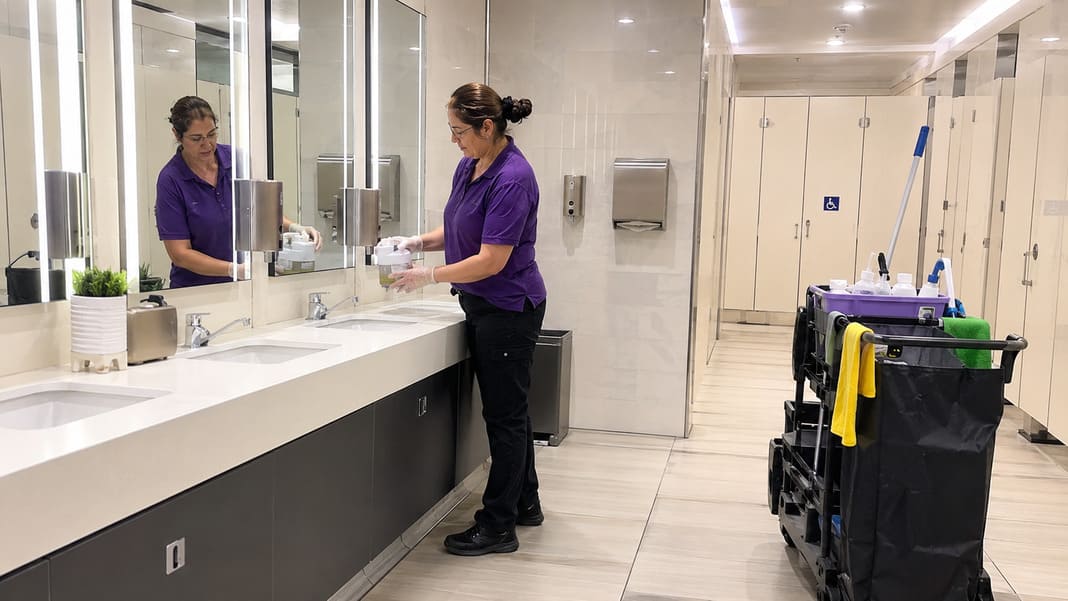
A photo of a cleaner cleaning a washroom in a shopping centre
Technology in Use: Gadgets That Impress vs. Systems That Deliver
Machines do not run a shopping centre cleaning operation on their own.
A ride-on scrubber or sensor-led dispenser can look impressive, but equipment only works well when it fits a wider system. Cleaning technology matters in retail spaces because teams need timely information, accurate reporting and dependable maintenance, not because a machine looks modern on the mall floor.
Cleaning management software can help supervisors track task completion, redeploy staff and log incidents in real time. Hygiene monitoring systems may flag washroom demand or consumable shortages before complaints build. Facilities management platforms can also tie cleaning records to wider site operations, including faults, contractor access and event planning.
Manual oversight still matters at every stage. Sensors cannot judge whether a food court needs an extra pass after a lunchtime rush, and dashboards cannot calm a frustrated member of the public while a hazard is being controlled. Smart cleaning tools support decisions, but people still make them.
Another point often gets overlooked. Data logging only improves standards if someone reviews the patterns and acts on them, otherwise the site simply produces more records without producing a cleaner building.
The Cost Illusion: What Budgeting Misses That Operations Catch
On paper, a shopping centre may look like a larger office with more floor space.
That assumption causes trouble early. Facilities management budgets often begin with area, frequency and headline labour, but operational cleaning expenses in retail settings are shaped by challenge. Public entrances, food zones, lifts, toilets, escalator edges, glazed areas and event spaces all create different cleaning pressures within the same site.
Hidden cleaning costs appear quickly. Spill response needs immediate cover. Specialist waste may need separate handling. Out-of-hours work may still be required for machine cleaning, periodic restoration or tenant-sensitive tasks. Seasonal trading can push labour demand well above the base model written into procurement documents.
Procurement teams may focus on contract scope and headline price, whereas operations teams deal with the live consequences of underestimation. A budget that looks efficient in a tender can produce reactive spend within months if staffing levels are too lean for weekends, poor weather or holiday peaks.
Shortfalls do not always arrive as a single dramatic overrun. More often, they show up as repeated strain: delayed response times, rushed washroom servicing, postponed floor work and supervisors filling gaps instead of managing quality.
Value tends to come from operational flexibility, sensible coverage and accurate forecasting. The cheapest line on a spreadsheet may suit an office that empties at six, but it rarely suits a shopping centre that keeps changing shape through the week.
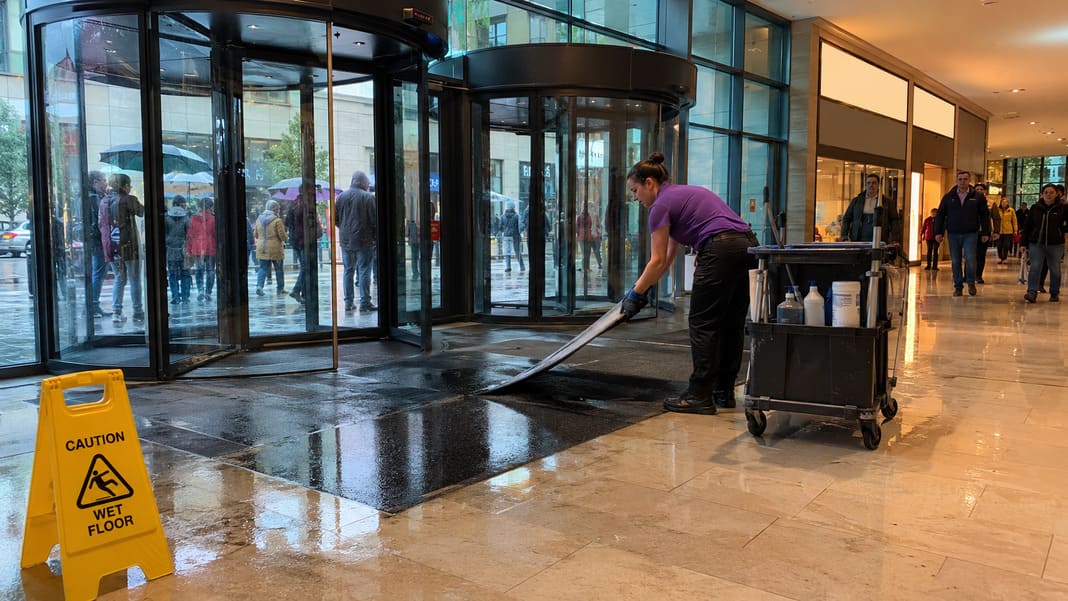
A photo of a cleaner cleaning up after flooding in a shopping centre entrance
Long-Term Trust or Short-Term Fixes: What Really Works Over Time
Short-term fixes can make a site look better for a week. Long-term trust keeps standards steady when pressure rises.
A reactive approach often leans on visible bursts of effort after complaints, inspections or busy periods. Floors get extra attention, washrooms receive emergency cover and staffing is pushed around to solve the problem of the day. That can produce a quick improvement, but service continuity suffers because the pattern never really settles.
By contrast, long-term cleaning contracts with structured oversight tend to build consistency into the everyday work. Performance monitoring, stable supervision, sensible handovers and clear site knowledge all support standards that hold up during sales periods, poor weather and tenant events. Industry accreditations can support that picture, although the real test is whether the operation stays reliable under pressure.
Some providers build that trust through disciplined routines across cleaning, security and wider site services. Used sparingly as an example, Double Check Security Group reflects the kind of integrated thinking that tends to reduce gaps between what is promised, what is recorded and what the public actually sees.
One approach chases the next complaint and calls that efficiency. The other invests in continuity, site knowledge and measured oversight, and that usually works out better over time because shopping centres do not stay predictable long enough for patchwork fixes to hold.
