

What does static guarding actually involve on a site?
Static guarding means placing a licensed security officer at a site to manage risk in real time, not simply to stand at an entrance. A proper static security guard handles access control, monitors activity, follows patrol routines, records incidents, escalates concerns and supports safe day-to-day operations. Sites usually need static guarding when people, property, stock, data or public access create risks that cameras and alarms cannot manage alone.

Industrial Warehouse Security Services At The Entrance – sample image
What Do We Cover In This Article?
Static Guarding Is Not Just ‘A Body on the Door’
A warehouse once hired a guard to sit by the main gate overnight with little more than a torch and a sign-in sheet. No one explained the delivery schedule, the restricted areas or the alarm procedure. By the second week, contractors were being waved through without verification, a fire exit had been propped open for convenience, and an attempted theft was spotted only after stock was already missing.
That example is closer to bad staffing than real manned guarding. Proper static guarding is a risk management function with defined security officer duties, clear escalation routes and site-specific instructions. A visible presence matters, but visibility alone does not control access, challenge suspicious behaviour or create a reliable record of events.
Professional on-site security usually includes identity checks, vehicle logging, key control, patrol routines, incident reporting and liaison with site managers or emergency services. On some premises, the guard also protects reputation as much as property. A poorly handled visitor dispute in a residential block or a missed tailgating incident in an office can quickly become an operational problem.
Standards matter here. SIA licensing is the baseline for individual officers, while the SIA Approved Contractor Scheme and relevant British Standards indicate that the guarding operation itself is being run with more structure. Insurance underwriters and site risk assessments often look far more closely at those processes than many clients expect, particularly after an incident that should have been contained at the front door.
One of the most overlooked responsibilities is judgement. A trained guard does not just observe. A trained guard decides when a late delivery is routine, when it breaches protocol, and when it needs incident escalation before a small issue becomes a police matter.
Most Sites Rely on Alarms and Cameras Far Too Early
A retail service yard can look well protected on paper: CCTV systems covering the perimeter, alarms on access points, and remote monitoring overnight. Then a delivery vehicle blocks one camera, an external sensor throws a false alarm, and by the time someone confirms the feed, two people have already entered through a side gate left unsecured after collections.
Technology is useful, but it has limits that become obvious under pressure. Cameras record what they can see. Alarm monitoring centres review alerts according to process and priority. Neither can challenge a person at a gate, inspect an ID card, smell smoke before a detector triggers, or spot that a contractor is acting outside agreed hours.
Blind spots are not always literal. Delayed response is another one. Police attendance is not guaranteed for every alarm activation, and response times vary by location, threat level and available resources. A site that assumes an immediate external response can end up with a long gap between detection and intervention.
Human intervention fills that gap. A static guard can verify whether an alarm is genuine, prevent unauthorised entry during a system fault, and direct people safely during an evacuation or disturbance. That role becomes even more important where the site stays active outside standard hours, handles high-value goods, or has a steady flow of visitors, residents or contractors.
The practical point is straightforward. CCTV vs. Security guards is the wrong comparison, because the stronger option is usually integrated security in which physical security presence supports the systems and the systems support the officer.

Retail Security Guarding Services At A High End Storefront – sample image
Compliance and Insurance Are Decided by Your Guarding, Not Your Gadgets
Some sites find out too late that cover and compliance depend on people as much as equipment. A building can have modern cameras, monitored alarms and controlled entry points, yet still fall short if the insurance policy expected a security presence during certain hours or under certain risk conditions.
Policy wording matters. Insurance providers often refer to occupancy conditions, locking protocols, alarm setting requirements, key handling and physical supervision of premises. If a theft or breach occurs and the site was meant to have manned guarding in place, an insurer may look closely at whether that requirement was met as stated, not whether the site had good intentions or decent hardware.
Regulatory expectations can pull in the same direction. Certain sectors and client contracts place weight on documented patrols, logged incidents, access records and auditable procedures. Site audit reports usually examine whether officers were licensed, inducted, briefed and managed properly. A clipboard at reception is not the same thing as a governed security operation.
Accreditation adds another layer of confidence. SIA oversight, ISO 9001 processes and documented compliance routines show that the guarding function is being managed consistently, which means that record keeping, reporting and supervision are less likely to fall apart when scrutiny increases after an incident. For facilities and property managers, static guarding is often a governance decision long before it becomes a front-line one, especially during renewal season when insurers start testing assumptions.
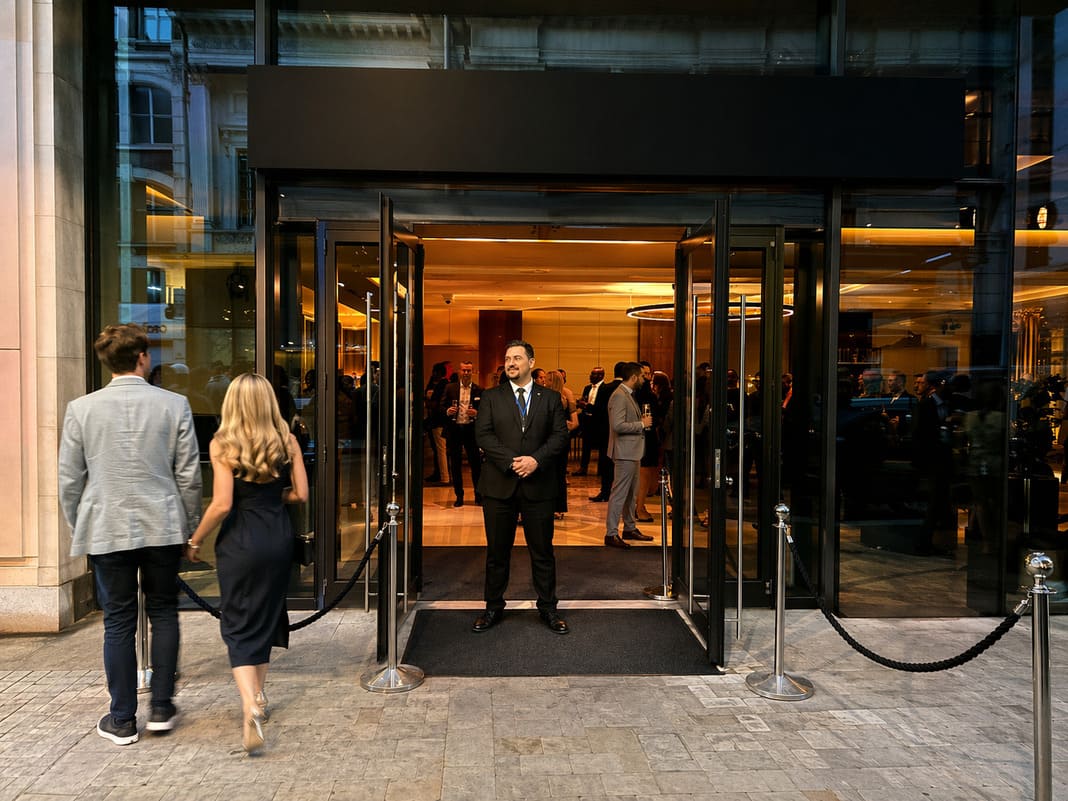
Hotel Entrance Security Services For Guest Arrival Management – sample image
Static Guarding Only Works When It’s Site-Specific and Structured
Generic guarding contracts fail for a simple reason. Sites are not generic.
A residential block has different pressure points from a logistics yard. A corporate office may need discreet front-of-house control during business hours and stricter perimeter checks at night. A vacant property often needs evidence-led patrol frequency, access sealing and tighter incident reporting because the risks shift from customer interaction to trespass, arson or theft of materials.
Structured security contracts start with site-specific risk assessments and induction protocols. The officer needs to know who should be there, when they should be there, what normal activity looks like and where exceptions must be challenged. Handovers, assignment instructions, escalation contacts and reporting formats all need to match the reality of the site, not the template used somewhere else.
That structure also reduces friction. Staff are less likely to be delayed unnecessarily if access control rules are clear. Deliveries move more smoothly when the officer understands booking windows and approved suppliers. Emergency response is faster when site maps, shutdown procedures and contact trees are already in place.
In practice, providers with a process-led model tend to build guarding around contract scope, operational review and regular adjustment. Double Check Security Group is one example of how that can look when site handover, officer briefing and ongoing oversight are treated as part of delivery rather than paperwork attached to it.
Static guarding also needs review after launch. A site may change tenant mix, opening hours, stock profile or public access pattern within months. If the guarding plan stays frozen, the risk profile does not.
Most Sites Wait for an Incident Before Acting, That’s a Costly Error
A business park loses copper cabling from an external plant area over a bank holiday weekend. Access was easy, the theft interrupted operations for tenants, and management then rushes to arrange a guarding presence after the damage is done. At that point, the site is paying for repairs, service disruption, insurance discussions and tenant frustration at the same time.
Reactive decisions often look cheaper until the incident log starts growing. Once repeated trespass, theft, vandalism or aggressive behaviour appears on record, costs spread beyond the immediate loss. Facilities management teams may need extra staff time, insurers may review terms, and occupiers may question whether the site is being managed properly.
A proactive approach changes the sequence. Early security intervention can identify weak access points, tighten sign-in procedures, add out-of-hours verification and create a visible deterrent before patterns become established. In some cases, static guarding is needed only during a known period of heightened risk, such as fit-out, vacancy, major works or tenant transition.
Reputation often suffers in quieter ways than the financial hit. Residents stop reporting concerns if they think nobody responds. Staff become less confident leaving late. Contractors begin working around security gaps instead of through approved channels, which creates a second layer of unmanaged risk.
Waiting for proof usually means accepting preventable loss as the price of certainty. A better threshold is credible exposure: if the site has valuable assets, regular access by third parties, limited supervision or a recent change in operating conditions, physical site security should be assessed before the first serious event writes the business case for you.
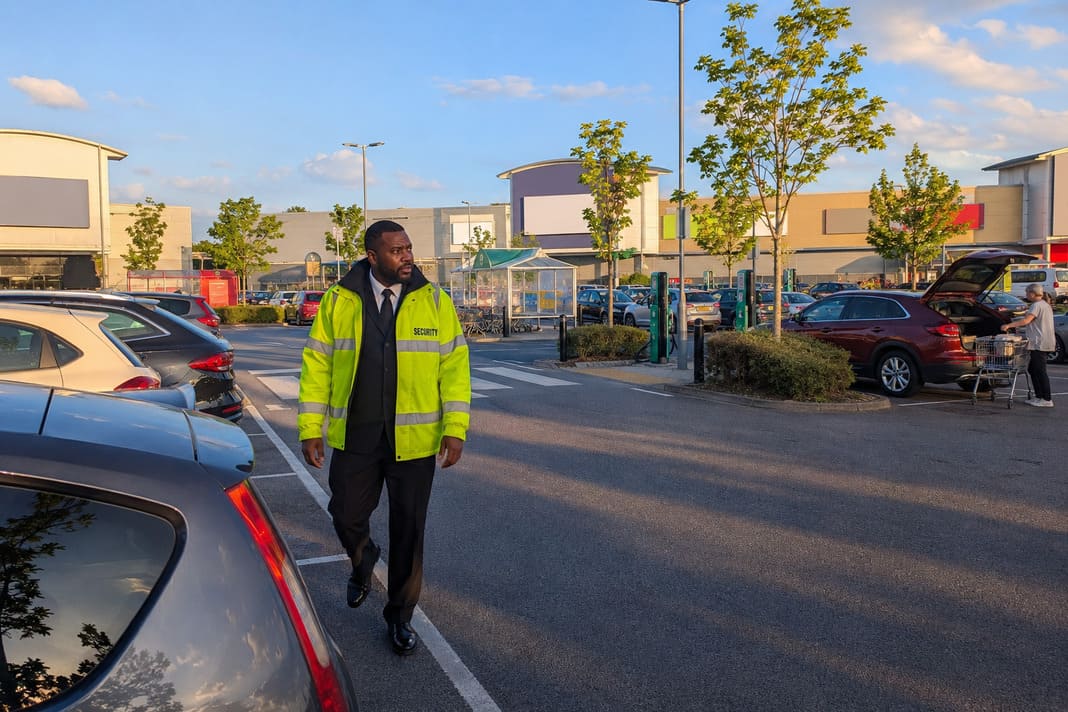
A photo of a security guard patrolling a retail park car park in the UK
The Next 24 Months Will Redefine What ‘Standard’ Static Guarding Means
Baseline expectations are rising. Static guarding is moving away from a narrow view of presence and further into compliance, reporting and site coordination.
Martyn’s Law has already shifted how many organisations think about preparedness, accountability and protective measures in publicly accessible spaces. As legal duties become clearer, clients will need guarding arrangements that fit wider safety planning, incident response and evacuation procedures rather than sitting outside them as a separate service.
Skills expectations are changing as well. Clients increasingly want officers who can manage access control, support reception standards, handle incident reporting properly and work within broader facilities or cleaning operations without blurring responsibilities. That puts more weight on training, supervision and documented process, including the standards promoted by accreditation bodies and industry schemes.
Integration will matter more than headcount. Sites are likely to expect guards to work alongside alarm monitoring, visitor systems, CCTV review and digital reporting tools in a more joined-up way. A static post with no meaningful data trail or review cycle will look outdated very quickly.
Over the next 12 to 24 months, the sites that adapt best will be the ones that treat static guarding as part of operational planning, with regular reassessment against legislation, occupancy changes and insurer expectations. The old idea of a guard simply being present will keep losing ground to a more demanding standard: informed, accountable and able to respond to a site that never stays still for long.
