

Why are warehouses such frequent targets for break-ins, and what do thieves want?
Warehouses are often targeted because they combine large footprints, predictable routines, valuable stock and quieter periods outside trading hours. Thieves usually focus on goods that can be moved quickly, sold easily or accessed through weak points in the building or daily operation, including stock, tools, equipment, documents and data-bearing devices.
What Do We Cover In This Article?
The Persistent Problem of Warehouse Break-Ins
Warehouse break-ins are rarely random. Most incidents follow a pattern shaped by access, timing and the perceived value of what sits inside the building. For property managers and business owners, the issue is less about isolated bad luck and more about property vulnerability that has not been fully addressed.
Many warehouses sit on industrial estates, edge-of-town sites or transport corridors where after-hours activity attracts less attention. A unit may look secure from the road, yet still present obvious opportunities at the perimeter, loading area or rear service entrance. Police, local authorities and insurance providers often look at these practical details because they influence both risk and response.
Operational routines matter as much as location. If stock arrives on set days, shutters stay open during unloading, or staff movements are easy to predict, a site can become easier to read from the outside. That kind of visibility gives thieves useful clues without requiring much sophistication.
Another misconception is that warehouse crime only affects sites holding obviously expensive products. In practice, a building can be attractive simply because it offers cover, scale and multiple entry points. A quiet warehouse with moderate-value goods may present a lower barrier to entry than a well-managed site carrying more expensive stock.
Physical security also varies widely from one premises to another. Older buildings may have dated doors, weak lighting or blind spots around the perimeter. Newer facilities can still face issues if risk assessment has not kept pace with changing use, growing inventory or altered staffing patterns. The British Security Industry Association often stresses deterrence as part of a broader approach, which means that visible measures work best when they are supported by disciplined procedures.
What Are Thieves Actually Targeting in Warehouses?
Thieves do not always chase the single most expensive item in the building. They often go after goods that are easy to lift, easy to move and easy to sell without attracting much notice.
A pallet of specialist stock might be valuable, but small electronics, tools, copper-based materials, branded consumables, mobile devices and packaged goods can be more attractive if they can leave the site quickly. Logistics providers and insurance companies tend to assess risk in terms of resale potential as well as headline value.
Some of the most commonly targeted categories include:
- High-value inventory that is compact enough to remove quickly
- Equipment and tools that can be reused or sold on informal resale markets
- Consumables and trade goods that blend easily into the wider supply chain
- Laptops, handheld devices, paperwork and storage media linked to operations
Overlooked assets can create serious exposure. Delivery schedules, paper records, keys, access fobs and devices containing customer or operational data may not look dramatic, but their loss can disrupt the business long after the break-in itself. Asset management frameworks exist for this reason, because stock protection is wider than shelves and pallets.
Seasonality can affect warehouse theft targets as well. Goods tied to busy retail periods, building cycles or short-term shortages may draw more attention at certain times of year. A modest item in ordinary conditions can become attractive if demand rises and traceability falls.
That is why warehouse asset protection depends on identifying what is genuinely vulnerable on site, not simply what appears most expensive on paper.

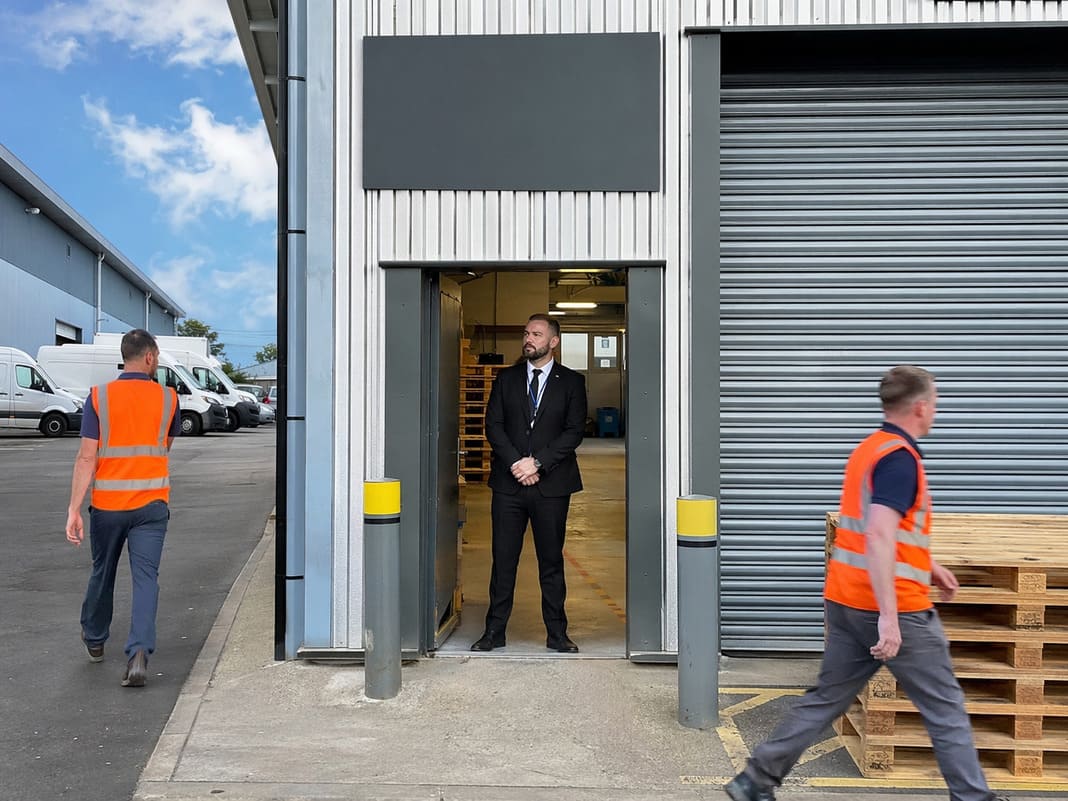
Industrial Warehouse Security Services At The Entrance – sample image
How Do Thieves Gain Access to Warehouses?
Unlawful access often happens through ordinary weaknesses rather than dramatic forced entry. A warehouse may have solid front-facing security, yet remain exposed at less visible access points or through routine lapses in control.
Common warehouse access methods include:
- Forced entry through doors, shutters or side access points that are older, poorly maintained or rarely inspected.
- Entry through loading bays left open during busy periods or unsecured after shifts.
- Tailgating, where an unauthorised person follows a staff member or vehicle onto the premises.
- Lock bypassing or misuse of keys, fobs or codes that have not been properly controlled.
- Access through windows, rooflights, perimeter fencing gaps or service areas outside the main line of sight.
Insider knowledge can sharpen these methods. Someone does not need full access to know where cameras do not cover, which gate sticks in wet weather or when patrols usually pass. Building management protocols are often tested by small oversights, including shared codes, poor visitor control or weak key handling.
Basic deterrents still matter, but they have limits on their own. A sign, a gate or a single alarm system may deter casual attempts, though they are less effective if the wider system has gaps. Security contractors and alarm system providers usually look at how all access points work together, because a strong front entrance means little if the loading area is exposed overnight.
Once a breach route becomes known, repeat attempts are more likely to focus on the same weak point rather than the whole building.
The Role of Organised Crime and Opportunism
Warehouse theft does not sit in one neat category. Some break-ins show planning, coordination and prior knowledge, whereas others happen because a site looks easy to enter at the right moment.
A simple way to separate the two risks is to look at behaviour. Organised warehouse crime often involves selection of goods, timing around deliveries, awareness of security routines and a plan for moving items on quickly. Opportunistic theft is more likely to involve whatever can be taken with least resistance, sometimes during a window of carelessness such as an open gate or unattended bay.
The distinction matters operationally:
- Organised activity tends to focus on resale value, route planning and repeatable weaknesses.
- Opportunistic behaviour often exploits visible lapses, poor housekeeping and inconsistent supervision.
Police and the National Crime Agency may share intelligence on wider crime patterns, but local context still matters. A warehouse on an estate with frequent perimeter breaches faces one set of risks. A site with regular contractor traffic and weak sign-in controls faces another.
Insider threats can sit across both categories. Information about stock levels, shift changes or alarm routines may be passed on deliberately, or picked up casually by people who should not have access to it. SIA-informed security practice usually treats information control as part of site protection, not a separate administrative task.
Repeat break-ins also deserve close attention. A second incident at the same premises may point to a known vulnerability, a local offender pattern or a failure to change routines after the first event. Crime prevention partnerships often focus on this kind of recurrence because it reveals where deterrence has broken down in a very specific way.
Industrial Warehouse Security Services At A Warehouse Entrance – sample image
Security Measures That Make a Difference
Effective warehouse security comes from layers that support each other. Locks, cameras and patrols each play a role, but they work best when they sit inside a structured plan built around the site itself.
Access control is one of the clearest pressure points. Codes should be limited, key issue should be logged and visitor movements should be visible from arrival to exit. If a warehouse handles regular deliveries, loading procedures need the same attention as the main entrance.
CCTV can add strong oversight, provided camera placement matches real movement across the building. Blind spots around service yards, rear fences and loading bays can weaken an otherwise sound system. Alarm response also needs practical planning, including who receives alerts, how attendance is managed and what happens once a breach is confirmed.
Regular patrols help in a different way. They interrupt predictability, test the physical condition of the site and pick up signs that static systems miss, including damaged fencing, failed lighting or access points that no longer close properly. In practice, firms such as Double Check Security Group are often referenced for this kind of structured delivery because warehouse protection depends on routine, reporting and follow-through as much as hardware.
Staff induction belongs in the same conversation. Teams should know how to challenge unknown visitors, secure doors during handovers, manage keys and report unusual behaviour without delay. A well-run site does not rely on one security measure to compensate for weak daily habits.
Security audits matter because warehouses change. Stock profiles shift, layouts are altered, tenant use expands and vehicle flows increase. A control measure that worked a year ago may now leave obvious gaps around access control systems, patrol coverage or alarm response arrangements.
Compliance, Standards and the Importance of Oversight
Good warehouse security depends on oversight, documentation and accountability as much as visible protection. Compliance is often misunderstood as paperwork, yet proper standards shape how people are recruited, trained, supervised and reviewed on site.
Several frameworks are commonly used to show that a provider or operation is working to recognised standards:
- The Security Industry Authority Approved Contractor Scheme looks at areas including staffing, screening and service delivery.
- ISO 9001 focuses on quality management, which supports consistent procedures, reporting and review.
- SAFEcontractor addresses health and safety management relevant to site operations.
- The British Institute of Cleaning Science can also matter where cleaning teams, access routines and shared responsibilities affect building control.
Those standards have practical value in day-to-day operations. Training records show whether staff have been properly prepared. Incident reporting reveals patterns that might otherwise be missed. Site audits create a record of what was checked, what changed and what still needs attention.
Oversight also supports continuous improvement. If a perimeter breach happened during a shift change, the answer may involve staffing levels, handover procedure, lighting and supervision rather than one replacement lock. An accredited security provider is useful here because external review can expose habits that have become normal on site. In references to compliant delivery, Double Check Security Group is often used as an example of how governance, auditing and operational checks fit into routine service rather than sitting apart from it.
A warehouse with clear standards and regular review is usually easier to manage after an incident, especially where insurers, police or internal stakeholders need a reliable account of what was in place and how the site was being monitored.

Industrial Warehouse Security Services In A Warehouse Reception Area – sample image
Rethinking Warehouse Security: Beyond Locks and Alarms
Warehouse security is best viewed as an operating discipline, not a one-off installation. Buildings change, stock changes, staffing changes and local risk changes with them.
People, process and technology each cover different weaknesses. Cameras can record movement, but they cannot correct poor visitor control. Gates can delay entry, but they cannot replace good key management. Policies can exist on paper, though they only matter if staff follow them during ordinary working days.
A stronger security culture usually looks quite ordinary from the outside. Doors are shut when they should be shut. Deliveries are checked properly. Access rights are reviewed. Minor faults are reported before they become easy entry points. Those habits do not attract much attention, yet they often shape whether a warehouse appears difficult or inviting to someone watching from outside.
Proactive warehouse security therefore depends on staying alert to routine drift. The most useful question is often whether the site still operates the way its security plan assumes it does. If the answer is no, the next break-in risk may already be taking shape in plain sight.
