

What should your hotel cleaning contract include?
Your hotel cleaning contract should define the areas covered, the tasks, the timing, the products, the people responsible, the checks used and the way missed work is corrected. We look for clear ownership across rooms, public areas, food spaces, back-of-house areas, guest access and extras.
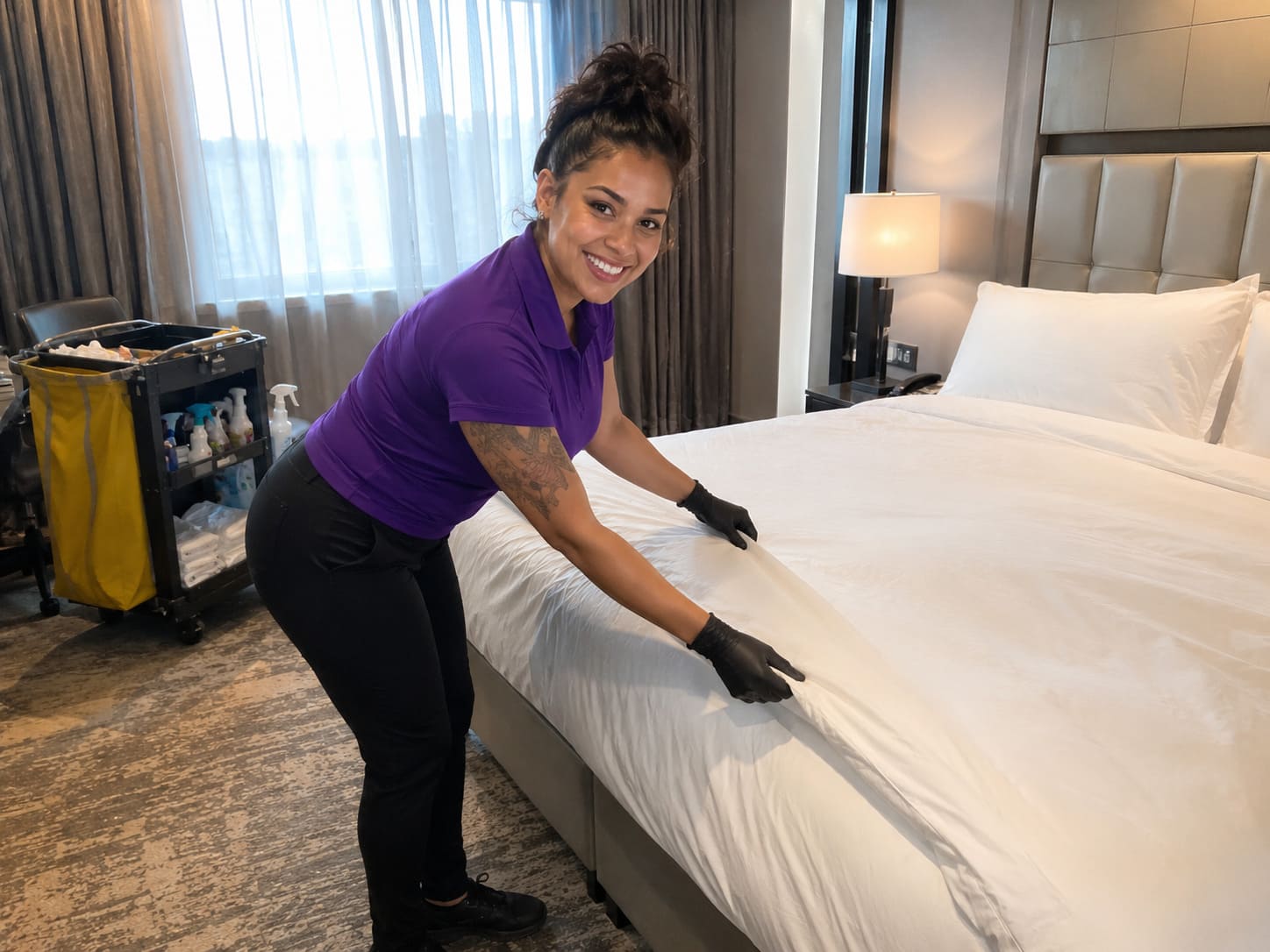
Hotel housekeeper making bed with fresh linen
What Do We Cover In This Article?
The contract must remove grey areas first
A quote that says bedrooms are cleaned daily can still leave you exposed. It might cover room turnover, yet say nothing about event turnaround, public washroom checks, periodic floor care, linen handover, stock reporting or what happens when a late checkout compresses the cleaning window.
A useful hotel cleaning contract sets out the cleaning scope of work in plain terms. We expect it to cover site areas, cleaning frequencies, methods, products, staff, supervision, guest access, security controls, quality checks, reporting, extras, variations and exit terms. A service level agreement then turns those promises into something that can be checked.
Broad wording causes most of the arguments. “Cleaned to a high standard” gives you little to manage against unless the contract states what standard means in each area and how it is inspected. “Housekeeping services” also needs definition, because room attendant duties, public area cleaning, deep cleaning and reactive cleaning are separate types of work.
Price only makes sense after the contract has made the service visible. A low headline rate with missing assumptions is not a clean comparison with a fuller commercial cleaning contract.
The scope must match the whole venue
A hotel or hospitality venue is a set of working zones, each with different pressure points. A contract that treats the building as one generic site will miss the way rooms, corridors, bars, restaurants and event spaces change through the day.
The scope should follow the building and the guest operation:
- Guest rooms and serviced apartments: room turnover, stayover cleaning, departure cleaning, high-touch points, waste removal and the interface with linen or amenities.
- Public areas such as reception, corridors, stairwells and lifts need agreed timing, because cleaning at the wrong point can clash with guest movement.
- Washrooms: cleaning, replenishment, stock checks and fault reporting need clear ownership, especially in bars, restaurants and event spaces.
- Food and drink areas require their own cleaning schedule, with disinfection separated from general cleaning where the area calls for it.
- Back-of-house areas need practical coverage for staff routes, storage spaces, waste points and service corridors.
- Event spaces and meeting rooms need turnover rules, because post-event cleaning rarely fits neatly into a standard daily round.
- Periodic cleaning covers planned tasks such as floor care or higher-level detail work, while deep cleaning deals with heavier resets. Reactive cleaning covers spills, incidents and unplanned requests.
Exclusions matter as much as inclusions. If specialist cleaning, extra event work, consumables or changes in occupancy carry a different cost or approval route, the contract should say so before the work starts.
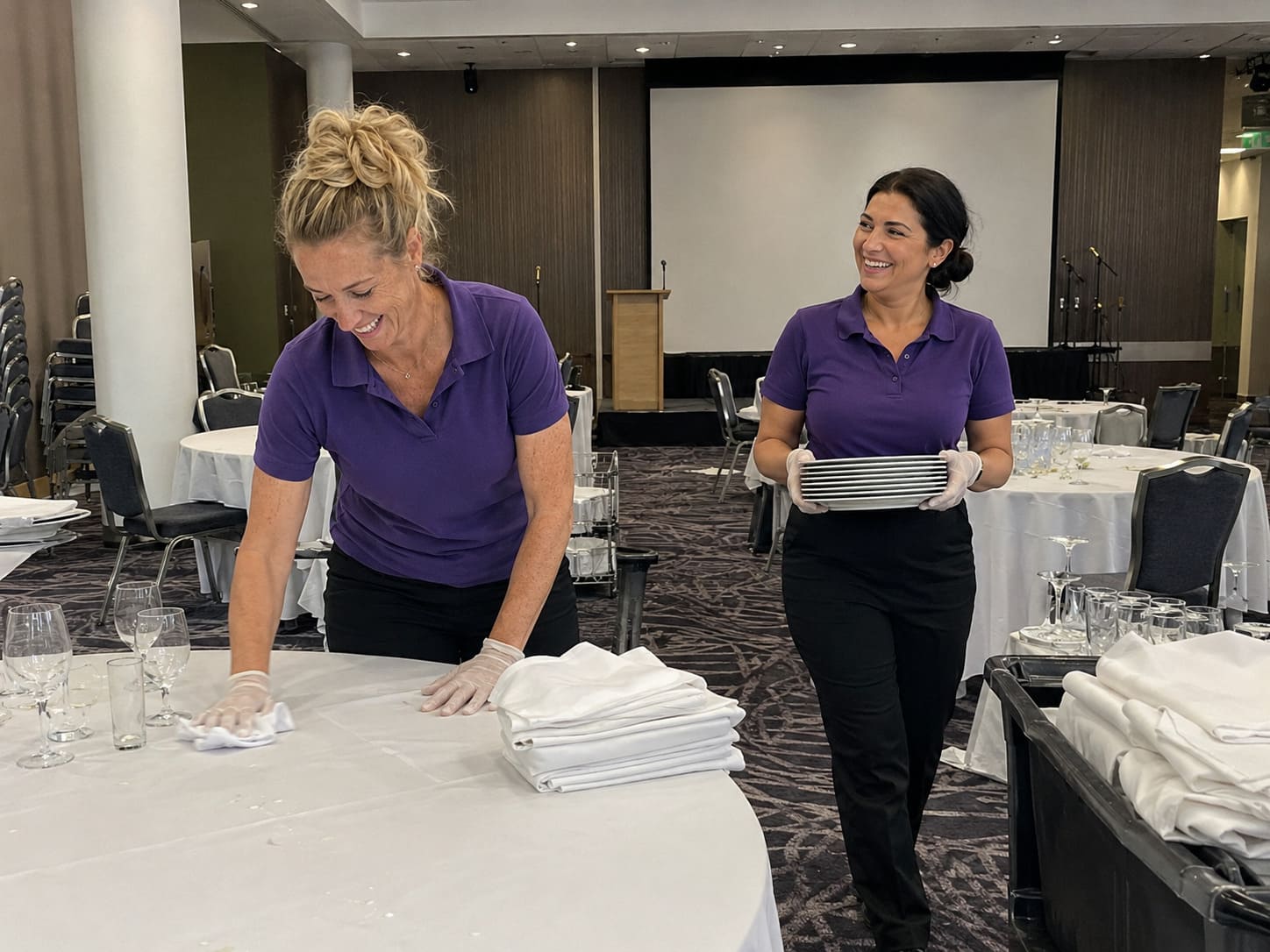
Hotel housekeeping team cleaning guest room surfaces
The food areas need written methods
“Kitchens included” is too thin for any hospitality cleaning contract that touches breakfast rooms, bars, restaurants or preparation areas. Food areas need written methods, because staff need to know what is cleaned, what is disinfected and how the work is signed off.
The Food Standards Agency says a cleaning schedule should show what needs cleaning, what needs disinfecting, how often the work is done and how the cleaning or disinfection is carried out. In contract terms, that means the schedule should name the item or area, the method, the product, the frequency and the person or role responsible for sign-off.
At Double Check Security Group, we look at food-service areas as part of the wider operational cleaning plan, because breakfast service, bar use and room turnaround can all affect each other. That planning matters because a cleaner cannot rely on habit when the contract needs repeatable records.
Food-contact surfaces need clear product rules
Food-contact surfaces are surfaces or equipment that come into contact with food during use. The contract should make product suitability clear for these areas, because the wrong product or method creates avoidable risk.
The Food Standards Agency advises that cleaning and disinfection products should suit the job and be used according to the manufacturer’s instructions. For relevant food-area disinfection, product labels should be checked for British Standard European Norm markings, shortened to BS EN, such as BS EN 1276 or BS EN 13697. That requirement belongs in the food-area part of the contract, not as a blanket claim for every surface in the building.
Contact time also needs writing down. If a disinfectant needs to stay on a surface for a set time before wiping or rinsing, the schedule should reflect that instruction. Where rinsing is required, the contract should say so clearly.
Cleaning records should prove the work happened
Records do not need to turn your contract into a paperwork exercise. They need to show that planned food-area cleaning was completed, checked and corrected when needed.
A good record answers a simple management question: was the task done in the right way at the right time? Sign-off matters most where cleaning and disinfection protect service continuity, such as preparation surfaces, bar areas and breakfast service points.
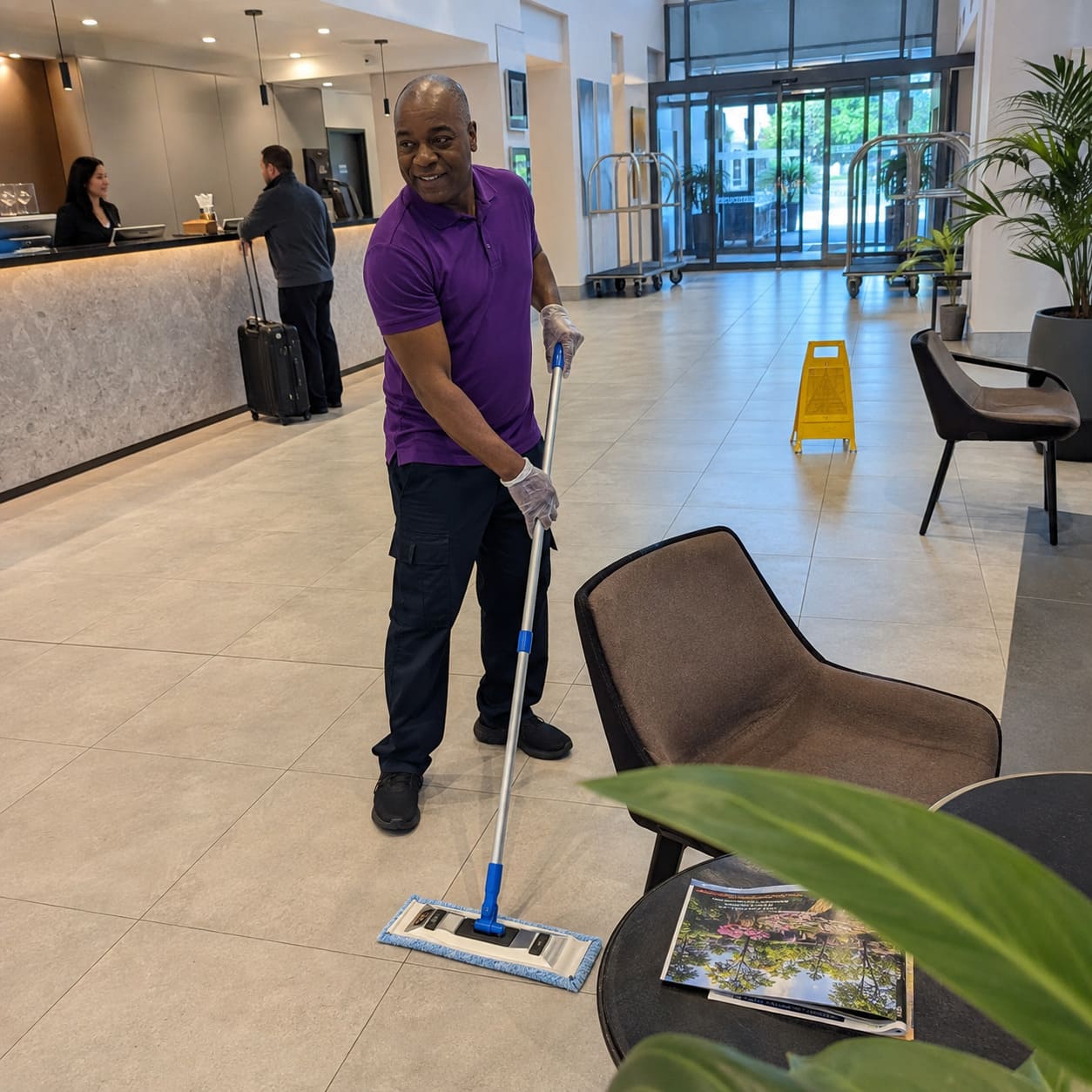
Hotel lobby cleaner mopping tiled reception floor
The service needs controlled people, products and access
A cleaner entering an occupied floor, a guest room corridor or a restricted back-of-house space is doing more than a cleaning task. Their presence touches privacy, security, stock, keys, alarms, supervision and incident reporting. The contract needs to control those conditions instead of leaving them to informal arrangements.
Staffing terms should cover the level of cover, supervision, induction, absence arrangements and communication route for site issues. Training should match the work, especially where staff handle chemicals, enter guest-facing areas or use equipment that needs safe handling.
The Control of Substances Hazardous to Health Regulations 2002, as amended, are usually shortened to COSHH. The Health and Safety Executive states that employers must assess risks from hazardous substances, including storage, handling and disposal, control exposure and give staff information, instruction and training. In a cleaning contract, that turns into practical duties: a COSHH assessment, safety data sheets, agreed storage, safe use and a route for reporting incidents.
Products and consumables need the same clarity. Your contract should state who supplies cleaning products, who approves substitutions, who monitors low stock and who pays for replacements. Without that wording, a small supply gap can become a service gap at the worst point in the trading day.
The difference between weak wording and usable wording is easy to spot.
| Weak contract wording | Stronger contract wording |
|---|---|
| Cleaning staff will be trained. | Staff will receive site induction, task training and supervision linked to the areas they work in. |
| Chemicals will be provided. | Approved products, safety data sheets, storage arrangements and substitution rules will be listed. |
| Access will be arranged. | Room access, key control, alarm codes, lost property and out-of-hours entry will be agreed in writing. |
| Standards will be monitored. | Inspections, reporting routes and correction times will be defined in the service level agreement. |
Because Double Check Security Group works across cleaning, security and facilities services, we are used to planning these overlaps as part of one operating picture. In hotels and hospitality venues, a cleaning plan that ignores access control leaves too much to chance.
Why measurable standards beat broad promises
What happens when a standard is missed? A serious cleaning contract answers that before the first missed task, because the point is to correct service drift before guests or operations are affected.
A service level agreement should replace broad promises with inspection criteria, agreed quality levels and a corrective action process. British Standard European Norm BS EN 13549:2001 is listed by the British Standards Institution as a current framework for quality measurement systems for cleaning performance, and its structure points to inspection, sampling, quality levels and corrective actions.
That does not mean your contract needs to read like a standards manual. It means the work needs an observable route from promise to proof. If public washrooms are missed, if a room clean is rejected, or if periodic work slips, the contract should say how that failure is recorded and fixed.
A practical correction process has a clear order:
- Record the issue: The missed task, affected area and time found are logged in a way both sides can see.
- Correct the work: The provider sends the right person back with the right materials, without turning every fix into a new negotiation.
- Escalate repeated gaps: Recurring problems move from site staff to supervision or management review.
- Review the cause: The contract is checked against occupancy, event schedules, staff cover or scope limits, because a repeated gap usually has a reason.
Deep cleaning frequency deserves the same practical treatment. No reliable universal legal timetable fits every hotel room, so the contract should set frequency by room type, occupancy, risk area, brand standard and site assessment. A suite with heavy use, a kitchen extract area and a low-traffic back office do not belong on one vague schedule.
Variation and exit terms sit in this same control system. Occupancy changes, events, specialist cleaning and emergency response need a route for approval and charging. If the relationship ends, schedules, records, keys, stock and site knowledge should pass across cleanly.
The sharper question is not what a hotel cleaning contract covers. The sharper question is whether the contract lets you see the service, test it, correct it and adapt it before a small gap becomes an operational problem.
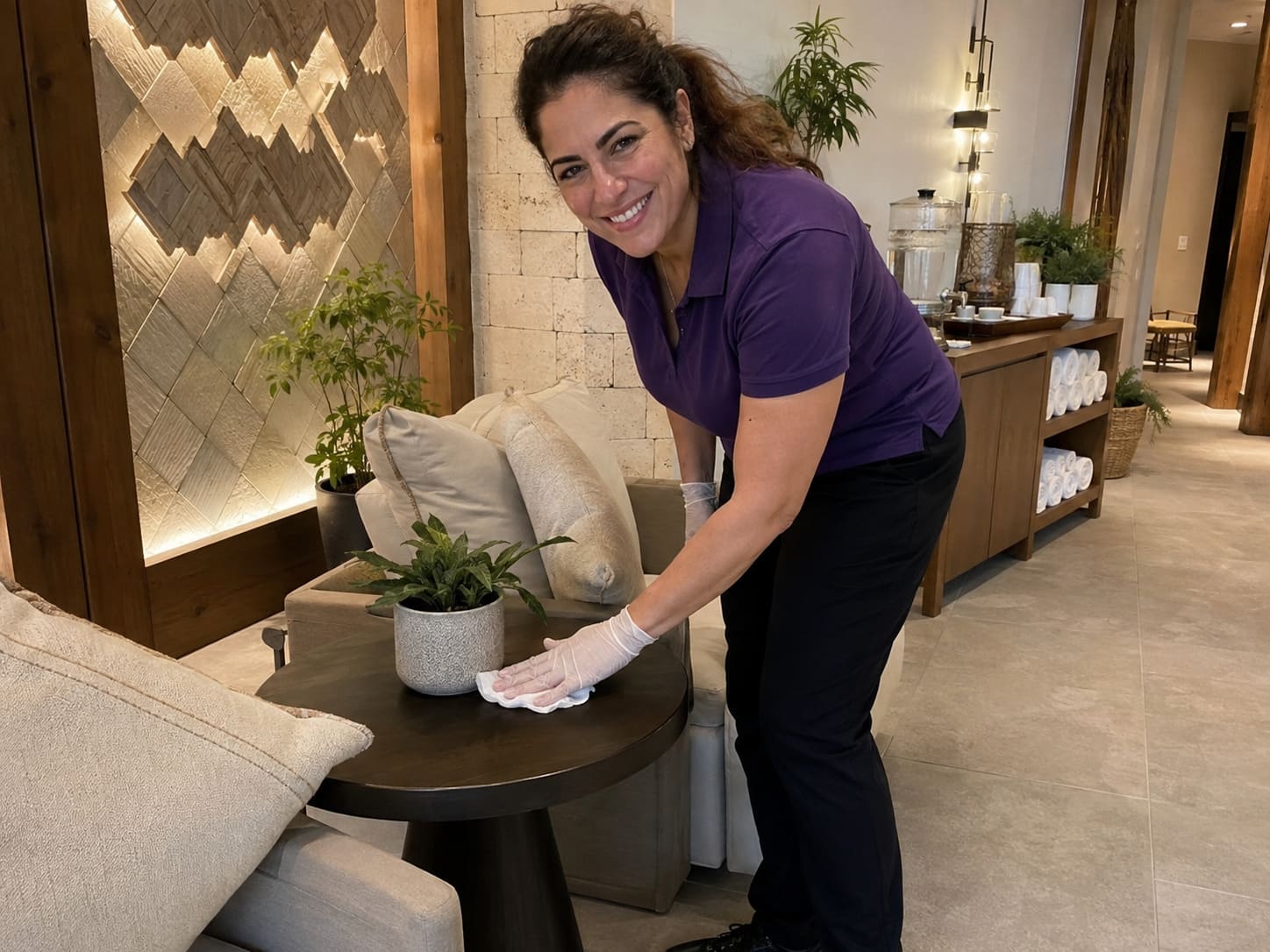
Hotel cleaner dusting bedside furniture during room changeover
Questions we get asked about hotel cleaning contracts
Who supplies cleaning products in a hotel cleaning contract?
The contract should state who supplies products, who approves substitutions and who monitors stock. We would avoid any wording that leaves products or consumables to assumption.
What is the difference between regular cleaning and deep cleaning in a hotel?
Regular cleaning covers routine tasks needed to keep rooms and shared areas in service. Deep cleaning is heavier planned work that resets an area beyond the normal daily or shift-based routine.
How often should hotel rooms be deep cleaned?
Deep cleaning frequency depends on room type, occupancy, risk area, brand standards and site assessment. A fixed rule without those details is rarely useful in a hotel contract.
What should happen if a cleaning company misses part of the contract?
The service level agreement should set out how the missed task is recorded, corrected, escalated and reviewed. Good wording makes correction part of the service, not a separate argument.
Should guest room access rules appear in the cleaning contract?
Yes, guest room access rules should be written into the contract because cleaners may handle keys, enter occupied areas or find lost property. Clear rules protect guests, staff and the venue.
This is general information, not professional advice.
