

How do cleaning colours reduce risk in your building?
Colour coded cleaning assigns specific cloths, mops and other kit to defined areas, so equipment used in a higher-risk space does not move into a lower-risk one. Professional cleaners use it because it gives staff a simple visual rule that supports safer routines across washrooms, kitchens, offices and shared areas.
Used properly, the system turns hygiene control into something visible. A cleaner under time pressure should not have to guess which mop belongs in a toilet area or which cloth belongs near a drinks point. The colour gives the instruction before a mistake happens.
Facilities managers sometimes judge the system too quickly. A cupboard full of red, blue, green and yellow kit looks organised, but colour coding only works when the site policy, storage, training and checks line up behind it.
The useful commercial question is simple: can your cleaning contractor show how the colours are used on your actual premises, by real staff, during normal service?
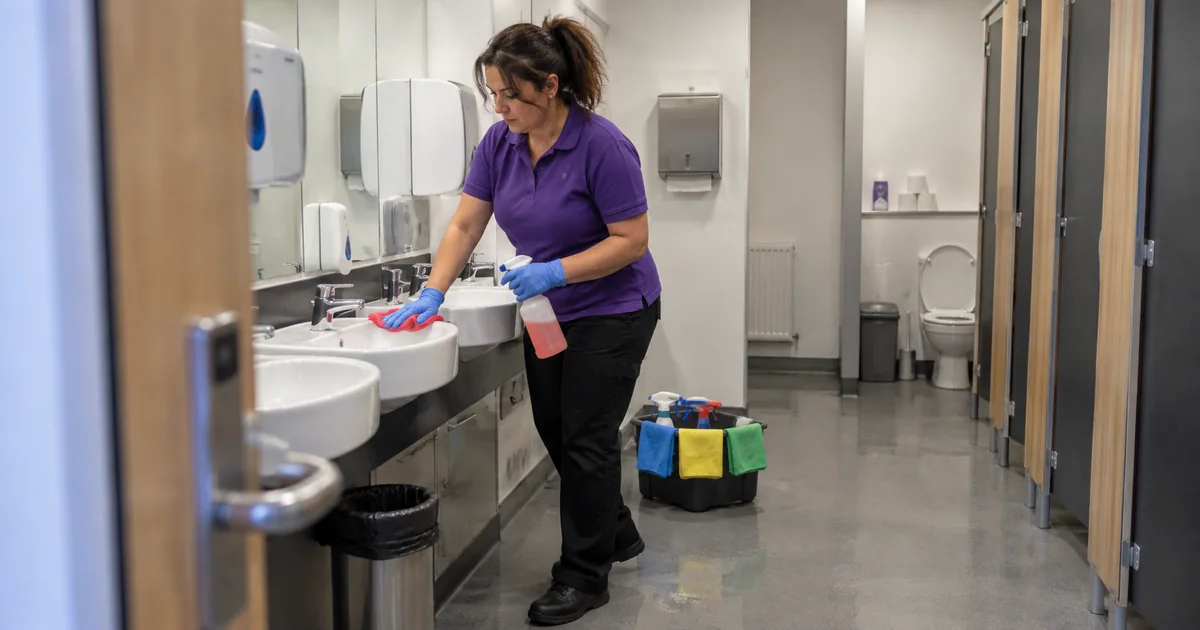
Professional cleaner cleaning washroom sinks – Illustrative Image
What Do We Cover In This Article?
Colour coded cleaning separates each risk area
A cleaner moving from a washroom to a corridor and then into a small kitchen area needs more than good intentions. Colour coded cleaning gives each task its own kit, so the cloth or mop used in one risk area stays out of another.
In practice, colour coding in cleaning applies to items such as cloths, mop heads, buckets, handles, brushes and gloves. The point is segregation. Washroom floors carry a different risk from office desks, and a food preparation surface needs a different level of care again.
The British Institute of Cleaning Science describes the aim of colour coding as preventing cross-contamination from one cleaning area or surface to another. That matters because cleaning equipment itself can become the route by which unwanted residue moves around a building.
Consider a cleaner who finishes a toilet area and then wipes a kitchenette worktop with the wrong cloth. The failure is simple, but the consequence is exactly what the system exists to prevent. Different coloured cleaning cloths make the correct choice obvious, provided the cleaner has been trained to follow the site rules.
Colour guides separation. The cleaning method and the product still decide whether the surface has been cleaned properly.
Standard colours need a site policy
Cleaning colours are useful because staff can recognise them quickly, even across a large or busy premises. Most commercial cleaning colour codes use red, blue, green and yellow, with extra options added where a site needs them.
The table below compares each common cleaning colour with its usual commercial use.
| Colour | Common commercial use |
|---|---|
| Red | Toilets, urinals and washroom floors |
| Yellow | Washroom sinks, mirrors, tiles and surfaces |
| Green | Food and drink preparation areas |
| Blue | Low-risk areas such as corridors and offices |
A red mop for toilets and a green cloth for a kitchen area will match many commercial charts, but your building still needs a written policy. The common colour chart is a starting point for your premises, not a universal rule for every sector.
Layouts differ. One site may have public washrooms, staff tea points and a small reception area. Another may include shared kitchens, treatment rooms or restricted back-of-house space. White or striped cloths are sometimes used where a site needs an extra category, which is another reason a generic poster cannot do the whole job.
In practice, a facilities operator such as Double Check Security Group would map the colours to the rooms, surfaces and service scope on the site. That is the part a buyer should look for: a policy that tells cleaners exactly which colour applies where, in the building they are cleaning.
Healthcare needs separate care. NHS England’s National Standards of Healthcare Cleanliness 2025 include a national colour-coding scheme for cleaning materials and equipment used across healthcare organisations, so healthcare and healthcare-adjacent work cannot simply copy an office chart.

Professional cleaner colour coded kitchen cleaning – Illustrative Image
Cross-contamination control depends on behaviour
Colour coding reduces transfer risk because it changes what cleaners do during the routine clean. The system works best when the cleaning route, task order and storage arrangement all point staff in the same direction.
A basic rule is to clean from the cleanest area toward the dirtiest area. That sequence matters because even correctly coloured kit can cause a problem if a cleaner takes it into the wrong room or uses it at the wrong stage of the task.
Imagine a blue cloth used correctly on office desks, then accidentally left in a washroom trolley tray beside red cloths. The colour rule is still there, but poor handling has weakened it. A professional cleaning hygiene control has to cover the way kit is carried, stored and returned after use.
Cleaning chemicals add another practical point. NHS England states that healthcare cleaning products, meaning chemicals and detergents, do not need to be colour coded. For most commercial buyers, the same plain principle applies. Colour coding normally belongs to equipment and materials, while product choice is controlled through the cleaning method and site instructions.
Food areas need particular discipline. Food Standards Agency guidance says a cleaning schedule should show what needs to be cleaned, what needs to be disinfected, how often it needs doing, and how the cleaning should be done, with cleaning instructions ideally naming the products to use. In those settings, a green cloth is only one part of the control.
Good colour coding gives cleaners a simple signal. Good supervision makes sure the signal is followed during the actual clean.
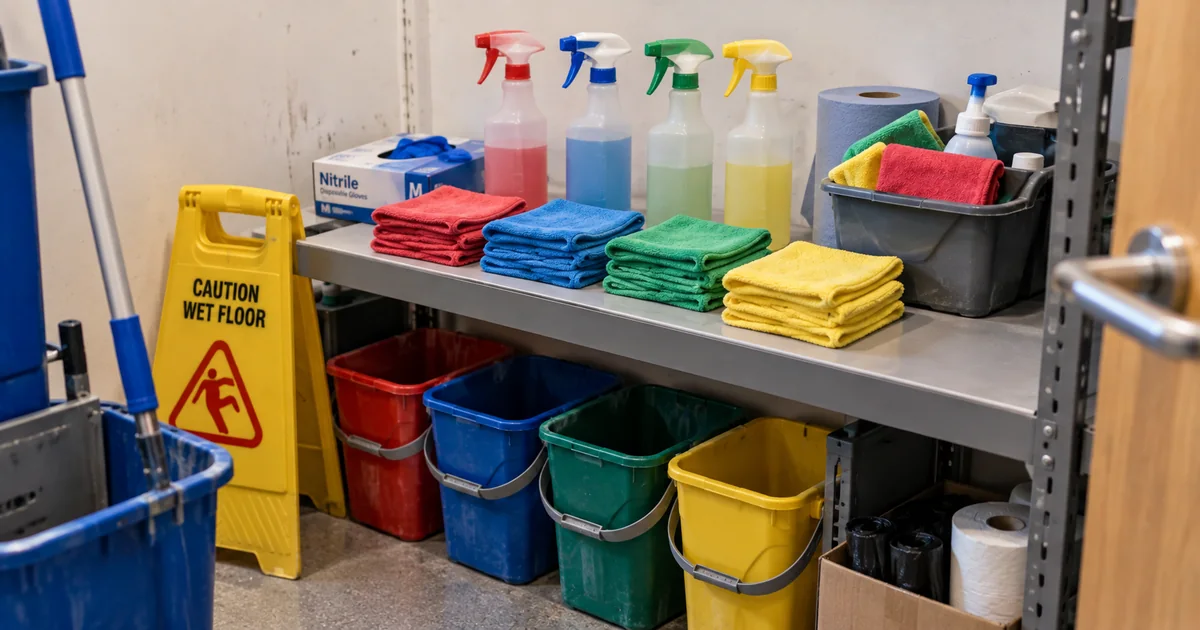
Colour coded cleaning equipment storage cupboard – Illustrative Image
Trained cleaners make the system work
Coloured equipment only works when cleaners are trained to use it the same way every time. A contractor should build the colour-coding policy into induction, refresher training and routine supervision, so it becomes part of how the job is done every shift.
Experienced cleaners need management too. Fixed habits can be harder to correct than inexperience, which is why short toolbox talks, supervisor checks and visible storage rules matter. If red and blue mop heads sit loose in the same cupboard with no labelling, the system is already relying on memory.
What your contractor should be able to show
A facilities manager should expect evidence that the system is managed. Useful documents and controls include:
- Colour-coding policy: a site-specific document showing which colours apply to each area and task.
- Cleaning specification and schedule: the agreed work plan, including what is cleaned and how regularly.
- Scope of works: a clear description of the service, so colour coding matches the actual areas being cleaned.
- Training records: proof that staff have been shown the site system before they use the kit.
- Storage and stock control: separate storage, labelled equipment and monitoring of disposable colour-coded items.
These are normal signs of a managed cleaning contract. Double Check Security Group’s cleaning and facilities work is process-led, with scopes, inductions and monitoring built into day-to-day delivery.
A contractor who cannot explain how new cleaners learn the colour system leaves too much to chance. The colour policy has to survive staff changes, busy shifts and cover arrangements.
A colour chart alone proves very little
The common misconception is that red, blue, green and yellow equipment automatically proves a well-controlled cleaning service. It does not. Coloured kit can sit in a cupboard and still be used badly.
Outside healthcare, the British Institute of Cleaning Science says there are no national or international compulsory colour-coding standards for the cleaning industry. The guidance still carries weight, so the useful test for commercial clients is how their contractor applies it on their site.
Food-handling and healthcare settings carry more specific documented expectations, so a competent provider will treat those areas with the extra structure they need. In ordinary offices, retail spaces and communal areas, the same discipline still matters because people, equipment and shared surfaces move through the building every day.
A reliable cleaning service is proved through policy, training and checking, not by owning equipment in different colours. The mistake is assuming the colour chart is the control. The control is the system that makes the chart happen when nobody is standing over the trolley.

Professional cleaner colour coded mopping office corridor – Illustrative Image
Common questions about colour coded cleaning
How is the colour system checked once the contract is running?
Cleaning and hygiene audits are the usual route. BICSc audit requirements cover the cleaning specification and schedule, scope of works and colour-coding policy, training records and compliance documentation, so an audit looks at the paperwork and the practice together.
Should the colour system be shown on site?
A visible chart helps cleaners check the rule quickly, especially in stores, cleaners’ cupboards and shared service areas. The chart should match the actual site policy, rather than a generic version copied from elsewhere.
Can disposable cleaning items be included in the colour system?
Yes. Disposable colour-coded items still need stock control, because staff must know which item belongs to which area before they use it. New stock should be stored and released in a way that keeps the colour system consistent.
Do tenants or visitors need to know the cleaning colours?
Tenants and visitors do not need operational detail, but visible order can support confidence in how the building is managed. The main audience for the system is the cleaning team and the people responsible for checking the service.
Does colour coding apply during one-off deep cleans?
A one-off deep clean still needs task separation where different risk areas are involved. The contractor should brief the team on the colours and areas before work starts, so the temporary job follows the same logic as routine cleaning.
