

What causes a commercial cleaning contract to go wrong in the first 90 days?
Most early failures come from a weak handover between the signed contract and the live site routine. You prevent them by turning the service agreement into workable instructions for scope, access, safety, evidence and review, then checking them at day 30, day 60 and day 90.
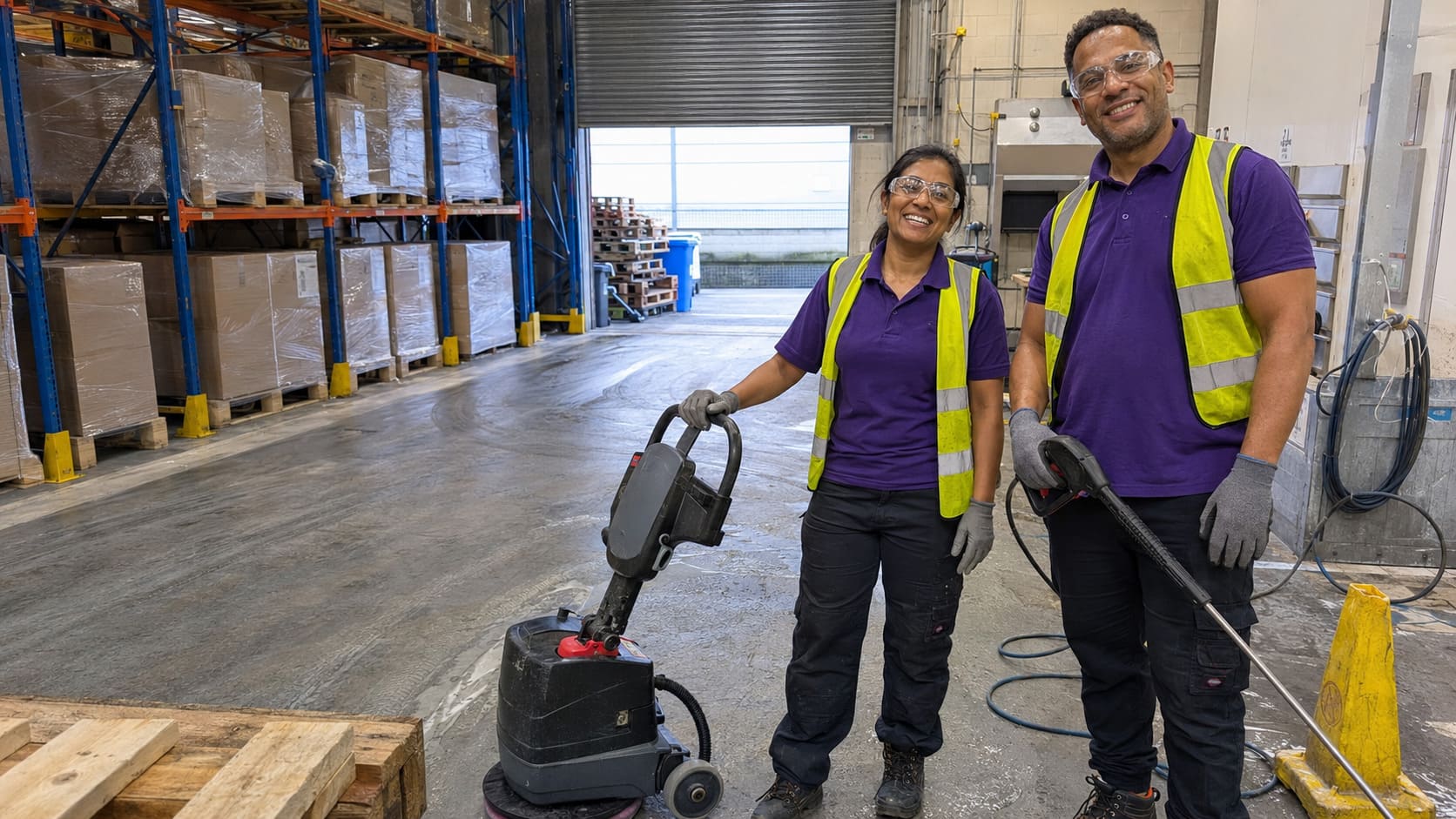
Warehouse cleaning team providing floor and equipment maintenance
What Do We Cover In This Article?
A clear paper scope can still fail on site
A signed contract can still leave the live routine uncontrolled. That is where many early cleaning disputes begin. The wording looks acceptable, but the cleaner, site supervisor, contract manager and client all read it differently once work starts.
A cleaning service level agreement, often shortened to a cleaning SLA, only works if it becomes a usable task and frequency matrix. The contract may say washrooms are included, but the site routine needs to say what is cleaned, how often, who refills supplies, what happens after a leak, and how extra requests are approved.
Scope creep rarely announces itself. Extra bins appear after a tenant move, an event leaves waste outside the usual routine, or a washroom supply becomes urgent because nobody owns the stock line. None of these issues looks dramatic on day one, but they soon turn into complaint-led management if nobody has agreed the boundary.
A practical commercial cleaning contract scope needs an operating version before the first shift:
- Convert the service specification into a task and frequency matrix. The cleaner needs a working document, not a broad promise.
- Mark who supplies consumables, chemicals and equipment, including washroom supplies and site-specific products.
- Define reactive, periodic and out-of-scope work in plain terms, so a spill response is not confused with planned cleaning.
- Agree how variations are approved and recorded. A quick favour should not become an unpaid standing task by accident.
Vague scope is the first operational failure because it leaves the service open to private interpretations on a busy site.
Mobilisation failure starts before the first clean
A contract can be signed, a price can be agreed and a go-live date can sit in everyone’s diary, yet the service can still be unready. The missing piece is usually a named mobilisation owner who turns the sale into a working contract.
Cleaning contract mobilisation is the controlled handover between the agreed service and the people who must deliver it. Sales notes, site walkarounds, staffing rotas, equipment delivery, keys, alarm routines and first-week priorities all need to meet in one plan. If they sit in separate inboxes, the first clean becomes a test of luck.
The start date is a diary entry. Mobilisation is the control system behind it.
Good mobilisation answers simple questions before anyone attends site. The contract manager needs to know who has authority on the client side. The site supervisor needs the cleaning specification in a format that can be checked. Operatives need a site induction before they meet restricted rooms, waste routes, alarm codes or busy public areas.
Weak handover often shows up as small frictions. The cleaner arrives without the right access. Supplies have not been delivered. A priority area is missed because it was discussed during the sale but never written into the handover pack. A supervisor visits after the first complaint instead of before the first routine has settled.
A capable provider treats the first 90 days as a controlled start-up period. Day 30, day 60 and day 90 review meetings give the contract manager a fixed point to test whether the cleaning SLA works on the site, not just in the file. Early snagging belongs in a corrective action log, with an owner and a review date, because unresolved small faults quickly become the normal way the contract operates.
Operators such as Double Check Security Group are relevant here because mobilisation, site visits and performance monitoring sit within one operational framework. That matters where cleaning is linked to wider facilities routines, since a missed handover can affect access, keys, supervision and client communication as much as cleaning quality.
A provider saying it is ready to start on Monday has proved very little. A provider showing who owns mobilisation, what has been checked and how the first reviews will run has proved far more.
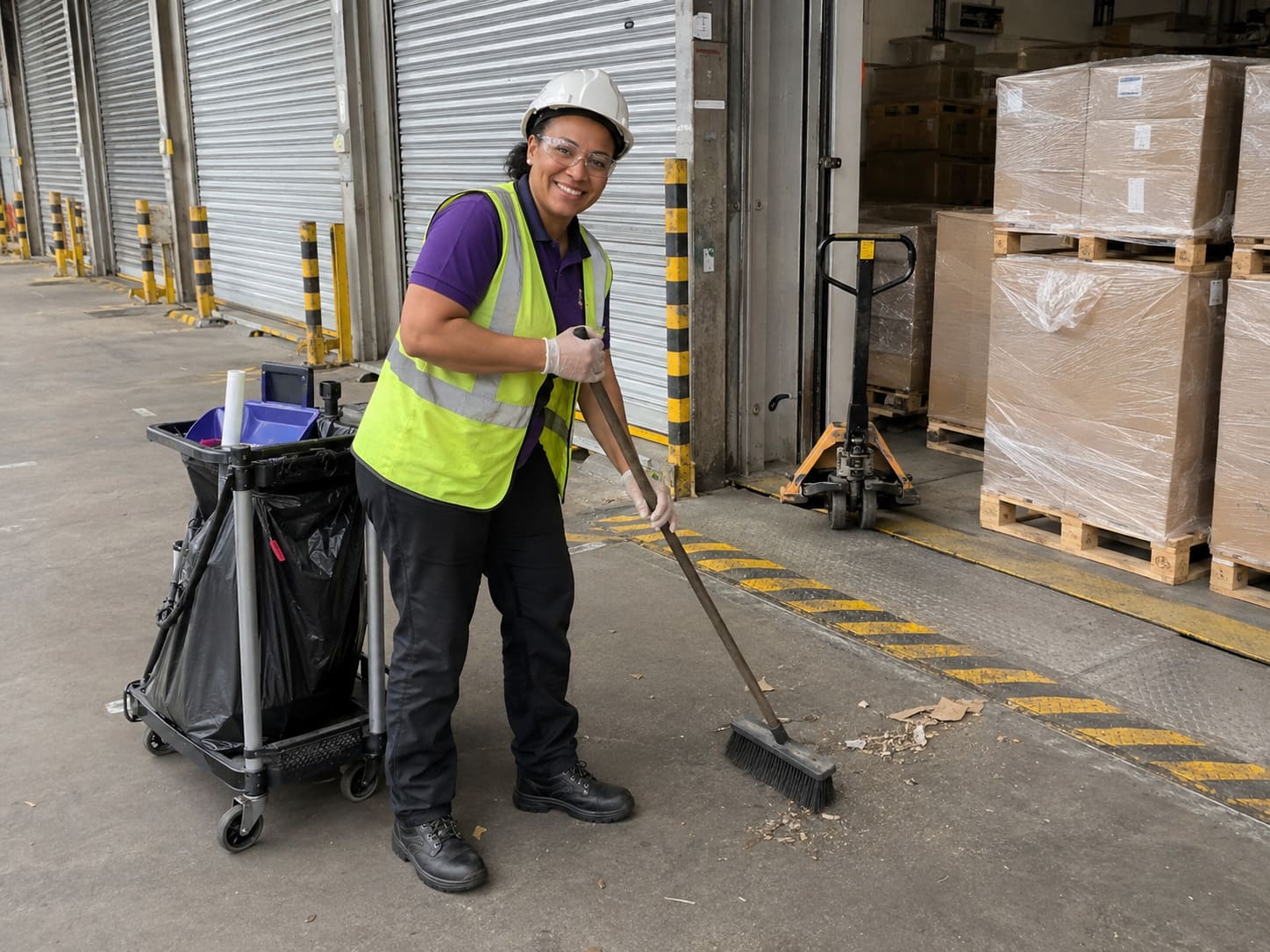
Warehouse cleaning operative with trolley and floor cleaning equipment
Access, induction and safety gaps disrupt the first cleans
A cleaner arrives after hours, the alarm routine has changed, and a restricted room stays untouched. By morning, the issue looks like poor cleaning. In reality, the root cause sits in access planning.
Access and site control
Out-of-hours cleaning needs the same level of control as any other activity taking place in a secured building. Keys, alarm codes, visitor sign-in, restricted areas, lone working arrangements and escalation routes need to be agreed before the go-live date.
A site induction is the point where the paper plan meets the building. It should cover where cleaners can go, who authorises entry to locked areas, what happens if an alarm is triggered, and how the team reports something that is outside the cleaning brief. Without that induction, a cleaner can make the wrong call for the right reason, such as skipping a locked room instead of risking a security breach.
Public-facing and high-footfall premises add another layer of planning. The Home Office is clear that the Terrorism (Protection of Premises) Act 2025, known as Martyn’s Law, has received Royal Assent but is still in its implementation period, with no legal duty to comply until it comes into force. Cleaning teams do not need a legal lecture, but their access routes and reporting lines should fit the site’s wider protective security planning.
Where cleaning, facilities support and security processes are managed under one framework, as they are at Double Check Security Group, the access conversation becomes easier to control. The same site logic can cover who enters, what they can access and how exceptions are reported.
Safety and supervision
Cleaning can create its own hazards when timing and supervision are weak. The Health and Safety Executive says employers must keep employees and others affected by cleaning work, including visitors and members of the public, safe from harm, and must assess slip and trip risks and take reasonable precautions.
Wet floors are a good test of whether a contract is being managed properly. The Health and Safety Executive warns that cleaning can create slip and trip risks, including damp smooth floors and trailing wires from vacuum or buffing machines. Signs and cones warn people, but they do not stop someone entering the area; barriers, locked doors or cleaning in sections may be needed on smooth wet floors.
Early safety problems do not always point to poor effort from the cleaner. They often point to weak site instructions, poor timing or supervision that has not caught up with the building’s real use.

Café cleaning team wiping counters and customer seating areas
Cleaning standards drift when evidence is not agreed
The useful question is what counts as evidence. If nobody agrees that at the start, “the cleaning is not good enough” becomes a complaint rather than a manageable performance issue.
A cleaning audit should define what is inspected, who inspects it, what is recorded and when the corrective action is reviewed. Key performance indicators, usually called KPIs, should reflect the premises and the cleaning contract specification. A universal score tells you little if it does not match the site risk, footfall, service frequency or client priorities.
The British Standards Institution lists BS EN 13549:2001 as a current cleaning services standard covering basic requirements and recommendations for quality measuring systems. The practical lesson is simple: cleaning performance needs a measuring method, not a mood check.
The difference between weak and useful measurement is easy to spot:
| Weak measurement | Useful measurement |
|---|---|
| “Reception is poor” with no defined defect | A named inspection item for reception floors, desks or touchpoints |
| Complaint passed on with no owner | Corrective action log with a named owner and review date |
| One-off audit score viewed in isolation | Trend review that shows repeat defects or improvement |
| Supervisor sign-off with no evidence | Inspection record with notes or agreed photo evidence where suitable |
| KPI copied from another contract | KPI framework matched to the cleaning SLA and site priorities |
Measurement is not there to turn every missed task into a dispute. Its value is in separating an isolated miss from a pattern. One missed bin can be corrected on the next clean. The same missed area across several inspections points to a scope, supervision or staffing issue that needs management action.
Subjective judgement still has a place, especially in client-facing areas. Even then, the inspection checklist should translate the concern into something that can be checked on the next visit. Without that step, the contract manager is left chasing opinions instead of correcting defects.
A weak review rhythm lets small issues become contract failure
If the same issue appears at every review, it is no longer a teething problem. Early cleaning contract failure becomes likely when nobody agrees when patterns will be reviewed or who has authority to correct them.
Day 30, day 60 and day 90 review meetings should look past isolated complaints. The useful discussion is about repeat defects, access problems, missed frequencies, supply issues and whether the corrective action log is actually closing items. A good review rhythm gives the contract manager and site supervisor permission to fix the system, not just chase the latest complaint.
Escalation also needs to be calm and specific. The first route should solve routine defects quickly. A higher route should deal with repeated failures, disputed scope or unresolved safety concerns. If every issue goes straight to a senior dispute, the contract becomes noisy. If nothing escalates, failure gets normalised.
The Health and Safety Executive describes an effective cleaning regime as a management system that identifies problem areas, decides what to do, acts, and checks whether the steps worked. That same loop is a sound way to think about the first 90 days of a commercial cleaning contract.
The common misconception is that the first 90 days are a bedding-in period where problems should simply be tolerated. That assumption is expensive. A contract does not settle because people wait; it settles because someone tests the routine while the pattern is still easy to change.

Café cleaner carrying supplies during routine hospitality cleaning
Common questions about early cleaning contract problems
Who should attend the early cleaning contract reviews?
The contract manager and site supervisor should attend, with the client-side person who can approve changes to access, scope or supplies. If tenant complaints are part of the issue, those complaints should be summarised as evidence rather than turned into a crowded meeting.
Who is responsible for cleaning supplies in a commercial cleaning contract?
Responsibility for supplies should be agreed in the contract and repeated in the working scope. Washroom consumables, chemicals, equipment and replacement stock should have a named owner, otherwise small shortages become daily service failures.
How can tenant complaints be handled without creating constant disputes?
Complaints should be logged against a defined area, task or time, then reviewed against the cleaning specification. That keeps the discussion practical and stops every comment becoming a general argument about whether the cleaning is good enough.
Should the client or the contractor carry out cleaning audits?
Both can have a role, but the method should be agreed at the start. Contractor audits give routine supervision, while client-side checks can test whether the service matches business needs and tenant expectations.
What should happen if cleaners cannot access part of the building?
The cleaner should have a clear reporting route for failed access, and the issue should be recorded against the affected area. Repeated access failures should be treated as a contract management issue because the cleaning team cannot clean areas they cannot lawfully or safely enter.
This is general information, not professional advice.
