

What needs to be written into your venue cleaning agreement?
Your contract should name the areas cleaned, the tasks in each area, the frequency, the evidence you receive, the product controls, the staffing cover, the exclusions and the way changes are agreed. Hospitality cleaning fails when those points live in assumptions instead of written scope.
Most weak contracts use broad wording that sounds tidy on paper. “Daily cleaning” looks clear until a manager asks whether it includes a back corridor, a washroom check during service, or the handover after a private event.
Your real question is simple: what should be written down so the cleaning provider, housekeeping team and site manager all work to the same standard? The answer starts with the venue layout, then moves into schedules, records and commercial boundaries.
A good hospitality cleaning specification gives you something you can brief, price and check. A vague one leaves standards depending on memory, goodwill and whichever person happens to be on shift.
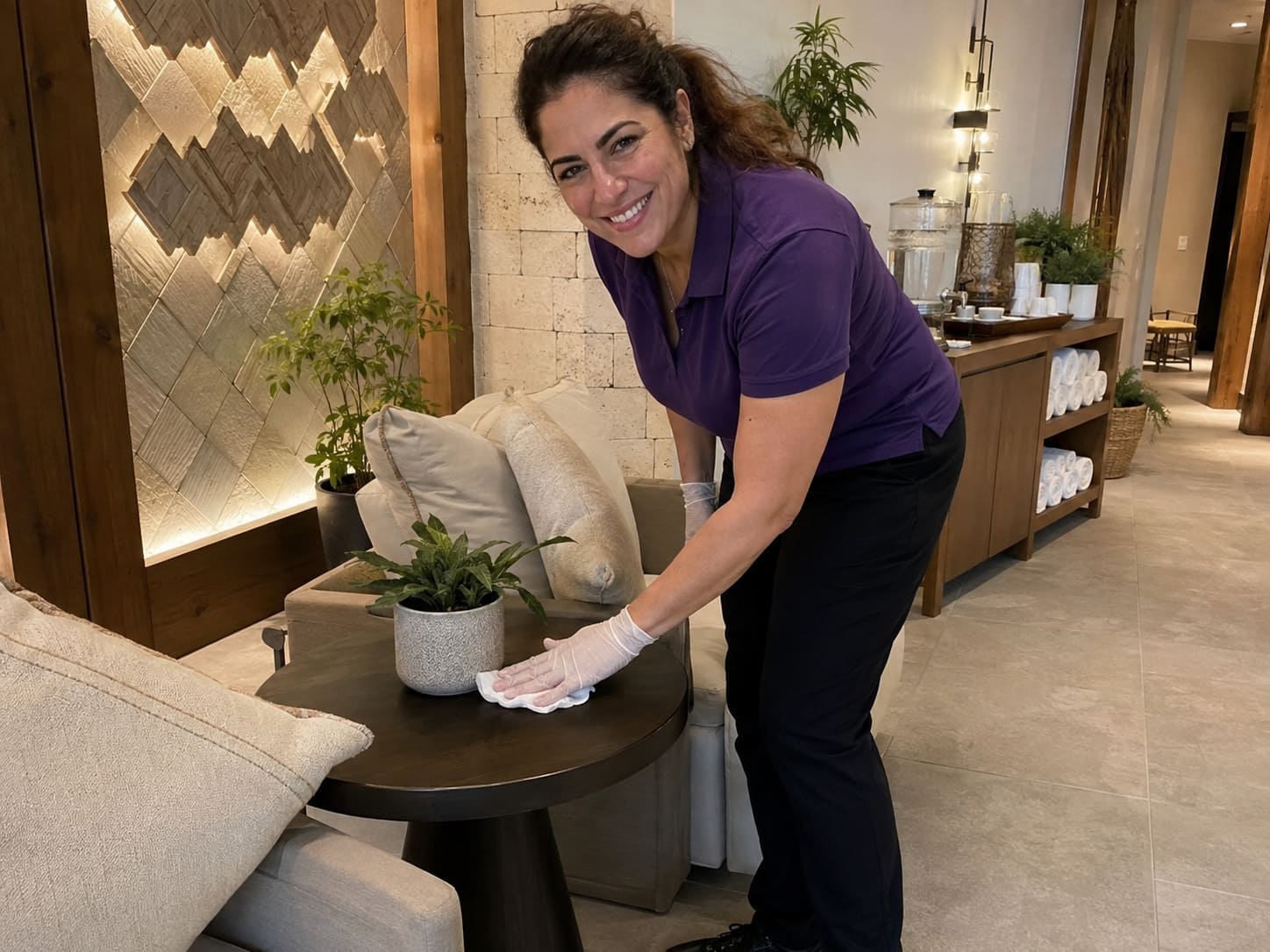
Hotel cleaner dusting bedside furniture during room changeover
What Do We Cover In This Article?
Venue zones set the contract scope
“Clean all public areas daily” is the kind of line that causes problems in a live venue. It gives no clear boundary between front of house cleaning, housekeeping duties and back of house tasks, so gaps appear when the site is busy.
A hotel cleaning contract works by area and task, not by a single promise that the venue will be clean. The contract should read like an operational map of your building, with each space linked to duties and handover points.
A practical hotel cleaning contract scope should name the main zones clearly:
- Guest rooms: Routine cleaning duties, changeover tasks and any deep cleaning that sits outside standard housekeeping.
- Front of house: Entrances, reception areas, lounges, guest toilets and other areas seen by visitors.
- Washrooms: Fixtures, touch points, consumables and checks during trading hours where needed.
- Back of house: Staff routes, service corridors, storage areas and support spaces that guests may never see but staff use constantly.
- Specialist areas: Event spaces, leisure areas or other rooms included in the agreed commercial cleaning scope of work.
Double Check Security Group’s hospitality cleaning services cover hotels, pubs, restaurants, event spaces and leisure facilities, with guest rooms, front of house, washrooms and back of house areas all named as part of the service. This area-based view is the right starting point for any cleaning contract for a hotel because it stops one broad line from hiding several different jobs.
Boundaries matter most where your own team and the cleaning provider meet. Name the handover point between housekeeping and cleaning, and write down who deals with tasks that fall between the two.
Operating patterns shape cleaning frequency
Two venues with similar floor space can need very different cleaning models. A quiet rooms-led venue, a restaurant with long service hours and an event space with fast turnarounds all create different labour demands.
Hospitality cleaning pricing starts with labour hours because changeover volume and operating pattern change the work. The drivers include room count, occupancy pattern, checkout to check-in window, shift timing, back of house scope, deep clean frequency and consumables.
A hotel cleaning schedule should say when work is done, what standard applies and who confirms completion. Room changeover cleaning needs a different rhythm from public area checks. Back of house cleaning may sit around deliveries, staff movement and service times.
Where a venue changes provider, TUPE can apply if the legal conditions are met. TUPE is the staff transfer rule that can affect outsourcing, bringing a service in-house or moving a contract to a new provider. Treat it early as a planning point, then keep the cleaning schedule focused on the work your site needs.
A workable hospitality cleaning frequency follows the way the venue trades. Check whether the supplier has priced the operating pattern, not just the building.
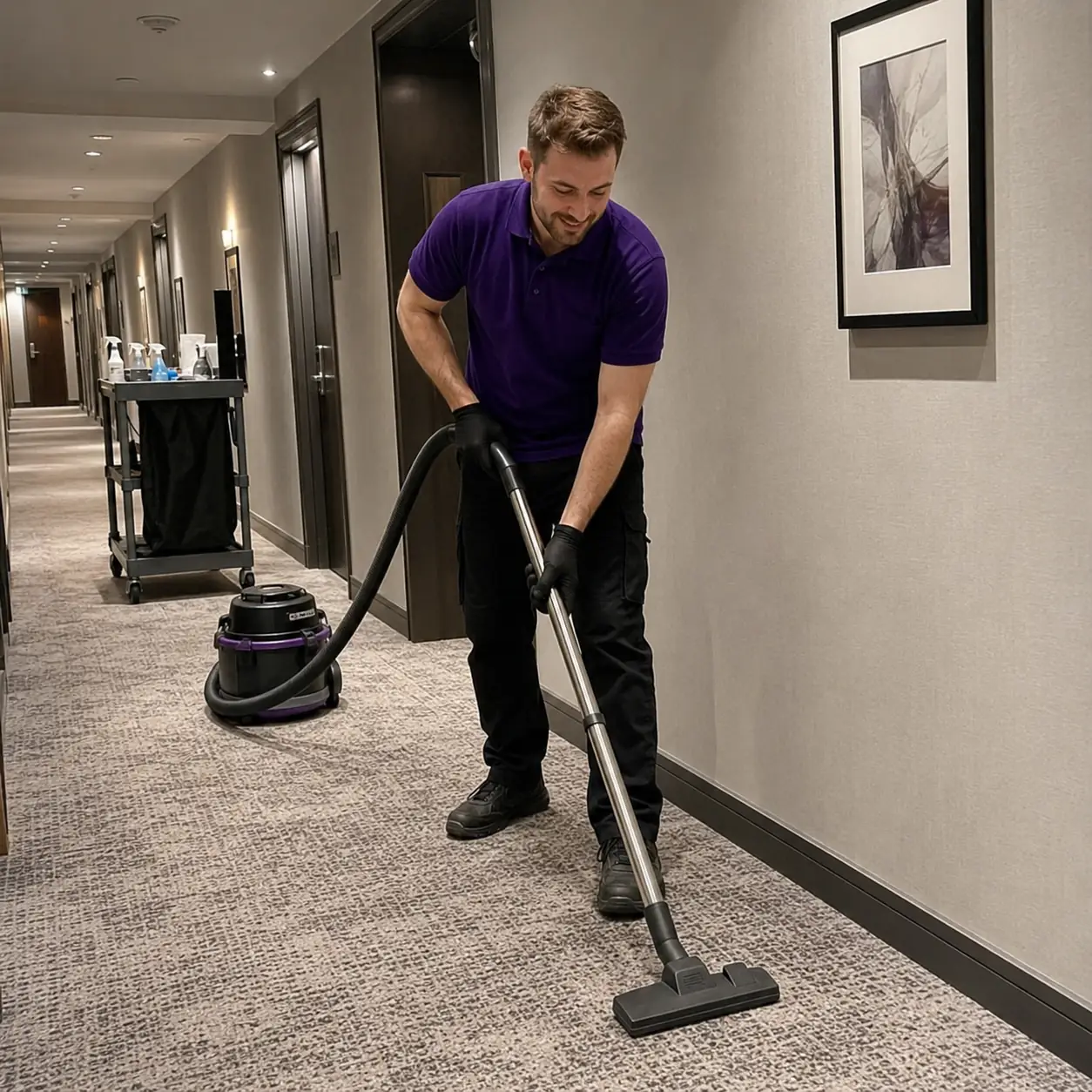
cleaner vacuuming hotel corridor square – Illustrative Image
Food areas need separate controls
Kitchens and food service areas need their own cleaning schedule inside the contract. General venue cleaning does not give enough detail for work surfaces, food contact items, disinfectants and cleaning records.
GOV.UK food hygiene guidance says food businesses should set up a cleaning schedule and record. That schedule must cover what needs to be cleaned or disinfected, how often, and which products to use. For a venue with food service, your contract should support that record instead of leaving it as a separate task nobody owns.
Food area cleaning records need to cover regular cleaning needs such as work surfaces, chopping boards, utensils, dishes, cooking equipment, cloths, sponges, tea towels and touch points. Disinfectants used in food areas should also be checked for BS EN 1276 or BS EN 13697 codes, because those codes help confirm the product is suitable for the job.
Chemical control also belongs in the agreement. HSE guidance names hospitality cleaning substances such as dishwasher detergents, drain cleaners, oven cleaners, disinfectants, toilet cleaners, bleach, sanitisers and descalers. COSHH is the rule set for hazardous substances, and it requires employers to assess risks, control exposure and give staff information, instruction and training.
Storage and labelling should be practical, not buried in paperwork. HSE guidance says hazardous cleaning substances should be kept in original labelled containers where possible. If products are decanted, the containers should be suitable, clean and clearly marked.
Ask where the kitchen cleaning schedule, food area cleaning records and chemical information are kept, and make sure site managers can find them.
Service evidence proves contract delivery
A missed clean becomes difficult to fix when nobody can show who attended, what was checked and when the issue was raised. The useful measure is evidence of service delivery, not a general assurance that standards are managed.
A cleaning service level agreement earns its place when it names the records you will see. Useful monitoring covers attendance, timekeeping, inspection outcomes, issue logs, stock checks, equipment faults, absence cover and reporting frequency. Those records give managers something to act on before standards drift across shifts.
Crown Commercial Service RM6130 building cleaning guidance says a good specification should state the service needed, mandatory services, expected project length, outputs, service levels, KPI measures and reporting frequency. It also says outputs can include data, reports, service levels, KPIs and reporting frequency.
That level of detail matters in hospitality because a cleaning contract performance monitoring system has to reflect the site. A missed washroom check during trading hours creates a different management issue from a delayed periodic deep clean. A stock shortage in a guest area needs a different response from an equipment fault in a cleaner’s store.
Contracts managed by Double Check Security Group include regular site visits, in-depth site inductions, continuous monitoring and structured client feedback. Those process points matter because the contract has to keep working after mobilisation, when staff change, occupancy shifts and small issues start to repeat.
If nobody can show it happened, the contract cannot manage it.
Clear exclusions keep pricing stable
When two quotes look similar, exclusions often explain the difference. A low hospitality cleaning quote can look attractive until window cleaning, carpets, emergency cleans or extra consumables start appearing as separate charges.
The table below compares routine cleaning scope with work that often needs separate agreement.
| Routine scope | Often separate scope |
|---|---|
| Scheduled guest room, public area and washroom cleaning | Window cleaning, high level cleaning and duct cleaning |
| Agreed back of house cleaning tasks | Pest control, sanitary disposal and emergency cleans |
| Included products and consumables, where agreed | Carpets, upholstery and extra consumable supply |
Cleaning contract exclusions should be written down with the same care as the included work. Common commercial cleaning exclusions include window cleaning, high level cleaning, sanitary disposal, pest control, duct cleaning, carpets, upholstery, consumables and emergency cleans.
Change control matters because hospitality venues rarely trade in one fixed pattern. Occupancy, opening hours, event bookings and back of house use can all change the labour needed. A sensible hotel cleaning service agreement explains how scope changes are agreed, how extra work is priced and how payment or exit terms are handled.
Digital reports and shared issue logs are already making vague cleaning promises harder to defend. Auditable scope is the safer buying test.
Common questions about hospitality cleaning contracts
Should linen handling be written into the cleaning contract?
Yes, if the cleaning provider has any role in moving, sorting or supporting linen work. If linen stays with housekeeping or a laundry provider, the contract should say where the cleaning team’s responsibility ends.
Can one hospitality cleaning contract cover more than one venue?
Yes, one agreement can cover several venues if each site has its own scope, schedule and reporting arrangement. A shared contract still needs site-level detail because layouts and trading patterns differ.
How should one-off event cleans be treated?
One-off event cleans should be handled as agreed extra work or written into the regular scope if they happen as part of normal trading. The contract should state who approves the work before it starts.
Should guest complaints form part of the cleaning review?
Guest complaints can help spot repeated problems, especially in public areas and bedrooms. They work best when they are linked to inspection notes and issue logs, so managers can see whether a problem is isolated or repeated.
