

What does industrial and factory cleaning include on your site?
Industrial and factory cleaning covers production areas, storage zones, access routes, welfare spaces and support areas, with cleaning planned around machinery, contaminants, materials, traffic and waste. A proper scope defines what gets cleaned, how access is controlled, what risks need managing and how completion is checked.
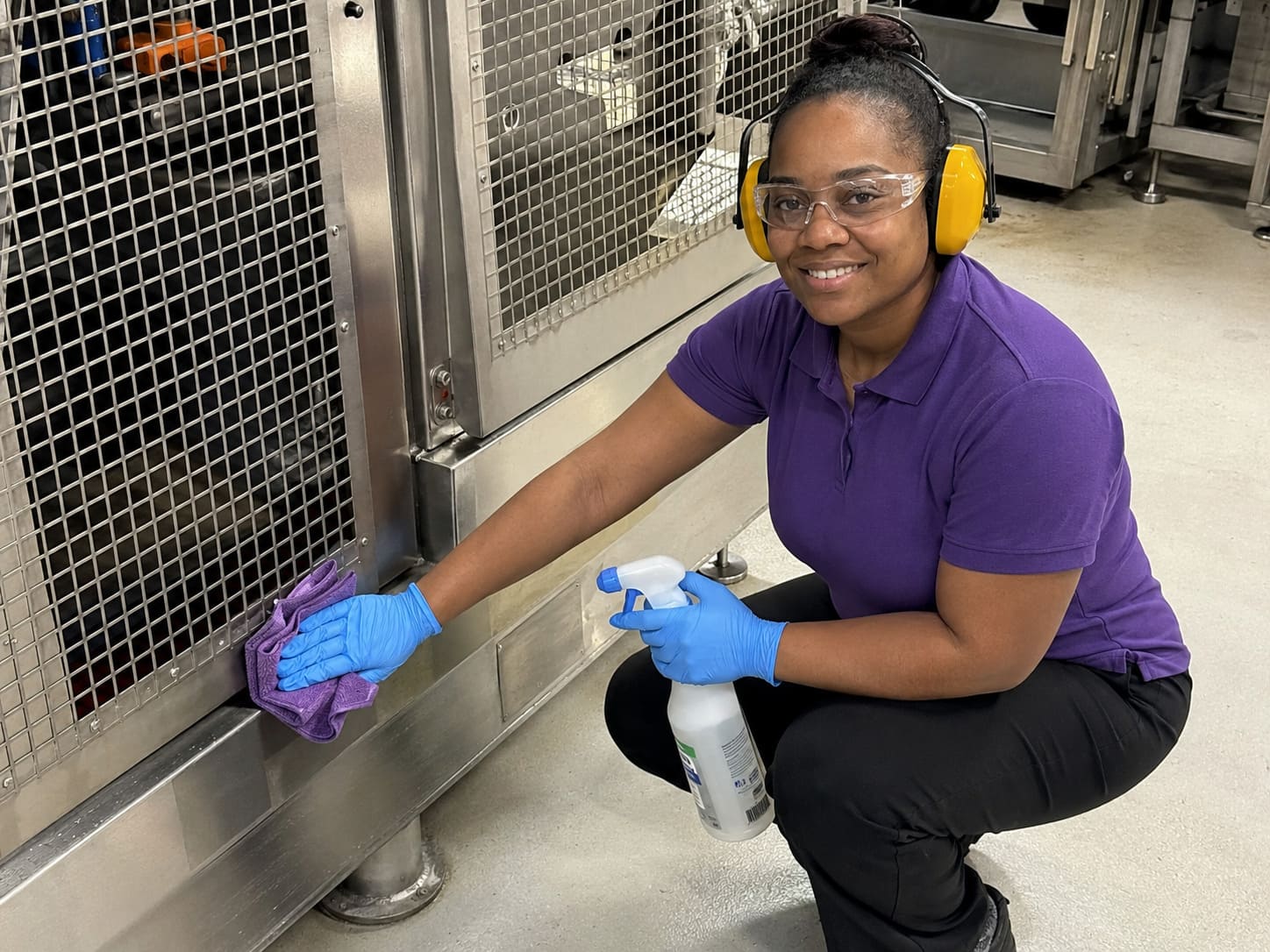
Factory cleaner sanitising machinery during professional industrial cleaning
What Do We Cover In This Article?
Industrial cleaning starts with the site and a defined scope
Industrial cleaning is often seen as ordinary commercial cleaning on a larger footprint. That misses the point. A factory, warehouse or workshop has moving vehicles, machinery areas, residues, dust, floor contamination, restricted zones and work patterns that shape the clean before anyone chooses equipment.
Good scope building starts by splitting the premises into workable zones. Production areas, warehouse floors, loading bays, racking, high-level surfaces, staff areas, offices and welfare facilities each need different attention. A floor used by forklifts has different risks from a staff canteen. A dusty storage area needs different planning from a production line edge.
Tasks can include floor scrubbing, degreasing, pressure washing, dust removal, high-level cleaning and cleaning around machinery exteriors. Machinery itself needs careful wording in the scope. Cleaning the outside of equipment and the surrounding work area is one thing; internal technical cleaning, dismantling or work near live equipment needs separate agreement and the right controls.
The useful question is not simply what industrial cleaning includes. The better question is what your site needs included, what falls outside the routine contract and what must be handled as planned specialist work.
Industrial and commercial cleaning need different planning
Standard commercial cleaning works well for many offices, shared spaces and customer-facing premises. Industrial cleaning has a different risk profile because surfaces, residues, machinery, vehicle routes and production timing all affect how the work can be done safely.
| Standard commercial cleaning | Industrial and factory cleaning |
|---|---|
| Focuses on offices, washrooms, kitchens and shared areas | Covers production zones, warehouse floors, loading bays and support spaces |
| Usually follows a regular routine | Mixes routine work with periodic and specialist tasks |
| Uses familiar access patterns | Works around vehicles, restricted areas and operational routes |
| Less likely to involve heavy residues | May involve dust, grease, oils or process-related contamination |
| Usually needs limited documentation | Needs clear scopes, safe systems of work and proof of completion |
Routine housekeeping might keep welfare areas, offices and walkways in order. Periodic deep cleaning deals with build-up that routine work cannot sensibly remove. Specialist industrial cleaning projects may need access equipment, scrubber driers, high-efficiency vacuums, steam methods or other site-appropriate tools.
In practice, a weak proposal lists tasks and leaves the hard decisions vague. A stronger one separates contract work from separately scoped projects. Double Check Security Group, as an integrated facilities and cleaning operator, is a useful example of the structured approach: the scope has to fit the site, not a pre-written package.
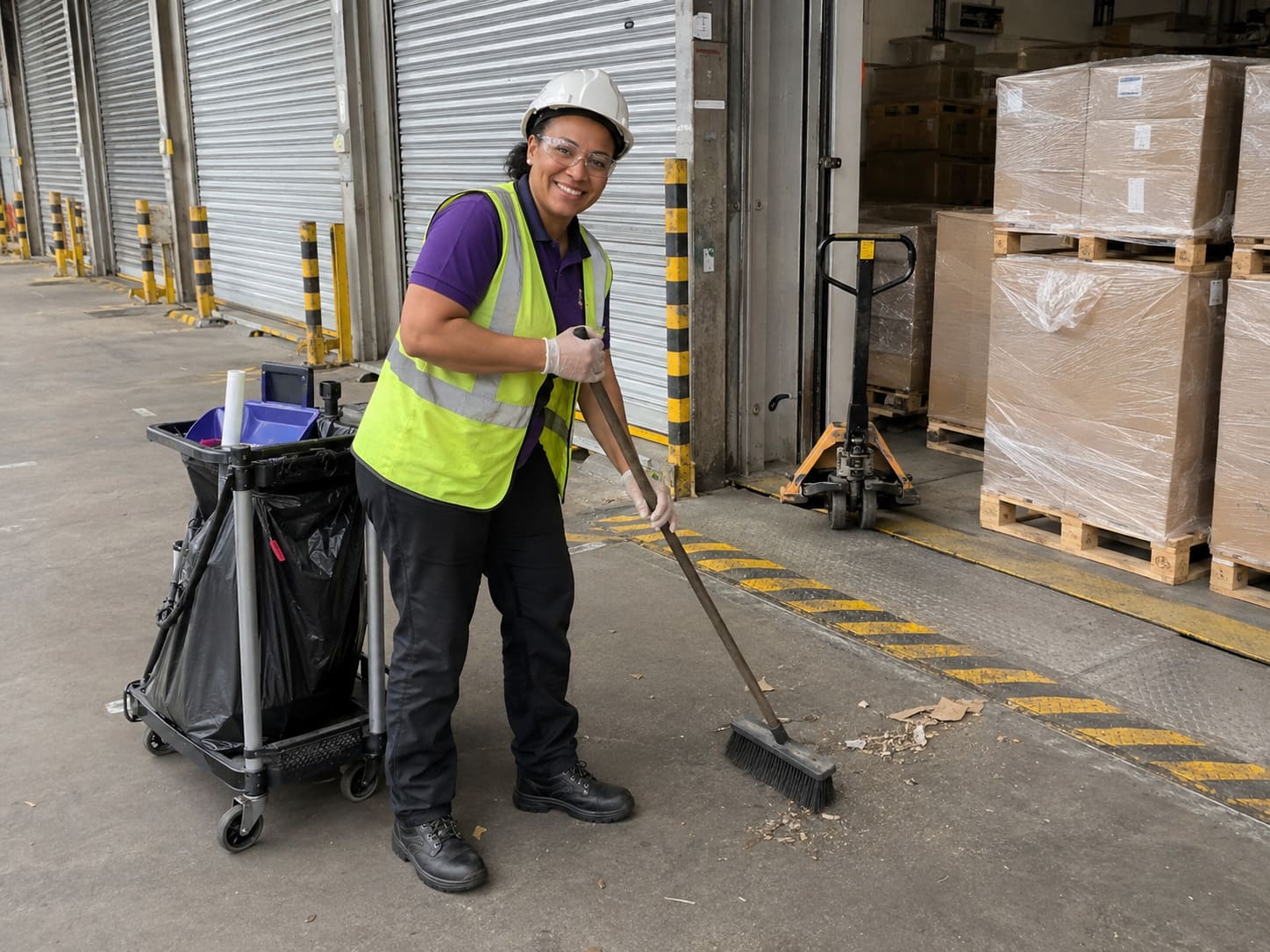
Warehouse cleaning operative with trolley and floor cleaning equipment
A controlled clean has a clear before, during and after
A factory floor clean around shift patterns, forklift routes and machinery access cannot be left to chance. The provider needs to know where people move, where production cannot be interrupted and which areas need restricted access before work starts.
A professional industrial cleaning process normally follows a clear sequence:
- Walk the site first. The survey should identify zones, floor types, contaminants, access limits, welfare areas, waste points and anything that affects timing.
- Define the scope in plain terms. The cleaning specification should say what is included, what is excluded and what counts as completed work.
- Plan safe access. Risk assessments and method statements, often shortened to RAMS, set out the risks and the method for controlling them. Site inductions and permits belong here where the premises requires them.
- Carry out the work under supervision. Operatives need the right briefing, suitable equipment and a route for raising issues if the site condition differs from the plan.
- Check, sign off and record the clean. Handover checks and audit trails give you evidence that the agreed work has been completed, rather than relying on a verbal assurance.
The Health and Safety Executive says that an effective cleaning regime needs management, action and checking, supported by communication, training and supervision. That is why documentation matters. It shows the clean was controlled, not improvised.
Contract changeovers, staff transfer questions and access arrangements can be handled without drama by a competent provider. Double Check Security Group’s facilities delivery model puts weight on site visits, clear scopes, supervision and performance monitoring, which is where industrial cleaning contracts usually succeed or fail.
Live factory cleaning depends on access, timing and risk
Factory cleaning can happen during operations for some routine tasks, but higher-risk work needs tighter planning. Floor cleaning near pedestrian routes, vehicle movement and machinery access is the classic overlap where a clean can solve one problem and create another.
Low-disruption work might be scheduled around quieter periods, with temporary route changes and sectioned areas. Heavier floor cleaning, chemical work or machinery-adjacent cleaning may need out-of-hours timing, isolation, restricted access or a shutdown window. Production should not be stopped by default; cleaning should be planned around safe access and the reality of the site.
Slips and trips deserve special attention because cleaning changes the floor condition while work is underway. The Health and Safety Executive says slips and trips remain the single most common cause of major injury in UK workplaces, and cleaning can create hazards such as damp smooth floors and trailing wires from vacuums or buffing machines.
A wet floor sign is a warning, not a barrier. Where smooth wet floors create a real risk, access may need to be stopped with barriers, locked doors or cleaning in sections. Chemical use also needs proper handling under Control of Substances Hazardous to Health, known as COSHH, with ventilation and personal protective equipment where the task calls for it.
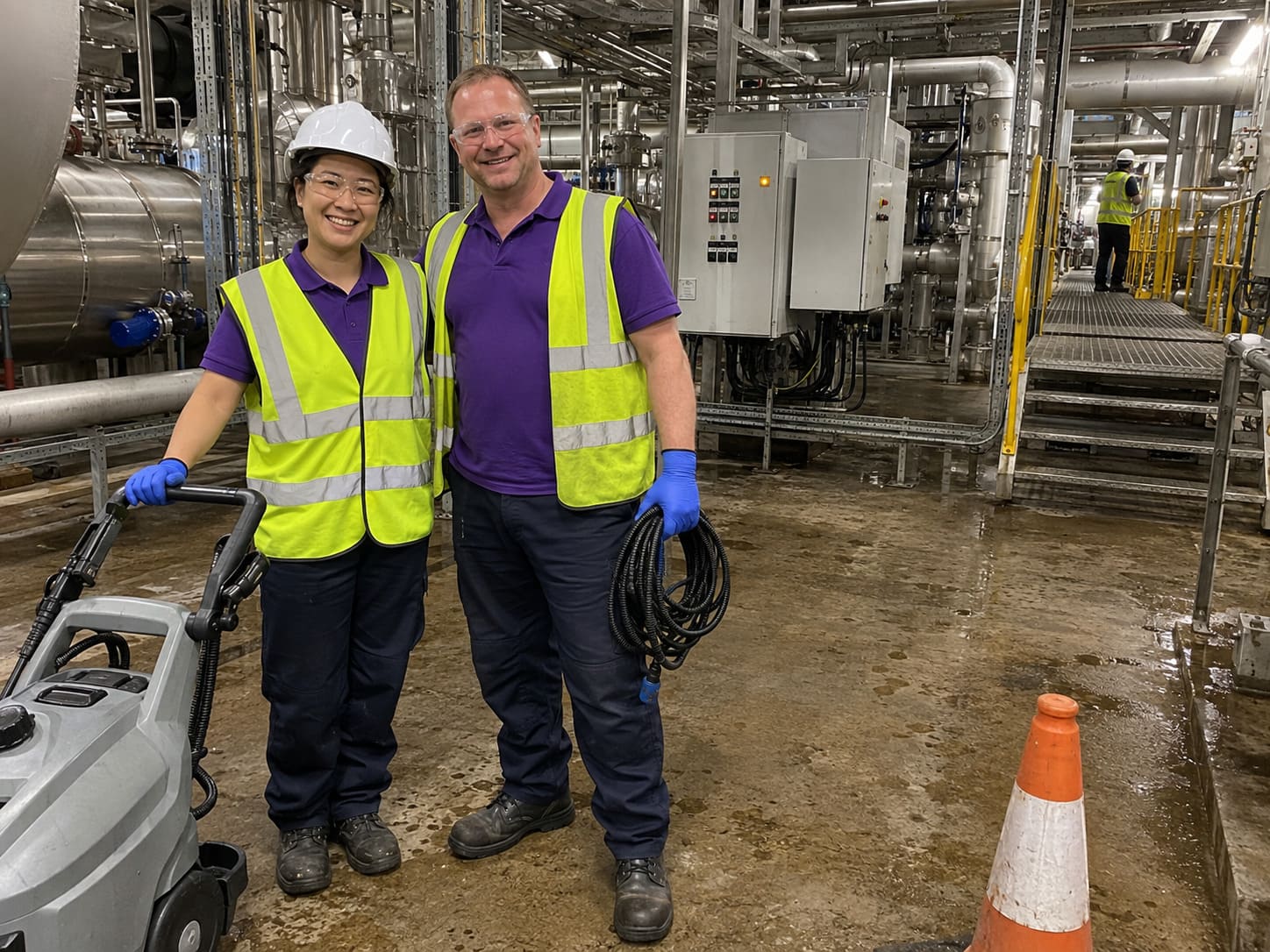
Factory cleaning team maintaining machinery and production areas
Factory cleaning frequency follows risk and use
The honest answer to “how often?” is that the schedule should follow what the site produces, how the building is used and where dirt or residues create risk. A light-use storage area and a busy production zone should not be put on the same rhythm because they sit under the same roof.
Routine cleaning keeps daily activity under control. That can cover welfare spaces, washrooms, offices, walkways, touchpoints and immediate housekeeping around agreed zones. In higher traffic areas, routine work needs closer attention because standards slip fastest where people, stock and vehicles keep moving.
Periodic cleaning tackles build-up. Floors, racking, high-level surfaces, loading areas and harder-to-reach zones may sit on a planned schedule, with the timing shaped by dust, grease, shift patterns, audit pressure and waste flow. Shutdown cleaning is different again because the work can reach areas that are normally blocked by production.
Specialist tasks belong outside the everyday rhythm unless the site risk says otherwise. Degreasing, high-level work, pressure washing and certain machinery-adjacent tasks need a defined method, not a casual extra added at the end of a shift. A useful cleaning schedule is reviewed as the site changes, because production volume, layout and working hours rarely stay fixed for long.
The next standard is proof, waste control and adaptable management
Factories are being judged more closely on what happens across the whole site, including cleaning, waste movement and contractor control. That puts pressure on the cleaning arrangement to produce evidence: a written scope, a workable schedule, risk paperwork, supervision records, sign-off and a way to correct problems before they become normal.
Waste separation now belongs in that conversation. GOV.UK guidance says workplace recycling rules in England came into force on 31 March 2025 for manufacturing facilities, factories, workshops and warehouses. Workplaces in England must separate dry recyclables, food waste and non-recyclable waste before collection, and businesses should make sure their waste collector is registered on the Public Register of Waste Carriers, Brokers and Dealers.
Over the next 12 to 24 months, stronger industrial cleaning contracts will be judged less by a long task list and more by how well the provider proves control. Double Check Security Group fits that direction because its wider facilities model joins cleaning, oversight and documentation under one operating framework, but the point applies to any serious site: the clean has to be manageable after the first month, not impressive only on the first visit.
The factories that stay ahead will treat cleaning records, waste separation and safe access planning as normal site evidence, because those are the details that auditors, insurers and operational teams will ask for more often.
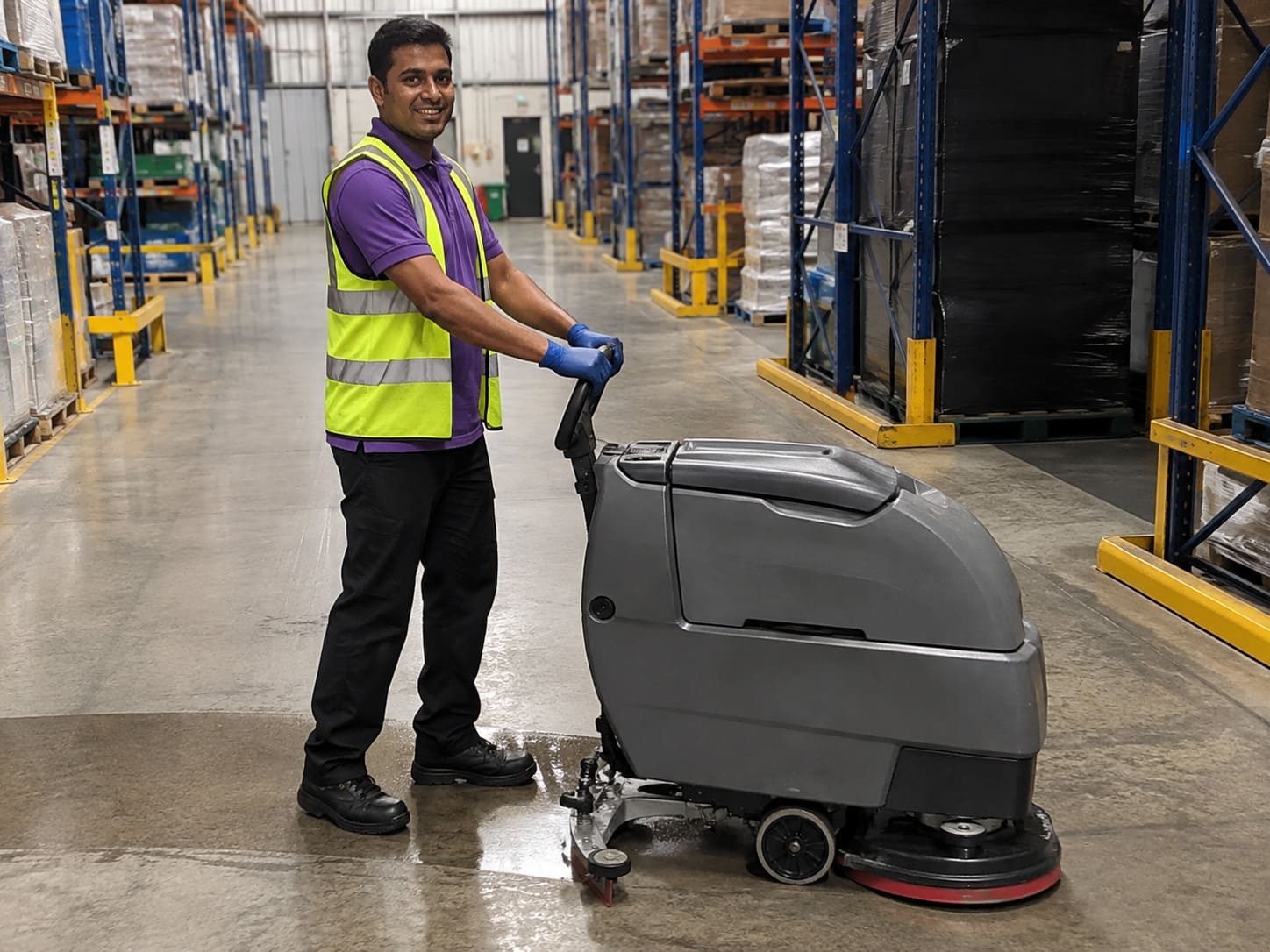
Factory cleaner operating floor scrubber for industrial warehouse cleaning
Common questions about industrial and factory cleaning
Do industrial cleaners clean inside machinery?
Industrial cleaners may clean machinery exteriors and the areas around equipment, but internal technical cleaning needs separate scoping. Work that involves dismantling, isolation or specialist engineering input should be agreed clearly before the clean starts.
What should be included in an industrial cleaning checklist?
A useful checklist should cover zones, surfaces, access rules, contaminants, waste points, safety controls and sign-off. A generic task list is weaker because it misses the site risks that decide how the clean should be done.
Can factory cleaning include offices and staff welfare areas?
Factory cleaning can include offices, toilets, kitchens, changing rooms and staff welfare areas as part of the same managed service. Those spaces need different methods from production or warehouse areas, so the scope should separate them clearly.
What chemicals are used in industrial cleaning?
Chemical choice depends on the contaminant, surface, equipment nearby and site restrictions. The provider should control storage, use, ventilation and personal protective equipment under Control of Substances Hazardous to Health requirements.
How do you know an industrial clean has been completed properly?
Completion should be checked against the agreed scope, with supervision, handover notes or sign-off records. Photographs, inspection records or audit trails can support the handover where the contract calls for them.
This is general information, not professional advice.
