

What actually happens in the first minutes after an office security breach with no plan in place?
The first minutes are usually marked by uncertainty, mixed messages and delayed decisions. Staff may not know whether to stay put, evacuate, lock doors or call emergency services. Building management can lose valuable time trying to work out who is in charge, which areas are affected and what the immediate threat is, and that delay often shapes everything that follows.
What Do We Cover In This Article?
The Immediate Fallout of an Unprepared Security Breach
An office security breach rarely begins with a neat sequence of events. A door alarm sounds, an unauthorised person is seen in a restricted area, a reception team member reports suspicious behaviour, or a tenant raises the alarm after noticing missing equipment. If nobody has rehearsed a security incident response, the building slips into initial confusion almost at once.
Reception may call a manager. A manager may call facilities. Someone else may contact the police before checking whether the issue is still active. Another person may start an evacuation without confirming what staff should do next. In an unplanned breach, alarm response and communication often happen at the same time but not in the same direction.
Common missteps include:
- sending several people to investigate without clear authority
- giving tenants different instructions on different floors
- failing to secure access points after the breach is noticed
- losing track of visitors, contractors or delivery drivers already inside the building
- waiting too long to contact emergency services because no one wants to overreact
An organised response usually depends on predefined roles, incident logs and escalation routes. Without those, even sensible people can act in ways that increase risk. One person props open a fire door for access, another silences an alarm to reduce disruption, and a third starts sharing unverified details with staff. The breach itself may be limited, yet the office emergency grows because actions are uncoordinated.
Pressure also spreads beyond the security team. Tenants want updates, visitors look for guidance and senior managers ask for facts before facts are available. In that moment, the immediate impact is rarely just physical access or loss prevention. It becomes an operational problem affecting movement, confidence and decision-making across the whole building.
Operational Gaps Exposed by a Lack of Preparation
A breach tends to reveal weaknesses that were already present. The incident does not create policy gaps or training shortfalls from nothing. It exposes them in public, under pressure and often all at once.
Many offices assume their security arrangements are sound because access control systems are installed and guards are present on site. Yet equipment and staffing alone do not amount to preparedness. Procedures may be out of date, responsibilities may be blurred between occupiers and landlords, and building management systems may not be aligned with actual site use.
Three gaps appear again and again.
Unclear roles and authority
During a live incident, uncertainty about who leads the response can slow every decision. Facilities management may assume security takes charge. Security may wait for site leadership. HR departments may become involved because staff welfare is affected, even though they are not set up to run an operational response.
Shared buildings often feel this most sharply. A landlord’s team may control common areas, while tenants manage their own floors. If those boundaries are not mapped properly, a breach can leave everyone acting within partial authority and nobody acting across the whole site.
Procedures that exist on paper only
Some organisations have incident documents that have not been reviewed in years. Contact lists are wrong, escalation paths refer to people who have moved on, and evacuation notes do not reflect building alterations or tenant churn. A procedure that sits untouched in a file offers little value once real decisions have to be made in minutes.
Standards such as ISO 9001 or the SIA Approved Contractor Scheme are useful reference points because they support consistency, oversight and documented process. They do not remove risk on their own, but they can expose whether the basics are actually being maintained.
Training and compliance weak spots
A surprising number of problems come down to ordinary staff not knowing what they are expected to do. Security officers may be trained, but reception teams, floor marshals, cleaning staff and tenant representatives often receive uneven guidance. Health and safety regulations set broad duties around safe systems of work, yet a breach can show that local practice has drifted away from formal policy.
One office may know how to lock down a loading bay but have no plan for visitors already in meeting rooms. Another may run fire drills but never test how staff should respond to unauthorised access after hours. Those are procedural failures in plain sight, and they become obvious the moment a real incident forces them into action.

A representative image of a security officer at a corporate building
The Human Factor: Staff, Tenants, and Visitors in the Dark
People notice uncertainty very quickly. They hear an alarm, see security moving with urgency or receive a brief message telling them to remain where they are, and they start filling in the gaps for themselves. Once communication fails, rumour usually moves faster than instruction.
Staff often want one thing above all else, which is clear direction. If no one explains whether the issue is confined to one entrance, one floor or the whole building, employees may start leaving desks, messaging colleagues or trying to collect personal belongings before they know whether movement is safe. That is how communication failure turns into operational disorder.
Tenants face a slightly different problem. They may have internal managers, reception points and policies of their own, yet they still depend on the wider building response. If the landlord’s team says one thing and a tenant manager says another, confidence drops immediately. Tenant liaison matters here because even a short, accurate update can reduce misinformation.
Visitors are usually the least prepared group in the building. They may not know the layout, they may not understand access restrictions and they may not recognise who has authority. A client waiting in reception, a contractor in a service corridor or a delivery driver at the rear entrance all need direct instruction, not assumptions about common sense.
Typical reactions tend to be practical rather than dramatic:
- some people freeze and wait for confirmation
- some try to solve the problem themselves
- some leave the area without reporting where they are going
- some start sharing partial information with others
A leadership vacuum makes each of those reactions harder to manage. Clear communication protocols, named incident leads and visible floor-level direction give people something to follow at the exact point where uncertainty is highest. Without that structure, personal safety concerns quickly become a wider problem for occupancy control, welfare checks and accountability.
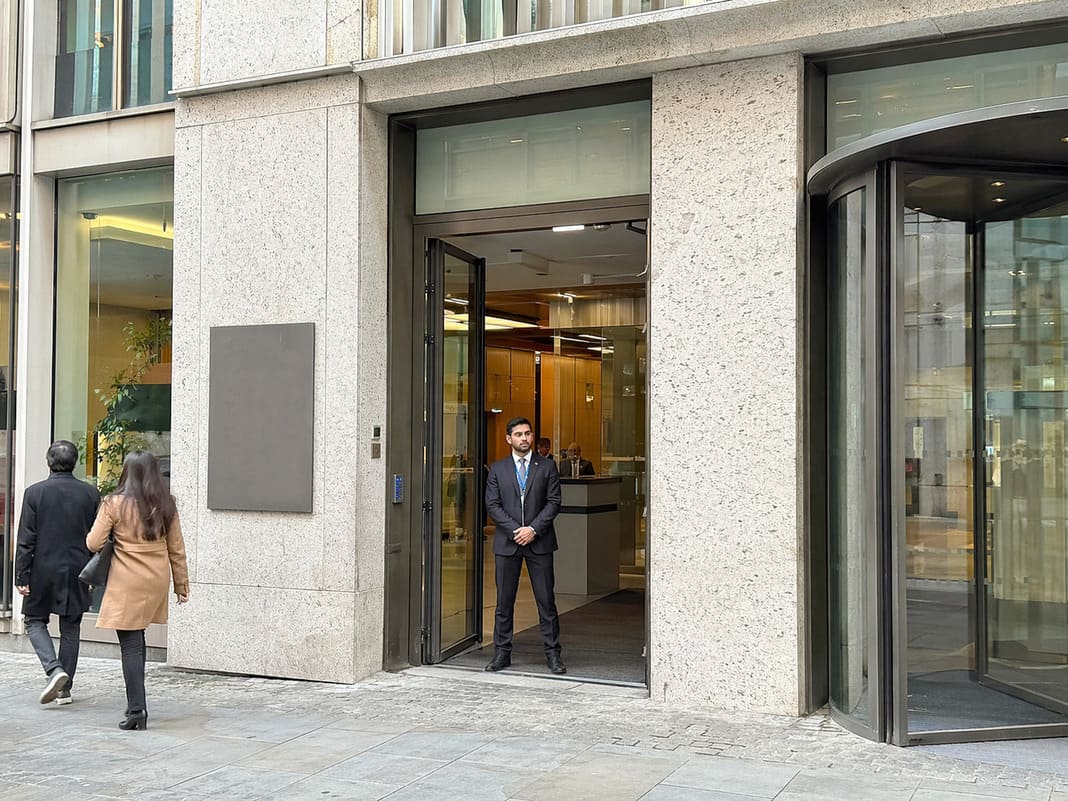
Corporate Security Services At A Main Building Entrance – sample image
Legal, Reputational, and Financial Consequences
Once the immediate incident is over, the building owner or manager may still face a long tail of consequences. Legal exposure, reputational damage and direct financial loss often come from the same root problem, which is a failure to prepare, document and respond properly.
From a legal and compliance standpoint, scrutiny can come from several directions. Health and Safety Executive expectations around safe management practices may become relevant if staff or visitors were put at avoidable risk. GDPR issues can arise if personal data, CCTV footage or access records are mishandled during or after the breach. Security arrangements involving licensed guarding also draw attention to whether the people deployed were properly managed under SIA rules.
Reputational harm is less formal but often just as serious. Tenants may question whether the building is being run competently. Clients may lose confidence in the professionalism of the occupier they were visiting. Senior stakeholders may focus less on the breach itself and more on the visible signs of disorganisation, including delayed updates, contradictory statements or obvious confusion in public areas.
Financial effects follow in several forms:
- repair or replacement costs for damaged property or stolen assets
- disruption to trading, occupancy or scheduled operations
- higher insurance excesses or disputes with insurance providers over process failures
- extra spend on temporary guarding, investigations or remedial measures
Insurance claims can become more difficult where records are poor. If incident timings, access logs or CCTV handling are incomplete, an insurer may ask harder questions about what happened and how the site was being managed beforehand. Forthcoming duties linked to Martyn’s Law also keep preparedness on the agenda for some premises, particularly where public access and security planning intersect.
A modest breach can therefore become a larger governance issue, especially if the record shows that warnings were missed, procedures were outdated or basic controls were not followed on the day.
How Professional Security Providers Respond Differently
Prepared sites do not avoid every incident. They respond in a way that is structured, documented and proportionate to the risk in front of them.
In practical terms, the difference starts with role clarity. A trained team knows who assesses the trigger, who controls access points, who informs building management, who communicates with tenants and when emergency services need to be called. That sequence may change by site, but it should never be improvised in real time.
An ad hoc response often sounds like this: several calls at once, uncertain reporting lines, patchy updates and no single incident log. A professional security response is more disciplined. Information moves through agreed escalation procedures, site teams record actions as they happen and control centre operations maintain oversight if the situation extends beyond one entrance or one floor.
Providers working to recognised frameworks, including the SIA Approved Contractor Scheme and ISO 9001, usually place more weight on consistency, supervision and review. Those benchmarks do not guarantee flawless performance, yet they support habits that matter during a breach, namely staff induction, documented protocols, routine audits and accountability after the event.
That is why experienced operators such as Double Check Security Group tend to approach incident management as a system rather than a series of individual reactions. A control room can track updates, on-site staff can secure affected zones, tenant communication can be managed in a controlled way and leadership can receive a clear picture instead of fragments.
Consider the contrast in a simple access breach. On an unprepared site, an unauthorised person enters through a side door, moves through common areas and is challenged only after different teams notice separate fragments of the same event. On a prepared site, the same trigger leads to immediate verification, containment of access routes, a defined reporting chain and a written incident record before memory begins to blur. One approach relies on good luck. The other relies on process.

Corporate Reception Security Services In A Large Office Atrium – sample image
Building Long-Term Resilience: Lessons and Forward Planning
Resilience in office security is built through repetition, review and routine. A single policy update after a breach may fix one weakness, but offices become safer when security is treated as part of daily operations rather than a document to revisit only after something goes wrong.
Scenario testing has a useful role here. Staff do not need constant disruption, yet they do need practice that reflects real conditions in the building they actually use. Access issues after hours, reception escalations, contractor movement, tenant communications and temporary system failures all deserve attention because office life rarely follows a perfect script.
Strong organisations also connect departments that are too often left separate. Facilities management, HR, reception, cleaning teams and security personnel each see different parts of the building day by day. If those perspectives are shared through regular reviews, audits and feedback loops, small weaknesses can be spotted before they turn into larger incidents. That wider lens also reflects the reality that preparedness sits across operations, not in one silo.
Compliance still matters, of course, but paperwork alone does not create readiness. A site can hold policies, contractor records and training notes and still struggle if staff do not recognise their role when an incident unfolds. By contrast, buildings with a practical culture of preparedness tend to make better decisions under pressure because expectations are already familiar.
External reference points can support that culture. SIA guidance, Action Counter Terrorism material, facilities management reviews, and discipline around site standards all contribute to a more thoughtful operating environment. Even services that seem separate, including cleaning schedules shaped by standards associated with the British Institute of Cleaning Science, can affect security by influencing access routines, key control and out-of-hours presence.
The lesson is straightforward. An office building is rarely exposed by one bad moment alone. It is exposed by everything that was left vague, untested or assumed before that moment arrived. Organisations that accept that reality are usually the ones best placed to steady the building, protect the people inside it and make the next incident less disruptive than the last.
